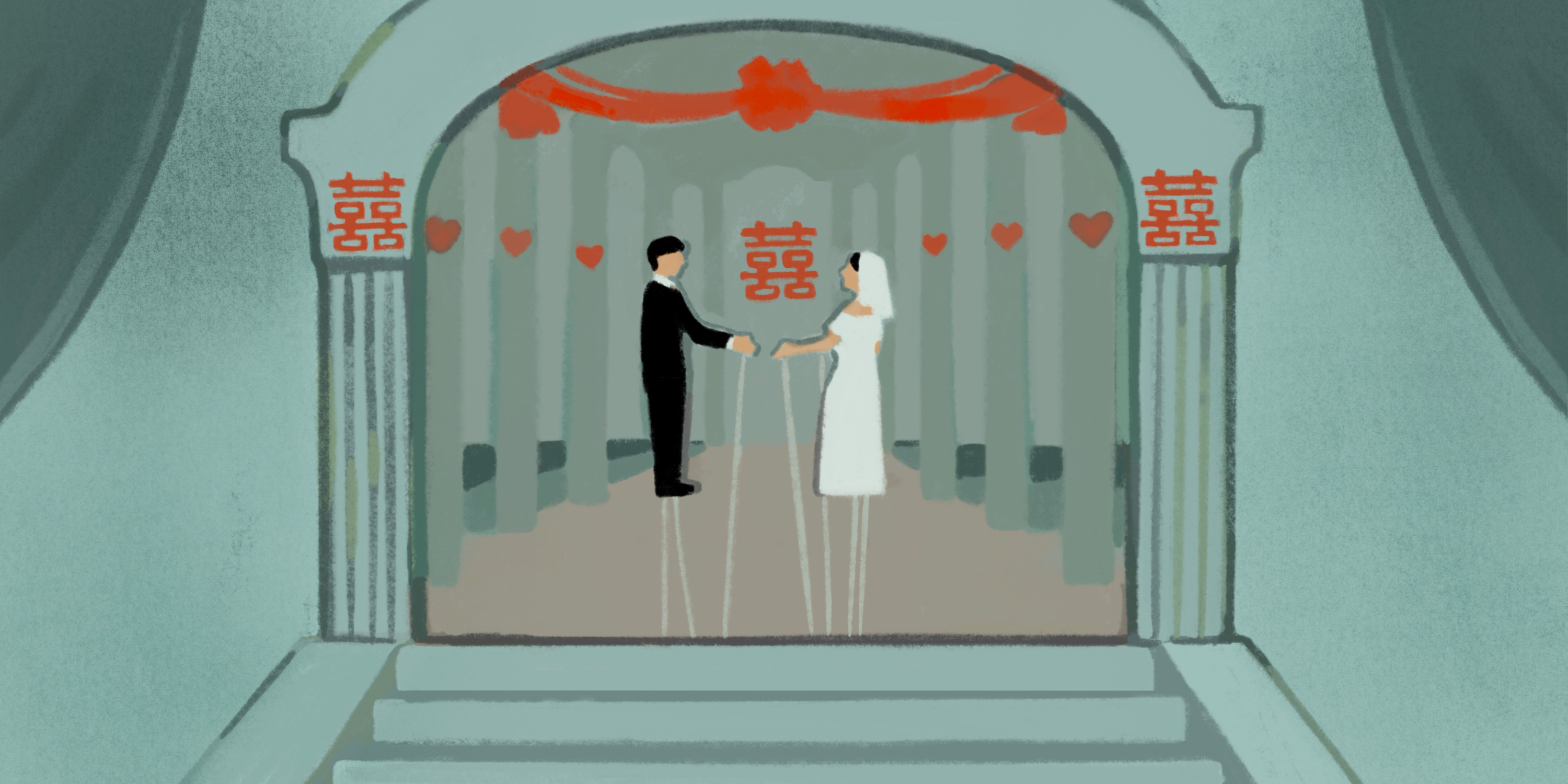
Has China Fallen Out of Love With Love?
This story is part of Sixth Tone’s 10-year anniversary series, Ten Years in Transition.
It’s a tricky time to be looking for love in China.
The average age of couples marrying for the first time has jumped in recent years, from 24.9 in 2010 to 28.7 in 2020. Some of that can be attributed to rising economic standards and increased independence, but it also reflects a mindset shift among young Chinese, many of whom increasingly see long-term intimate relationships as a source of risk as much as security. What if your partner cheats on you? Harbors a secret addiction? Prioritizes their parents’ needs over yours? Or what if their love is all just an act — a way to use and manipulate you before leaving you broke and broken-hearted?
These fears are reflected in — and reinforced by — popular culture, where depictions of whirlwind romances and love at first sight have been replaced by more placid “intimate relationships.” TV and streaming services are home to a seemingly endless array of couples of all ages cooly breaking down their feelings, calculating their partners’ “emotional value,” and deciding whether their “attachment styles” are a good long-term match.
Social media is no different. Relationship influencers pump out a constant stream of warnings against the dangers of “love brain” — what earlier generations just called “love” — and recommend their followers avoid marriage altogether.
I’ve taken to calling this new relationship ideal “loveless intimacy.” That’s not to suggest young Chinese are no longer falling in love or getting married. Rather, it reflects a kind of “conscious uncoupling” of love from long-term relationships.
In 2001, when researchers asked young Chinese whether they would marry someone they didn’t love, just 11.6% of men and 8% of women said yes. When they asked the same question in 2023, those numbers had jumped to 25.5% and 23.6%, respectively.
Separated from romantic ideas like sanctity and destiny, love has become disenchanted. Young Chinese see it as just another psychological state, and not always a positive one. At the same time, intimacy is no longer tied to stable relational institutions like marriage. Instead, it is a functional connection — one that can be freely entered into and exited at any time.
All that is to say, a relationship’s legitimacy no longer stems from a couple’s passion or even their commitment to each other, but from its capacity to satisfy individual psychological needs while posing manageable levels of risk. When the ideal marriage is less about love and more about rational calculation, getting swept off your feet is just the prelude to a fall.
A knife’s edge
First proposed by medieval English philosopher William of Occam, Occam’s razor is a philosophical principle that holds that “entities should not be multiplied without necessity.” In other words, when facing a problem, opt for the simplest explanation with the fewest assumptions.
Applied to love, Occam’s razor recommends a relationship grounded in efficiency, safety, and self-preservation. All “inessential” elements of romantic love — such as sacrifice, fate, or uncontrollable passion — can be discarded as redundant or even dangerous to the manageable and optimal core of healthy intimacy between partners.
This idea of love as a kind of tumor that can be cut out of a relationship did not emerge out of nowhere. It has been constructed and promoted by influencers on Chinese social media for years. Although the reasons given to men and women differ, the conclusions are the same: the transcendent feeling of love is an illusion that must be discarded in favor of a new type of relationship centered on risk control and emotional value.
According to this logic, deep devotion is no longer a virtue, but a hazard caused by blurred boundaries. Likewise, love at first sight is not a miracle, but the product of cognitive bias.
Core to this narrative is the pathologization of love through the use of pop psychology. Relationship influencers identify three forms of unhealthy relationships: irrational “blind love,” manipulative “toxic love,” and “insecure love” rooted in attachment trauma.
In essence, they’re recoding the characteristics of traditional romantic love as psychological defects. Love at first sight or sudden intense attractions are not romantic, but projections or pathological obsessions stemming from childhood trauma. And sacrificing for another person is no longer understood as a sign of devotion, but vulnerability to “emotional exploitation.”
They contrast this with a “healthy” relationship, which must be grounded in your “authentic self.” It should be egalitarian, rational, and negotiable.
This use of scientific language echoes sociologist Eva Illouz’s observation that modern relationships have been systematically “psychologized.”
This psychologization aligns closely with neoliberal narratives, which subtly transform social problems — such as gender inequalities that bring men and women into conflict — into personal failures. It also opens the door to the commodification of intimacy: The rise of relationship influencers has been accompanied by a vast array of product offerings from the psychological counseling and media industries including courses, paid assessments, and relationship coaches.
Instead of acknowledging that, sometimes, love hurts, the heartbroken are sold on the idea that, with sufficient psychological training and self-awareness, they can successfully form and enjoy “ideal” relationships.
Complex emotional experiences are simplified into standardized “symptoms” that can be classified and treated. From “love brain” to “over-sensitivity,” “avoidant attachment” to “insufficient emotional value,” each condition has a cure, provided you’re willing to pay.
This diagnosis and treatment model plays on people’s anxieties about relationships to sell them ever more products. Under the banner of freeing people to pursue autonomy and happiness, the industry convinces individuals to willingly submit their most private experiences to market logic, making love just another extension of self-actualization. As cost-benefit analysis reshapes emotional cognition, people are increasingly unable to switch between “economic” and “emotional” thinking — and may even not perceive any fundamental difference between the two.
Worse, while Occam’s razor seems to carve out a safe, orderly, and autonomous emotional space for individuals, it’s actually hollowing out the radical social potential that love once possessed. Traditional romantic love may have been utopian, but it also embodied ideas of resistance — against arranged marriage, class barriers, and gender discipline. Advocates for its replacement pretend to be radicals who reject the social order, when in reality they preach self-discipline and accommodation to social problems.
A family matter
If Occam’s razor suggests eliminating the irrational elements of romantic love and embracing manageable, healthy intimate relationships, what does that mean in practice? In many cases, what seems like a path to greater individual autonomy actually reinforces a much older pattern of marital relationship in China: one centered on the family.
In contemporary Chinese society, although choices in marriage and love are nominally directed by individuals, they remain deeply embedded in the strategic logic of the family. Whether due to the persistence of traditional values, the inability to pay sky-high “bride prices,” or the need for parental help buying a home, choosing a partner is rarely a private decision based purely on two individuals’ emotional feelings toward one another. Instead, it is a systematic reflection of two families’ wealth management strategies, career aspirations, and even elder care needs.
Liu Wenrong, a researcher at the Shanghai Academy of Social Sciences, recently surveyed a group of educated 20- to 40-year-olds in three major metropolitan areas. She found a growing number of what she termed “new arranged marriages” among urban Chinese.
Between 2001 and 2023, the proportion of young people in Beijing, Shanghai, and Guangzhou who met their partners through introductions from parents and elders had doubled, while introductions through friends, colleagues, and other peers had declined significantly.
This suggests that young people are not relying solely on chance encounters within their own social circles to meet partners; instead, they are incorporating their natal families into their marital strategies.
Underlying these “new arranged marriages” is a family-based mechanism of risk sharing. Facing high house prices, intense competition, and pervasive uncertainty, young people and their parents see marriage as a major investment that affects both the well-being of individuals and the family as a whole.
The ideals of romantic love seem irrelevant in the face of these obstacles, while parents are a valuable resource for screening potential partners, assessing family backgrounds, and negotiating the terms of marriage and child-rearing.
When love is recoded into a contractual alliance between families, intimate relationships become subservient to the broader project of family reproduction, and the privacy of emotions gives way to the need for prudent, rational family calculations. Love and intimacy, stripped of their sacred and social aspects, are returning to the family, creating a security framework shaped by intergenerational negotiation.
The social anthropologist Yan Yunxiang believes that the social dislocations of the “reform and opening-up” period have not atomized Chinese families, as many Western theorists once predicted. Instead, a new family ethic has emerged alongside the rise of individualism, centered on what Yan calls “neo-familism.” Parents invest resources to support their children’s education, down payments, and marriage — not for immediate returns, but in expectation of emotional comfort, future care, and family continuation.
This arrangement provides moral legitimacy for intervention in their children’s relationships, as it is framed not as control but investment. Their children’s obedience is likewise not submission or an abdication of autonomy, but a modern version of performing filial piety. If the family is a fortress against risk, the question of who to let in is naturally open for discussion and negotiation.
Is love really dead?
Chinese attitudes toward love seem to be in a curious, almost contradictory place. On the one hand, young people are retreating inward and focusing on personal autonomy. On the other hand, their families have occupied the ceded ground around relationships, reclaiming their traditional role in marital decision-making.
Yet, while the family and individual’s interests may seem at odds, they share a core logic: In a highly uncertain social environment, security is paramount and risk is unacceptable.
That requires rejecting one of the core aspects of romantic love: the uncontrollability of others. The key to winning at love turns out to be abandoning the courage to be vulnerable and opening yourself up to others.
Given the current state of the world, advocating for a return to a more “irrational” approach to love may seem out of step with reality, if not completely crazy. But if the old dreams cannot be revived, I do think it’s worth reaffirming the value of those “unnecessary” elements that Occam’s razor would shave away: the chance encounters, sudden attractions, and moments of vulnerability that make us human. I’m not a poet, but I find the charm of love lies in how it constantly changes — and how it calls upon us to have faith in both each other and in an uncertain future.
(Header image: Wang Zhenhao for Sixth Tone)