After Years of Endless Choice, China’s Shoppers Now Want Trust
This story is part of Sixth Tone’s 10-year anniversary series, Ten Years in Transition.
HENAN, Central China — Groceries, fruit, and hot meals can be delivered in under an hour almost anywhere in China. But in Xuchang, a fourth-tier city in central China’s Henan province, shoppers from across the country arrive by the busload for a supermarket.
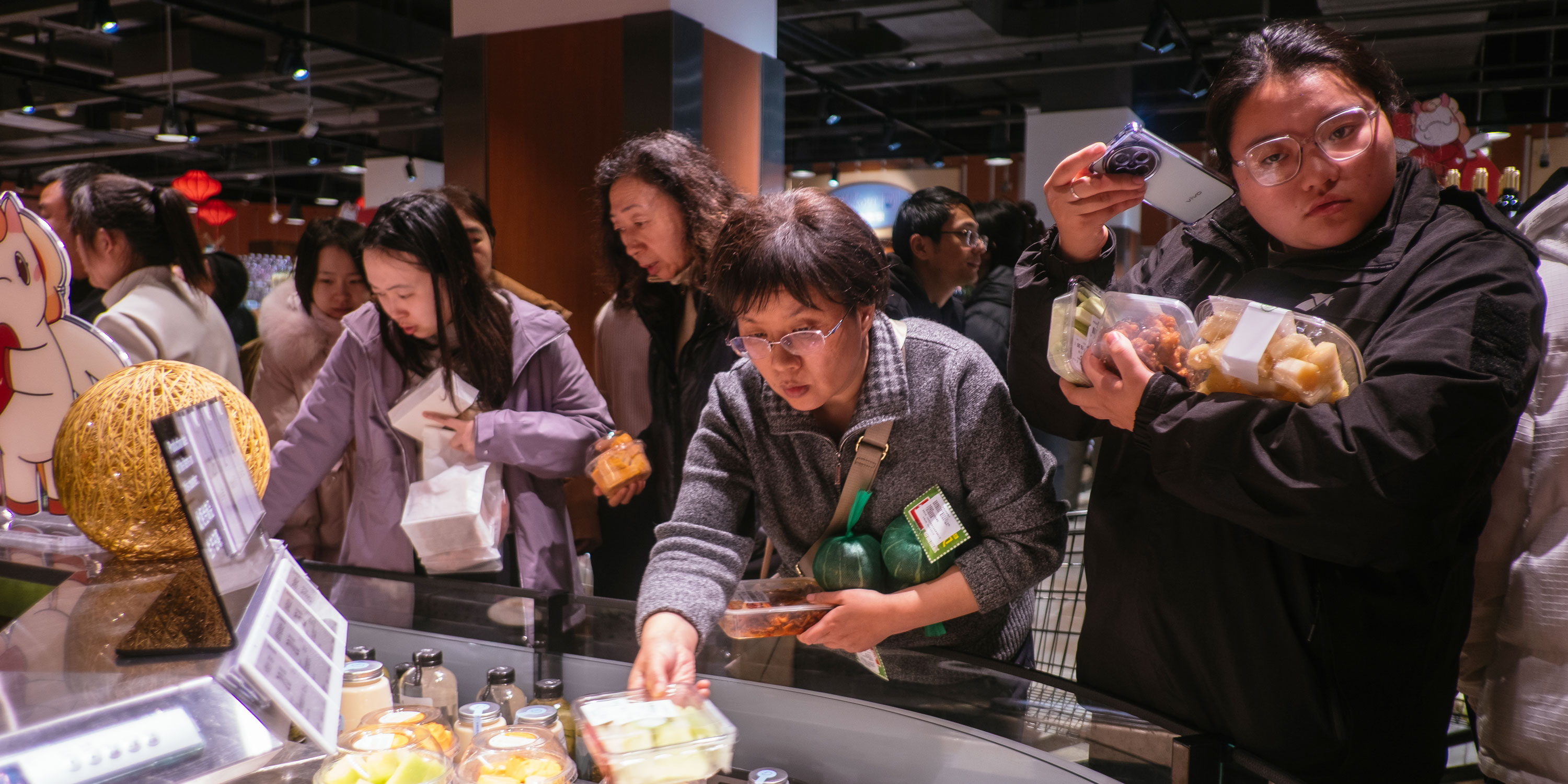
On a cold morning in February, long queues snake outside Pangdonglai’s sprawling 70,000-square-meter complex. Shoppers can move freely through the multistory mall, but the flagship supermarket on the first floor has its own line, stretching outside the building. For jewelry and specialty teas, they scan QR codes to reserve a time slot before stepping in.
Among them is Ma Yanan, a Xuchang native who once guided Chinese tourists overseas and now leads paying visitors through Pangdonglai’s aisles.
“I never thought a supermarket in my small hometown could be this exciting,” Ma tells Sixth Tone. Over the past three years, she says, her agency alone has hosted more than 80,000 clients, many of whom travel to Xuchang for the sole purpose of studying Pangdonglai.
More than two years after the chain burst into the national spotlight by outperforming much larger rivals despite operating only around a dozen stores in lower-tier Henan cities, China’s retail industry is still trying to understand why.
Over the past decade, e-commerce platforms, delivery networks, and algorithm-driven recommendations moved more of China’s shopping online, making it faster, cheaper, and available almost anywhere. But that convenience also shifted more of the burden onto consumers, who now have to compare prices, verify quality, decipher reviews, and absorb the cost of getting it wrong.
As shoppers grow more cautious and less willing to tolerate disappointment, Pangdonglai’s crowded stores suggest an appetite for something beyond price and convenience.
And as consumption grows faster in lower-tier cities, more retailers are trying to understand the Henan chain’s appeal. On the ground, that means new pressures on workers, new expectations from shoppers, and new demands on stores trying to give people a reason to come back.
Burden of choice
Feng Xiang spends most of the year running a bakery in the southern city of Guangzhou, seeing his son in Henan only during the Chinese New Year. Yet for the past three holidays, he has used part of that brief reunion to drive nearly 100 kilometers to Pangdonglai in Xuchang.
There, the family stocks up for the season: snacks for his son, liquor for relatives, fruit and fresh seafood for the reunion dinner.
“I don’t do a lot of shopping,” Feng says. “When I do, I don’t want the hassle. I’d rather spend my time with my son than comparing prices on my phone.”
For Feng, Pangdonglai’s transparent pricing, tight quality control, and reliable aftersales service remove the need to worry, second-guess, or compare.
In Qiqihar, in northeastern China’s Heilongjiang province, Ding Lu organizes her shopping around those same calculations, dividing purchases by what she needs and what she trusts.
“Shopping today offers so many choices, and different platforms have become highly specialized for different kinds of products,” she says.
Fresh produce and jewelry she buys in person. Cosmetics and appliances come from platforms like JD.com and Taobao. For clothes, she turns to Xiaohongshu, also known as RedNote, and Douyin, China’s version of TikTok, often guided by reviews and short videos. Cheap household items come from Pinduoduo.
She still visits wet markets for daily ingredients. But fruits, especially imported ones like blueberries and durian, she orders online, where supply is wider and prices are often lower.
“Some tropical fruits aren’t sold where I live,” she says. “I kept seeing them on social media and wanted to try them, so I ordered online.”
Wang Jia, 43, sees the same pattern every day on her subway ride home in Shanghai. She starts with short videos on school psychology and tips for her child’s English. Within minutes, the feed kicks in.
Books appear. Then workbooks, children’s clothing, and indoor playgrounds. Scroll a little longer, and the suggestions grow more specific, as if the system has even calculated her daughter’s age.
On short-video platforms, products arrive inside the content itself, a pan in a cooking video, a foundation in a beauty clip. “The recommendations feel uncannily aligned with my tastes,” says the pharmaceutical professional.
It is a form of shopping driven less by search than by discovery. Douyin calls it “interest e-commerce” — shopping in which the impulse to buy is sparked mid-scroll.
Zhuang Shuai, founder of the Beijing-based consulting firm Bailian, says algorithms embedded in the shopping experience learn from user behavior and refine what appears next. “AI is reshaping the entire retail value chain, from consumer decision-making to supply chain management,” he says.
As consumers split their spending across platforms, formats, and price points, physical stores have had to find new ways to stay relevant. Some chased lower prices through warehouse clubs, direct sourcing, and private-label goods. Others narrowed their focus, building specialty stores around older shoppers, fresh produce, or other specific needs.
In Xuchang, Pangdonglai has become a model that people now pay to study. Ma Yanan says her two-day tours, priced at 1,000 to 2,000 yuan ($146-$292), combine store visits with classroom discussions and attract entrepreneurs, retail managers, and visitors from hotels, restaurants, banks, and even kindergartens.
“I want to understand why offline stores here are growing at all and how they make it work in a third- or fourth-tier city,” said Zhang Qiang, who works on branding for the clothing label Hanjinji.
With notebooks and phones in hand, they trail her through the store as she points out price tags showing both purchase and selling costs, pet care centers, and maternal rooms designed for shoppers. Around her, they discuss supply chains, customer habits, and store layouts less like customers than students.
On the clock
For more than two decades, Liu Xin has had to keep relearning the rules of retail.
He entered the industry in 2002, soon after college, when big-box hypermarkets were still at their peak. He started as a floor supervisor at RT-Mart, a major hypermarket chain, and worked his way up to store manager.
Back then, business depended largely on foot traffic. Shoppers wandered the aisles, compared prices, and lined up at checkout counters. “The job was straightforward,” says Liu, from Qingdao in the eastern Shandong province. “Manage staff, keep shelves stocked, make sure customers move smoothly through the store.”
By the 2010s, e-commerce platforms were pushing deeper into groceries and other daily essentials. In 2021, after years at Vanguard, a major supermarket chain, Liu watched the store where he worked get acquired by a competitor as business slowed.
He moved to Freshippo — Alibaba’s grocery chain, known in Chinese as Hema — one of the companies that defined China’s online-to-offline retail model, combining traditional shopping with online orders and delivery.
“Even with more than 10 years in retail, joining Freshippo felt like starting all over again,” he says. “It wasn’t a transition, it felt like starting from scratch.”
During his first month, Liu rotated through nearly every frontline role in the store. He stocked fresh produce, handled live seafood for the in-store dining counters, picked goods for online orders, and shadowed delivery drivers to see how purchases moved from shelf to doorstep.
Now a store manager at Freshippo, he says managers essentially run two businesses at once: a storefront serving walk-in customers and a fulfillment center processing online orders for nearby customers.
“In a traditional hypermarket, customers take their time shopping,” Liu says. “But here, every online order is on the clock.”
Nearby customers are promised delivery within 30 minutes. “That means inventory must be accurate, staff must pick items quickly, and logistics must run with precision,” he says.
In a conventional supermarket, shoppers choose their own vegetables, fruit, and meat. At Freshippo, employees do it for them.
“Quality control becomes crucial,” Liu says. “Staff must make sure what arrives at a customer’s door matches what was shown on the screen — fresh, intact, and properly packed.”
Those pressures extend well beyond grocery retail. Across China’s e-commerce market, shoppers have grown more cautious after years of high return rates, uneven quality, and relentless promotions. In many categories, the impulse buying that once powered online sales no longer comes as easily.
At Hanjinji, Zhang Qiang says e-commerce — once a lifeline for fashion brands — is no longer sustainable on its own.
“Many of my friends who sold purely on platforms like Douyin or Xiaohongshu — and once made tens of millions of yuan in annual sales there — have quit,” Zhang says. “High return rates, rising traffic costs, and the burden of aftersales service gradually eroded their margins.”
After years of scaling down physical stores, Zhang’s company opened six new locations across China in 2025 alone. The decision, he says, was driven in part by falling rents and changing consumer behavior.
“Consumers are willing to visit stores, but not just to shop,” Zhang says. “Stores used to be purely commercial spaces, packed with inventory to justify high rents. Now they’re designed primarily for experience.”
People no longer lack products, Zhang says; if anything, they have too many, with goods piling up in warehouses, shops, and closets at home.
“Online is for transactions, offline is for experience,” he says.
Trust, for sale
At Pangdonglai in Xuchang, that “experience” begins with the price tag. Many list both the store’s cost and its margin. Staff weigh products, explain them, and offer samples.
For Hui, a shopper from neighboring Hebei province, such transparency was worth a six-hour trip. Like many visitors, she bought in bulk despite shipping costs that could nearly match the price of the goods.
“The prices aren’t cheap, but the quality makes it worth it,” she says, using only her surname.
Last year, that reputation for value was reinforced by a viral comparison. A 2,099-yuan down jacket from a major outerwear brand drew criticism online for containing just 86 grams of down. At Pangdonglai, shoppers circulated a private-label alternative priced at 599 yuan, with 154 to 213 grams of filling. The tag also listed the store’s purchase cost and gross margin.
“We live in a time of abundance,” Hui says. “It may feel like we have endless choices, but what we really want is a seller we can trust.”
Founded in Xuchang in 1995 as a small tobacco-and-alcohol shop, Pangdonglai spent years as a regional chain. Rather than expand aggressively, it built its reputation on fair prices, attentive service, and an unusual emphasis on treating both customers and employees well.
Then, in 2024, a series of food-safety scandals shook consumer confidence across China, pushing Pangdonglai into the national spotlight. Shoppers began traveling from other provinces to visit its stores, while resellers snapped up popular items to ship elsewhere.
By 2025, Pangdonglai’s 14 stores had generated 23.5 billion yuan in sales, up nearly 40% from a year earlier, with profits of 1.5 billion yuan. That it happened in a fourth-tier city made it harder to ignore.
As growth cools in China’s biggest cities, retailers are pushing deeper into smaller markets, where rising incomes and better logistics are drawing fresh investment.
In Xuchang, Pangdonglai also had time and room to build a reputation. Lower costs helped. So did a local market where word of mouth traveled quickly and service failures were harder to hide.
In 2025, its employees earned an average of 9,886 yuan a month, about twice the local average in Xuchang. At a time when China’s “996” culture — working 9 a.m. to 9 p.m., six days a week — has become shorthand for burnout, the company offers shorter hours, higher pay, 30 to 40 days of annual leave, and even designated “unhappy leave” for emotional well-being.
Those same conditions may also limit how far the model can travel. In cities like Shanghai or Beijing, where rents are higher and competition is fiercer, the formula becomes harder to sustain. Shoppers there move fast and have no shortage of alternatives, from Freshippo and Aldi to Sam’s Club and delivery platforms.
In Xuchang itself, Pangdonglai’s popularity has changed the shopping experience there. For locals, the store can now feel less like a neighborhood supermarket than a tourist attraction. Buses of visitors arrive daily, and popular items like the chain’s beer and pastries can sell out within hours of opening.
Xu, a local taxi driver, says the effect reaches beyond the store. The city’s rising popularity has brought him more visitors and better business, but it has also raised expectations.
He usually helps passengers who need it — elderly riders or travelers with heavy bags — but now finds himself irritated when perfectly healthy young men expect the same treatment.
“Once (Pangdonglai) raised the bar,” he says, “other businesses had to step up, too.”
How far that influence can travel beyond Xuchang is less clear. For now, Ma Yanan’s study tours remain booked out, suggesting retailers across China are still looking for answers of their own.
Editor: Apurva.
(Header image: Consumers select fresh produce at a Pangdonglai supermarket in Xuchang, Henan province, February 2026. Wu Huiyuan/Sixth Tone)