Silver Is the New Gold: How Retail Is Adapting to an Aging China
SHANGHAI — Gu Yan spent years settling for the same kind of footwear: supportive, affordable, and ugly. She just calls them “old people shoes.”
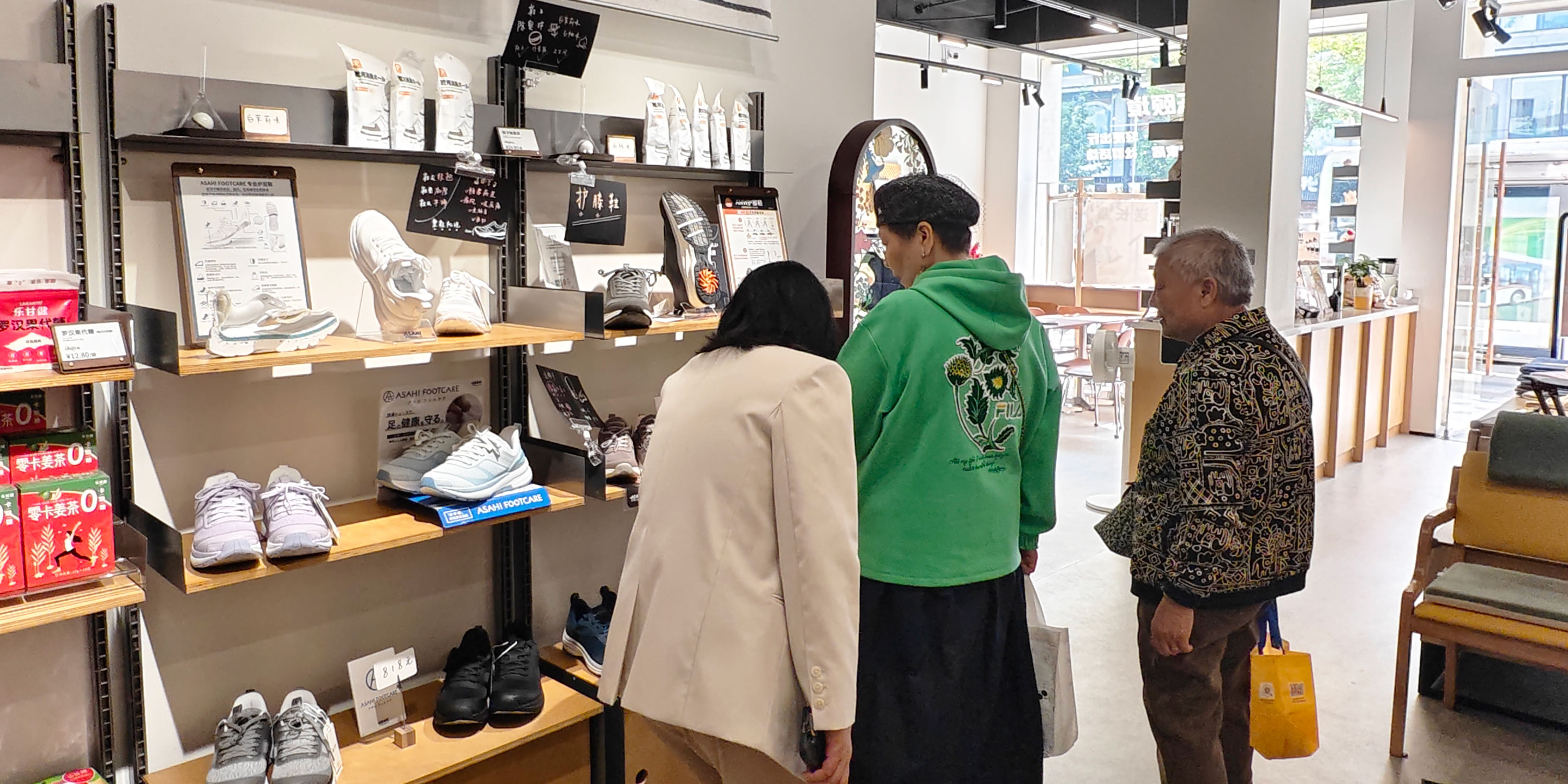
But inside a bright, modern shop near a Shanghai subway station, the 72-year-old slipped on a pair that, for the first time in decades, felt different. They eased pressure on her knees but looked stylish enough to match her beige coat and beret. “The color is quite nice,” she said. “Not dowdy at all.”
The shoes cost 10 times as much as her usual pairs, but she bought them anyway. “Why shouldn’t aging be graceful?” she told Sixth Tone.
That question sits at the center of a growing retail shift in China, where stores serving older adults are beginning to prioritize style, comfort, and independence alongside practical support.
In a country where more than 310 million people are now over 60 — over a fifth of the population — aging has long been treated as a condition to manage. Senior products were typically sold online or in shops tucked beside hospitals, focused more on function than form.
But a new wave of stores is reimagining senior retail as part of everyday life rather than an extension of medical care. Offerings include shoes that ease joint pain without looking medical, recliners that help users stand, and pants with discreet openings for washing or exams.
They’re also rethinking the experience of aging itself. Many outlets feature warm lighting, curated displays, and staff trained to explain not just how products work, but why they matter. Some serve tea or host flower-arranging classes. Others recreate entire bedrooms or kitchens to show how thoughtful design can support daily routines without sacrificing comfort or dignity.
Behind many of these spaces is a younger generation of entrepreneurs, often designing for their own aging parents or grandparents, and rethinking a long-neglected sector now growing into a trillion-dollar economy.
By design
All Liao Shenghan wanted was a decent shower chair for his grandmother.
She was nearly 90, and he needed something safe and reliable. But online, the product images all looked the same, offering little way to judge quality. Offline, he found just one store in all of Shanghai where he could see the options in person, in a city where 5.78 million residents are over 60, accounting for 37.6% of the population.
“This is Shanghai,” he recalled thinking. “The city with the highest aging population in the country — and there’s just one place like this?”
Within months, he took time off to travel to Japan to study how senior products were sold there. What he found was a retail landscape that treated aging as part of daily life. Products were meant to be used and seen, from shower systems with built-in steam functions to nail polish formulated for older hands.
Back in Shanghai, Liao set out to apply what he’d seen in Japan. Instead of opening near a hospital, he chose a storefront on a busy commercial street next to a subway station, placing senior goods squarely within the flow of everyday life.
“Buying products for older adults should be a pleasant experience,” he said. “Like visiting a fashion boutique or sitting down for a cup of coffee.”
That philosophy shapes nearly every detail of his store, HeleVibe. Signs at the entrance greet passersby with the words “55+ friendly community,” and the 150-square-meter space feels more like a lifestyle showroom than a medical supplier.
Staff explain the biomechanics behind certain products, and further in, realistic home setups replace the usual clinical shelving: mock bedrooms, bathrooms, and kitchens showcase how products can fit seamlessly into daily life.
During a mid-October visit by Sixth Tone, a steady stream of customers came through: most middle-aged or elderly, some accompanied by younger relatives, several having traveled from other cities just to see the store.
Many echoed that places like this are still hard to find. Since opening in August, Liao said traffic, both in person and online, has exceeded expectations, largely driven by organic interest and short videos shared on social media.
Demand is only set to grow. China’s “silver economy” is already valued at 7 trillion yuan (just under $1 trillion), or about 6% of its GDP. By 2035, it’s projected to surpass 30 trillion yuan, according to the Blue Book of the Silver Economy.
In early 2024, the central government issued its first national guidelines focused on the aging economy, followed by additional directives in 2025 aimed at encouraging product innovation, expanding care services, and boosting consumption among older adults.
And with aging now central to both policy and profit, more businesses are rushing in.
Signs of scale
One of those new entrants is the government itself.
In 2020, Shanghai opened a certified “technology and innovation experience store” for seniors, part of a city-level effort to bridge the gap between medical supply, retail, and design for an aging population.
The 340-square-meter showroom began as an equipment rental center. But as interest grew, it expanded to offer more products, from ergonomic furniture and mobility aids to canes and cookware. Much of the inventory comes from Japan, Switzerland, France, and other countries with mature markets for products aimed at aging consumers.
According to manager Peng Xia, shoppers today are looking for more than utility. Among the store’s most popular items is a sleek purple cane from Japan, priced at 1,980 yuan — nearly 10 times the cost of a basic model.
“It feels great in the hand, is adjustable, and most importantly, it’s good-looking,” she said. “We only started stocking this cane a few months ago and have already sold about 30 in a single month.”
To help customers see how products might fit into daily life, the store includes mock kitchens and living rooms where items can be tested, Peng said. “Senior consumers are moving beyond products that are merely ‘usable,’” she added. “Now they want things that are ‘usable and user-friendly,’ and increasingly, ‘good-looking, user-friendly, and usable.’”
The store now plans to open additional locations. “Demand is substantial,” Peng said. “We’re already being asked to open more branches, and we will, step by step.”
The push toward more dignified design is also drawing in companies from beyond the elder care space.
At the Changrun Elderlycare Store, one of the best-selling items is a pair of gray pants that look like ordinary casual wear. Inside, however, are features designed specifically for older adults: self-heating fabric and a discreet side opening that allows wearers to wash their feet or receive medical treatment without removing them entirely.
“They look just like stylish casual pants — nothing about them says ‘aging,’” said the store manager.
The store, opened in June, is part of a broader expansion by Changrun, a company that previously focused on maternal and child products. Founder Zhuang Zhilin told Sixth Tone that the move into elder care was driven by a shift in consumer expectations.
“Today’s active seniors increasingly prioritize appearance and dignity,” he said. “They no longer want products that merely provide care — they seek well-made items that integrate seamlessly into daily life.”
Much of the inventory is sourced from Japan, a market Zhuang described as “more mature.” The Shanghai store currently carries about 2,000 products and works with more than 100 brands. It has already expanded beyond the city, launching franchise locations in northern China.
Interest is strong, Zhuang said, especially online, where users often ask where to find the store or how to buy the products remotely. “We plan to introduce more items — clothing, shoes, hats,” he added. “But the principle stays the same: functional and aesthetically pleasing.”
Editor: Apurva.
(Header image: Customers browse shoes at HeleVibe, Shanghai, October 2025. Fan Yiying/Sixth Tone)