The Costly Little Toys Taking Chinese Men for a Spin
Zhong Weiting’s wife recently bought him a pair of trousers with four front pockets. They’re for the little metal objects he carries around — things that spin, slide, click, or flip open, some made from titanium and costing thousands of yuan.
Each day, he picks a few from a plastic organizer originally bought for socks. He plays with them in elevators, in his car, and at his desk, switching to quieter models when other people are around.
For Zhong, 32, they help relieve stress and keep his restless hands occupied. “I like the sounds they make, and knowing exactly how they’ll respond gives me a sense of certainty,” he tells Sixth Tone. “I feel a kind of electric tingling in my fingertips.”
For all their elaborate mechanisms, they’re just toys to fiddle with. And Zhong, an export salesman in China’s southern tech hub of Shenzhen who began collecting only in November 2025, already owns 25, including one he bought this month for 2,199 yuan ($330).
Across China, the toys have found a growing following under the name EDC, short for “everyday carry,” a term borrowed from an online subculture centered on practical gear such as pocketknives and flashlights. On social media, they’re also dubbed “cyber walnuts,” after the traditional Chinese pastime of rolling a pair of walnuts in the hand.
Among the most popular designs are sliders, known in China as “push cards,” whose metal plates produce a series of tactile clicks as they slide against each other. Some toys mimic the motion of revealing a playing card or recreate the sharp tap of a telegraph key, with adjustable resistance and sound on more elaborate models.
Basic models sell for less than 100 yuan, while stainless steel versions typically cost 300 to 500 yuan. Limited editions made from rarer metals or featuring elaborate designs can run into the thousands.
Between July 2025 and June 2026, online sales of EDC toys tracked by consulting firm Meritco Databank rose 55.5% to more than 45 million yuan, with nearly 500,000 toys sold, up 78% year on year.
The vast majority of the trade, however, still takes place within collector circles. While a few large brands sell openly on popular e-commerce platforms, smaller makers rely on private groups on Chinese super app WeChat to announce new releases, sometimes limited to just a few dozen pieces.
At an EDC exhibition in Beijing in October, organizer Fu Chunjun told domestic media that the community has a name for its growing obsession: the “men’s version of Pop Mart,” the Chinese collectible-toy company known for its blind boxes.
But when Zhong shows his latest purchases to friends, few understand the appeal. “They think, why should a plastic or stainless steel gadget sell for 500 yuan?” he says.
Idle hands
To buy a toy from one vendor at Shanghai’s EDC exhibition in April, Guo Songhao first had to draw one of two jokers from a deck of 21 playing cards.
He drew the big joker, securing a limited-edition knuckle roller, a small metal toy designed to be rolled and flipped between the fingers. “My luck was pretty good that day,” the 25-year-old Shanghai-based engineer tells Sixth Tone.
Organized by Laotiejiang, one of China’s oldest EDC brands, the exhibition brought together more than 100 brands and drew three times as many visitors as its 2025 debut. By the time Guo arrived that afternoon, many of the most sought-after toys had already sold out.
A friend who makes a living reselling EDC toys had traveled from northeastern China for the exhibition. After securing a 399-yuan VIP ticket through a lottery, he lined up for hours to get in half an hour ahead of regular visitors. When Guo caught up with him, his friend was carrying a bag containing more than a dozen toys worth tens of thousands of yuan. “He was there to stock up,” Guo says.
Guo first discovered EDC toys in high school but began collecting them in 2022. Still a student with little spare cash, he spent around 500 yuan on two spinners and a push card.
“I thought I’d stop after those three,” he says, even when the toys fell short of his expectations. “I couldn’t stop myself.”
Over the years, Guo estimates he’s bought and sold toys worth a combined 200,000 to 300,000 yuan, recovering what he spent on the hobby. One piece he bought for a little over 1,000 yuan later sold for 5,000 or 6,000 yuan.
Roughly 90% of those purchases took place in private WeChat groups, where Guo says some makers reserve new releases for repeat buyers, or give priority to collectors who already own all three of their earlier models.
While some brands increase production as demand grows, Guo says others deliberately restrict supply, leaving collectors who miss out on new releases facing higher prices on the secondhand market.
“Once everyone can buy it, people lose interest,” says Zhong.
Zhong recently tried to buy a slider he’d seen in numerous videos online. When he tried to add its maker on WeChat, the account had already been flagged for unusual activity following a flood of friend requests. Zhong eventually reached him and waited several more days to join the buying group, where nearly 1,500 people were vying for the first batch of just 200 toys.
He managed to get one, but no amount of adjustment produced a sound he liked. “The tactile feedback was atrocious,” he says. “It was really disappointing.”
He soon sold it on Xianyu, a popular Chinese secondhand marketplace, for 240 yuan, though he reckons it could have fetched more than 320. It was one of about 10 toys he recently sold, all priced below comparable listings.
Even secondhand, buyers expect these toys to look almost new, complete with their original boxes — a peculiar requirement for objects meant to be constantly handled. “I held on to the boxes, but my wife scolded me and told me to get rid of them, so I tossed them all out,” Zhong says. “That makes reselling things quite a hassle for me.”
After discovering EDC toys through online videos in 2025, Wang Yunfei, a master’s student at Shanghai’s Donghua University, began buying secondhand pieces to try different designs without losing too much money if he tired of them.
Over several months, he bought and resold toys worth a combined 2,000 to 3,000 yuan before growing weary of tracking new releases and prices. “I’ve archived those group chats,” he says, adding that he now rarely checks product announcements, spending more time on his studies.
Even Guo, after six years of collecting, has become harder to impress. He believes the market has expanded faster than the quality of its designs. “There are few people with real ideas, design ability, and taste,” he says.
During one spell of boredom, Guo switched to collecting actual walnuts, the traditional kind rolled in the palm. “I ended up buying a bunch of those, too,” he says.
New spin
Before founding 01EDC, now one of China’s leading EDC brands, Lin Tianfeng had simply set out to design a fidget spinner for himself.
In 2016, Lin, now 35, was repairing secondhand sweater-linking machines for his family’s business in southern China’s Guangdong province when he spotted a metal spinner on e-commerce platform Taobao and figured he could make one.
But factory after factory turned him down until a stainless-steel product manufacturer agreed to take his order. Lin commissioned a batch of about 20 three-bladed brass spinners, each weighing 120 grams — nearly three times the ideal weight.
Keeping a couple for himself, Lin tried selling the extras to fellow enthusiasts on Baidu Tieba, a Chinese discussion platform. “But nobody in China wanted these tie geda,” he says, using Chinese internet slang for EDC toys that translates to “little lumps of metal.”
A buyer in Singapore, however, spotted the spinners on Taobao and bought the remaining pieces. “He told me, ‘Your design is amazing. You’re a genius!’ I honestly thought he was trolling me,” Lin recalls. “But I figured, I’m not going to say no to money.”
Lin’s parents were less impressed. Unable to fathom why anyone would pay hundreds of yuan for a piece of metal, they stopped giving him money. At the time, he had just 75 yuan in his pocket.
Earning 10 yuan for every machine he repaired at the family shop, plus more for house calls, Lin managed to scrape together 3,000 yuan in less than two months. A business partner put up another 3,000 yuan, and with the Singaporean buyer’s help, Lin began reaching overseas collectors through Facebook groups.
“Our 6,000 yuan grew to over 10,000, then over 30,000, and then over 90,000,” he recalls. “It just snowballed.”
In his first year, Lin made more than 100,000 yuan in profit, mostly from spinners, all of which he gave to his family, plus an additional 10,000 yuan. “That’s when they believed I was building a business, not messing around,” he says.
Lin handled much of the work himself, sometimes spending 12 hours straight, from 2 p.m. to 2 a.m., meticulously cleaning brass spinners. And as collectors began favoring stainless steel and titanium alloys over brass, finding factories willing to work with the harder metals became increasingly difficult.
Of the seven factories Lin approached on one occasion, only one eventually agreed to take his order — after he spent hours drinking tea in its office. “They turned me down at first, as was to be expected,” he recalls. “I didn’t leave; I just kept sitting there until they finally agreed to handle one production run for me.”
For the first six years of his business, Lin had to keep finding manufacturers willing to take his orders. “It was a guerrilla-style operation, taking a shot here and a shot there, with no fixed base of operations,” he says.
In 2022, Lin finally bought his own machinery, set up a factory, and renamed his brand 01EDC. Most of Lin’s early customers were in the U.S. and Europe, though orders came from as far away as Brazil, where buyers were willing to pay $100 in shipping for a $60 toy.
“In China, the fidget-spinner craze of 2017 was followed by a second wave of interest during the pandemic,” Lin says. Videos demonstrating new designs on Bilibili and Douyin, China’s version of TikTok, drew more people into the hobby.
For men accustomed to collecting figurines or Gundam models, Lin says the pocket-sized toys had another attraction: They could play with them in public without attracting much attention. “Nobody thinks you’re childish,” he says.
Once reliant entirely on overseas customers, 01EDC — selling toys priced from 299 yuan to more than 3,000 yuan — now generates more than 70% of its sales in China, with Lin largely leaving exports to distributors. He estimates the number of Chinese EDC brands has grown from about a dozen in 2020 to more than 400 today.
“At home,” he says, “China alone is a whole world.”
Among his competitors are manufacturers selling near-identical designs under different names and at much lower prices. Many promote their toys on Douyin, and while Lin has struggled to take legal action, he acknowledges that some of the imitations are well made.
Wang, the Shanghai graduate student, once paid 189 yuan for a copy of a slider, less than half the price of the original. “In terms of feel, it’s practically indistinguishable from the original, although a few of the tracks aren’t as refined,” he says.
With hundreds of brands vying for collectors’ attention, Lin believes the bigger challenge now is coming up with original designs. “We’re not afraid of great products appearing,” he says. “We’re afraid of too many identical ones.”
Lin acknowledges that at 01EDC, too, the focus has long been on making reliable, well-crafted toys rather than experimenting with more imaginative designs.
“Next year,” he says, “we’re going to focus on something that really catches people’s eye.”
Editor: Apurva.
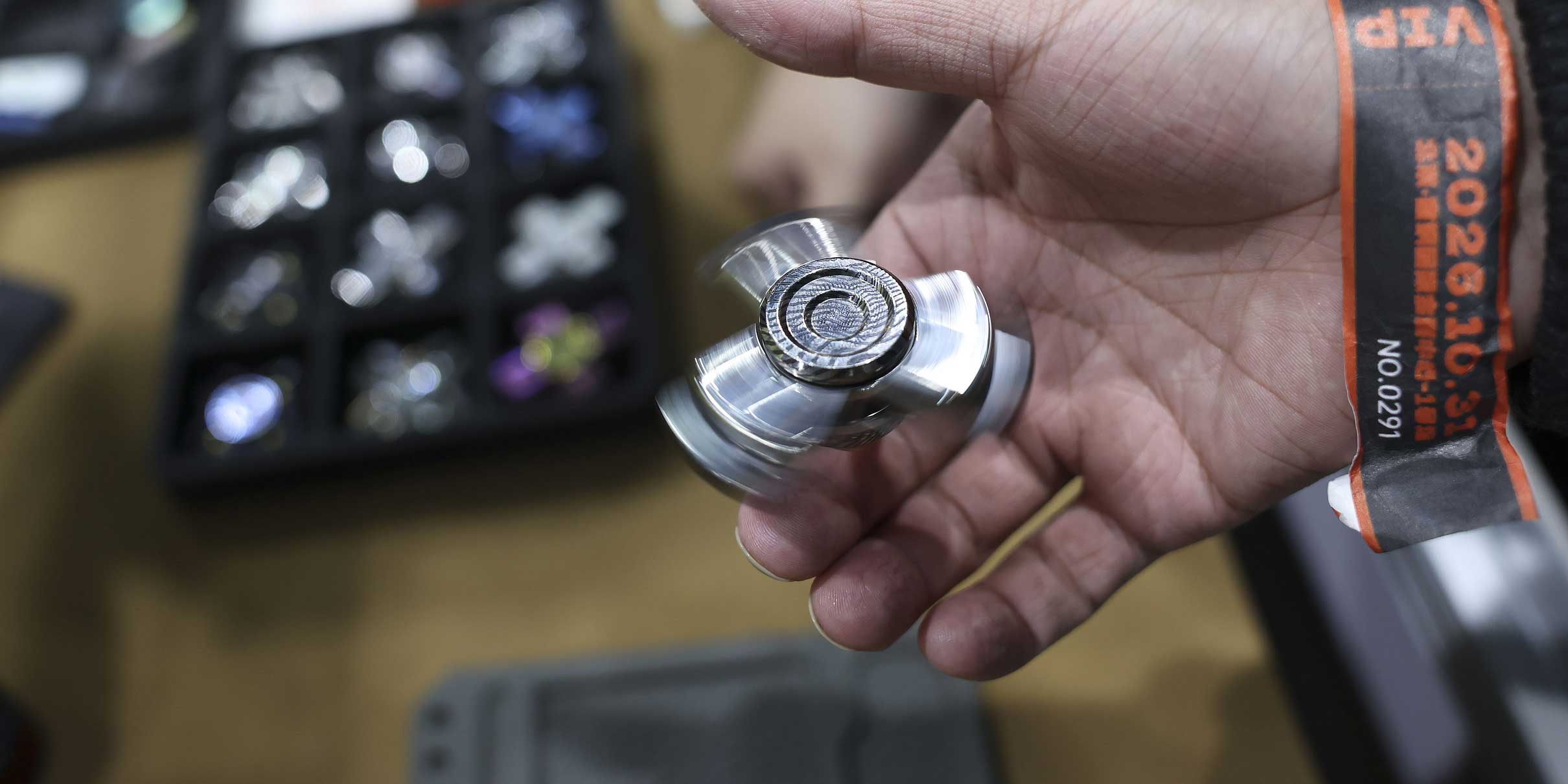
(Header image: A collector tries out a fidget spinner at an EDC toy exhibition in Beijing, Oct. 31, 2026. VCG)