From Monkey Kings to Little Demons: China’s New Age of the Supporting Character
In the classic Chinese novel “Journey to the West,” little demons are nobodies. They serve powerful demon kings, perform menial tasks, and are easily dispatched by heroes like Sun Wukong, better known as the Monkey King. Most do not even have names.
But increasingly, these once-forgotten characters are moving to the center of the story. Across Chinese films, TV shows, games, and books, little demons are being transformed from anonymous supporting characters into protagonists in their own right.
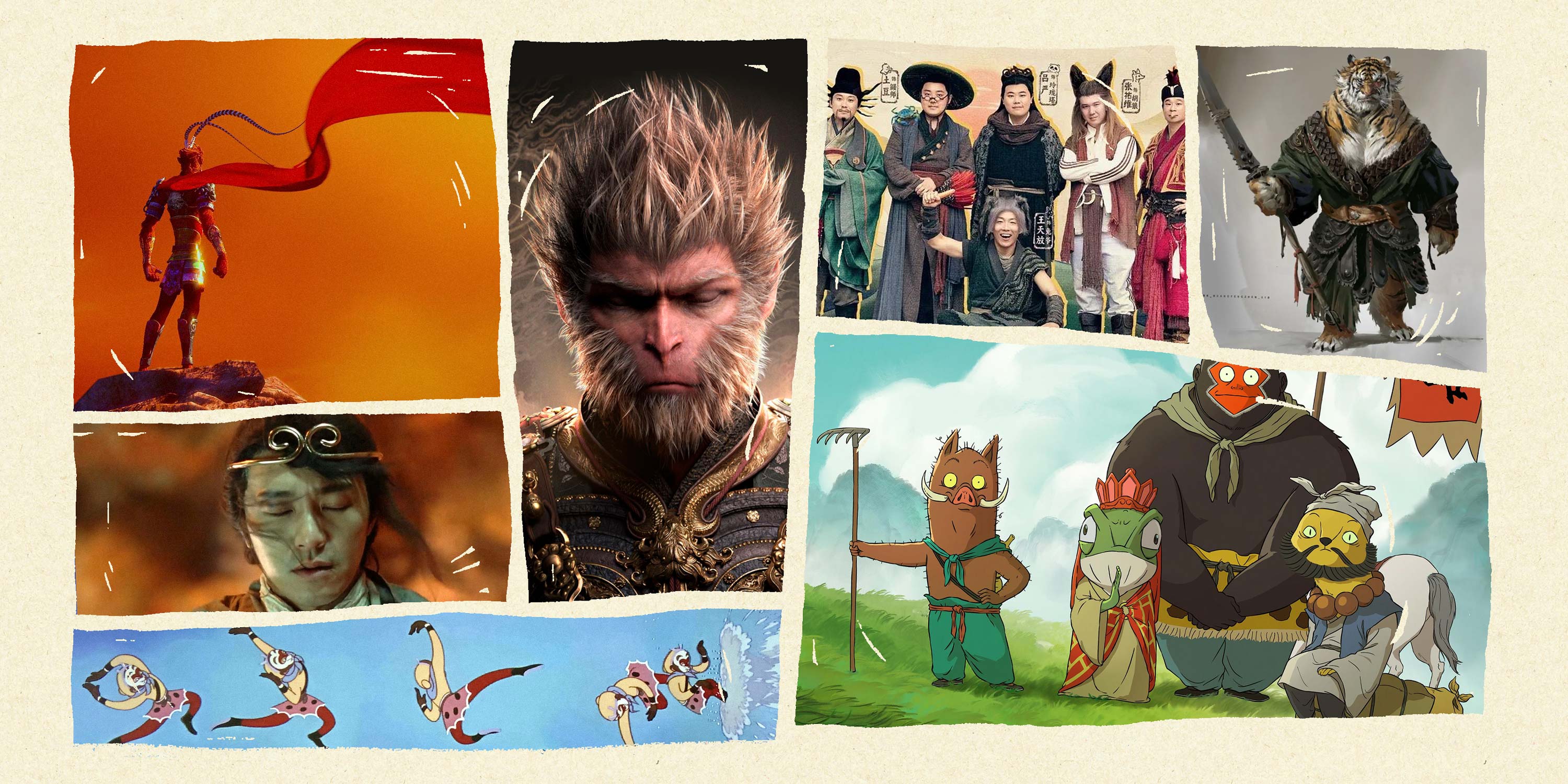
Take Black Myth: Wukong, the Chinese AAA video game that became a global hit. The game features a compendium of 203 supernatural creatures, including 90 classified as “little demons,” each with its own biographical profile. It is almost like an archive assembled from the gaps in “Journey to the West,” a who’s who of forgotten characters.
Another example is 2024’s “The Great Nobody,” a Chinese comedy series spinoff that grew out of the variety show “Amazing Night.” In it, a group of little demons living on the fictional Flower Neck Mountain waits in vain for the monk Tang Sanzang and his disciples to arrive on their pilgrimage to retrieve Buddhist scriptures. The reworking of the classic tale becomes a commentary on supporting comedians struggling to make their mark in the entertainment industry.
But perhaps the most striking example is “Nobody,” a Chinese animated film that grossed 1.7 billion yuan ($240 million) at the box office last summer. Expanded from the first episode of “Yao-Chinese Folktales,” an animated anthology series released on the video platform Bilibili in 2023, the film follows a “knock-off” pilgrimage team of demons comprising a pig, a toad, a weasel, and a gorilla.
Seen in the broader history of “Journey to the West” adaptations, this renewed interest in little demons represents the third major approach to interpreting the classic since the turn of the millennium.
The first was what might be called “post-revolutionary interpretations.” Emerging in the late 1990s, this approach is represented by Stephen Chow’s “A Chinese Odyssey” (1995) and the online novel “The Legend of Wukong,” which began serialization in 2000. These works focused on Sun Wukong’s struggle for individual autonomy, symbolized by his decision over whether to don the golden headband, a device used by Tang Sanzang to rein in his mischievous nature. At their core was the tragic rebellion of the neoliberal individual against the grand narrative of the pilgrimage, as well as a playful deconstruction of earlier “revolutionary” interpretations of “Journey to the West.”
The second consisted of “gothic interpretations,” represented by films including “Journey to the West: Conquering the Demons” (2013), “The Monkey King 2” (2016), and “Journey to the West: The Demons Strike Back” (2017). Through digital spectacle, these films created fantastical worlds and recast the classic as a monster movie. Their dark, horror-filled atmosphere can be seen as a cultural expression of the crisis of neoliberalism.
The third approach is what I call “system-based interpretations.” These works portray the Heavenly Palace and Vulture Peak, the respective seats of the Taoist and Buddhist hierarchies, as parts of a vast network of relationships. Tang Sanzang and his disciples’ pilgrimage to obtain the scriptures becomes a meticulously planned project, while the 81 trials they encounter along the way are recast as conspiracies orchestrated by the powers that be.
Ma Boyong’s bestselling novel “The Annoyance of the Gods” (2023), for example, portrays Taibai Jinxing, a deity associated with the planet Venus, as a project manager exhausted by office politics. In doing so, the novel reframes the pilgrimage as an internal struggle within a sprawling bureaucracy characterized by maneuvering, competition, and checks and balances.
The focus on little demons emerged from this same “system-based” approach. Rather than subverting the logic of the original text, these works stand in the shadows of its grand narrative and construct detailed accounts of the lives of those who remain nameless.
This interpretation is closely connected to the current social mood. Since 2020, growing uncertainty has weakened faith in nixi, or the idea that ordinary people can beat the odds and dramatically improve their fortunes. As economic growth has slowed, such aspirations have increasingly given way to greater empathy for ordinary workers simply trying to get by.
If the era in which little demons were ignored corresponded to a period of economic expansion, when workers believed they too could “retrieve the scriptures and achieve Buddhahood,” then the era of empathizing with them belongs to the period after that peak. Ordinary people stuck on the periphery of systems recognize themselves in these little demons: operating at the margins, with limited control over events, and little guarantee that their efforts will be rewarded.
Take “Nobody,” for example. Close-ups of the little demons’ vacant eyes and sluggish expressions reflect the mental state of some workers today. Their circumstances , to a certain extent, closely mirror contemporary workplaces: routine and often modest tasks, represented by scrubbing pots and making arrows; shifting expectations and promises that do not always materialize; and the risk of being treated primarily as a functional part of a larger operation.
Identification with these little demons reflects a changing sense of where ordinary workers locate themselves within larger systems. Rather than always imagining themselves as protagonists destined to rise above their circumstances, they may find greater resonance in supporting characters who navigate constraints, make compromises, and carve out limited forms of agency within the roles available to them.
This sense of being a supporting character also underlies the popular idea that “the world is just a ragtag troupe.” Some individuals may struggle to fully identify with the current situation while also finding it difficult to imagine viable alternatives. For those who remain within these structures, a common response is to learn how the rules operate and navigate the available room within them in order to maintain a workable position.
This shift toward accepting a supporting role has already manifested in forms of spectatorship common online. “Roasting” other people’s stories allows individuals to mock them from a safe distance while releasing some of the psychological pressure they themselves face.
Posting “bullet comments” that scroll across videos in real time creates a more distanced form of viewing while giving spectators a sense of collective belonging. “Eating melon,” a Chinese internet expression for following gossip and online drama as a bystander, similarly turns public events into spectator entertainment. Rather than emphasizing individual agency, these forms of spectatorship encourage people to watch from the sidelines.
This consciousness has also spread into contemporary cultural production, with little demons being just one example. In the 2024 web novel “The Diary of a Female Zombie’s Hiking Adventure,” the protagonist has no desire to become involved in other people’s storylines and instead chooses simply to observe. Meanwhile, in the animated film “Chang An” (2023), the figure who guides the audience through the splendor of the Tang dynasty (618–907) is the diligent and orderly poet Gao Shi rather than Li Bai, the personality who most fully embodies the era’s poetic spirit. Through Gao Shi’s eyes, Li Bai’s wildness and romanticism are viewed with a sense of incomprehension and detachment.
The audiences for these works are people navigating rapid social change, uncertainty, and shifting forms of connection. They are not merely digital natives, but individuals searching for a sense of place and meaning in this “era of supporting characters.”
Translator: David Ball.
(Header image: Visuals from Douban and VCG, reedited by Sixth Tone)