Why Young Chinese Think the World Is a ‘Ragtag Troupe’
Last month, a shortlist for China’s “Word of the Year” had one candidate that stood out. Amid more mundane terms that dominated 2025 headlines, like “rare earths” and “the 15th Five-Year Plan,” was a piece of social media slang, “ragtag troupe.”
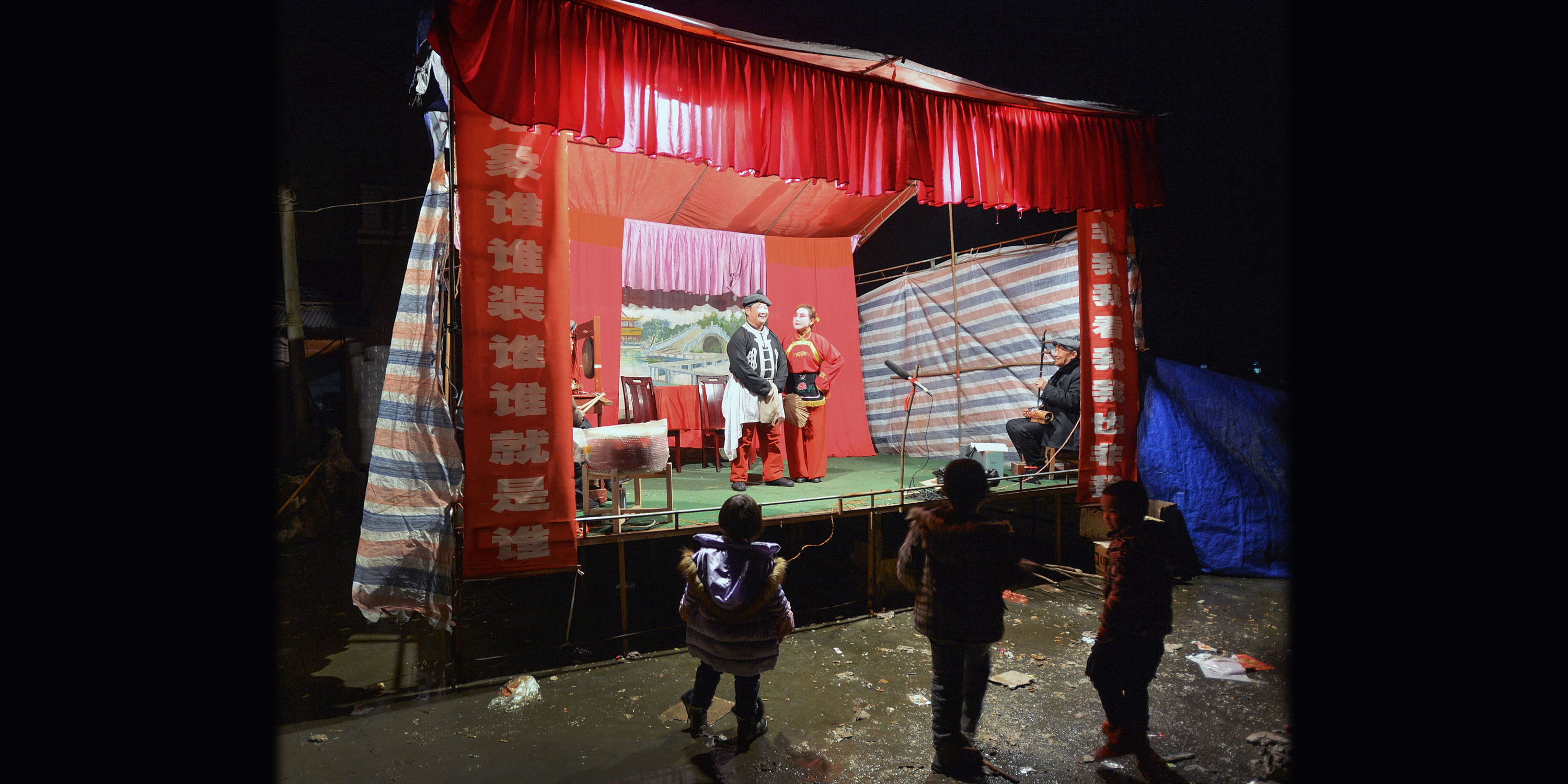
The word, caotai banzi, originally describes an amateur, makeshift theater group performing on rudimentary countryside stages. Over the past few years, it has steadily risen in popularity to describe a wide range of unprofessional, ill-prepared, or poorly coordinated institutions — football clubs, workplaces, and even foreign governments.
“Some ragtag troupe-style amateurish performances have added a touch of farce to otherwise serious international exchanges,” publisher The Commerce Press — which together with a language research center and a news agency had created the shortlist — wrote in a press release. (Nevertheless, “geopolitics” won the international word category.)
On Chinese social media, 2025 gave rise to the phrase “the world is just a ragtag troupe.” In the U.S., there were various clumsily executed actions by President Donald Trump’s new administration — mistakenly inviting a journalist into a chat group discussing combat plans, or the chaotic tariff roll-out. The recent saga around the Chinese-owned but Netherlands-headquartered chip company Nexperia earned Dutch officials the “ragtag troupe” moniker.
But international politics is far from the only realm where China’s younger generation has grown skeptical toward elite institutions. In a December essay, a graduate of a top university described the “absurdities” of her internships: “In consulting, we’d pay lip service to clients, pitch a grand vision — worth hundreds of thousands of yuan in fees — and then deliver a few hastily prepared slides, rushed out overnight by interns. In the tech industry, where you don’t get off work until after 10 p.m., real achievement is simply keeping users engaged on a completely nonsensical app.”
She later transitioned to journalism, an industry not immune to absurdity either. In July, inattentive reporters and an inaccurate social media post purportedly based on AI chatbot messages created a pile-up of confusion. The mess began after social media users believed that DeepSeek — China’s breakout AI model — had confirmed rumors linking an actor to a corruption scandal. One netizen then asked DeepSeek to make an official apology for its “mistake,” and shared its response. This was then picked up by journalists, who were apparently unaware they were reporting on several layers of false information. As a hallucinatory cherry on top, AI chatbots would later cite these mistaken news reports about DeepSeek’s supposed apology.
It is no coincidence that the tech industry is among the most visible examples of “ragtag troupes.” The very aura of innovation and progress only deepens the frustration when users and employees alike suspect that what’s delivered is not progress, but chaos. Given the persistent issue of AI chatbots hallucinating incorrect information, the AI industry might serve as the perfect symbol of “ragtag troupes”: not just flawed, but fundamentally failing to meet the expectations it is hyped to deliver.
This disillusionment extends beyond tech into the wider white-collar world. Over the past few years, a social media trend whereby people share the absurdities and hypocrisies of their workplaces has made many young Chinese come to the conclusion that suits and ties no longer signal professionalism but instead function as a veneer that masks Kafkaesque bureaucracies. Being hired by a highly respected company, they’ve realized, is nothing more than joining a ragtag group that is well-dressed.
The phenomenon can be explained by the theories of 20th-century sociologist Erving Goffman. Using theatrical language, he compared professionals to actors who constantly manage the impressions they present to the public, keeping the “audience” at arm’s length from the “backstage,” where they can behave more carefree and reveal the raw, unfiltered truth. When such a protective boundary collapses and the reality is exposed, a crisis of trust emerges, and both the “actor” and the “audience” must renegotiate their relationship.
Goffman introduced his concept of “dramaturgy” in the 1950s, an era when public faith in reason, progress, and bureaucratic institutions remained fervent. The division of the front stage and the backstage was carefully maintained by “actors” themselves, but also by magazines, television, and advertising, which sought to cultivate idealized, almost divine figures. Today, however, social media offers a rear window into the inner workings of professional lives, allowing organizational malfunctions to be on full display. Anyone, regardless of profession, can now share their backstage struggles, and the voices of disillusionment are amplified.
Yet the bigger change takes place in people’s relationship with their own organization, which explains why professionals who are supposed to carefully manage their image now voluntarily expose the backstage. Unlike in China’s early boom years, when career paths were often linear and predictable, employees today are increasingly skeptical about whether their personal success aligns with organizational goals or the broader interests of society. Gone are the days of lifelong employment. As in other societies exiting their era of extreme economic growth, young workers now face precarious employment prospects and hold no illusions that what worked for their parents will work for them.
In a 2025 academic paper on “ragtag troupe,” He Yufang, a professor at Beijing Jiaotong University, interprets the slang as a coping mechanism among young people facing relentless and sometimes meaningless competition in both schools and workplaces — a socioeconomic phenomenon known as “involution” in China.
Tensions rise when young professionals find obstructions on their path to personal growth — failing to land a lucrative job or promotion — while at the same time seeing industry leaders make ridiculous mistakes. An early ragtag troupe example was the prospectus for the 2021 IPO of streaming site Bilibili. The U.S. law firm that had drafted it referred to the company multiple times as Baidu, its tech industry competitor.
To people in these situations, the myth of meritocracy, that everyone is responsible for creating their own success, takes a hit. This explains why the institutions most often accused of being ragtag troupes — the tech industry, finance, and consulting — are without exception those that claim a culture of meritocracy.
At the same time, He argues, this also breeds a sense of entitlement, as many young Chinese no longer think that they’re necessarily less competent than their seniors or peers with elite backgrounds. Others instead opt to prioritize their own physical and emotional well-being. If people with polished CVs appear everything but polished in practice, why not embrace mistakes at work or detours in life?
Not everyone is a fan of this perspective. In his 2024 New Year’s Eve speech, Luo Zhenyu, founder of the online course and e-book platform Dedao, urged his audience to remain hopeful: “The world may be a ragtag troupe, but you shouldn’t be one!” When admiration turns into disillusionment, and disillusionment into cynicism, it is not just unfair to those who do take their job seriously, but also risks fostering a culture of inaction, which doesn’t help address the mounting challenges facing us, from economic stagnation to climate change.
However, the onus shouldn’t be solely on individuals to persevere with unwavering confidence in human beings. The antidote to “ragtag troupe” cynicism, ironically, lies in allowing real “ragtag troupes” — the grassroots — to thrive. Great things in tech, business, and organizations often begin as experiments; people learn from mistakes, gradually build expertise, gain an edge, and eventually scale up. But as up-and-comers achieve success, they can also become complacent and stand in the way of what they once symbolized: social mobility. The younger generation’s disenchantment with elite status is, in essence, a cry for fairer opportunities — one that demands the renewal of a social contract in which merit is not assumed because of titles, but earned through concrete contributions.
(Header image: Children watch a performance by a county troupe, Huaihua, Hunan province, 2015. VCG)