The Chinese Tea That Became a British Joke — and Those That Didn’t
This is the second article in a two-part series exploring how Chinese culinary terms came to be included in the Oxford English Dictionary (OED). Read Part 1.
China is the origin of tea, and its global vocabulary remains deeply rooted in Chinese. The English word “tea” derives from the Minnan (Hokkien) dialect, reflecting maritime trade routes that carried the leaf from the coastal ports of China’s eastern Fujian province to Europe. Meanwhile, “char” (or “cha”), originating from Mandarin or Cantonese, persists in British slang as a colloquial term for a cup of tea. More recently, the Indian-derived “chai” — a popular blend of black tea, milk, sugar or honey, and spices — has gained traction in Western coffee shops. Yet the foundational lexicon of tea in English remains unmistakably Chinese.
While China produces a wide array of premium teas, English dictionaries have historically been highly selective in what they adopt. Among the commonly accepted lists of China’s most celebrated teas, only Wuyi rock tea (Bohea) and Keemun black tea (Keemun) traditionally made the cut, both transliterated from regional names. However, a closer reading of the Oxford English Dictionary (OED) reveals a more expansive linguistic landscape: nearly 30 Chinese tea terms have been formally incorporated into English. Some are widely used, while others survive as lexical relics. This lexicon includes foundational terms such as green tea, white tea, oolong, and congou; premium black teas like pekoe, souchong, and Lapsang souchong; historic green teas including Hyson and Singlo; post-fermented varieties such as Pu-erh; and descriptive terms such as pearl tea (gunpowder tea) and imperial tea.
Within this OED-derived lexicon of Chinese tea terms in English, one striking anomaly stands out: the theatrical caricature of “Widow Twankey.” The linguistic transformation began in Tunxi, a historic tea hub in the eastern Anhui province. The city’s name was phonetically adapted into “Twankay” to denote large quantities of green tea exported from the region during the 18th century. As this tea became associated with lower grades in Western markets because of its older, coarser, and more ragged leaves, “Twankay” was later repurposed by playwrights into the comedic character “Widow Twankey,” and eventually entered British slang as a term for cheap gin.
In 1861, playwright H.J. Byron named Aladdin’s mother “Widow Twankey” to imply she was “past her best.” The character went on to become a pantomime staple — a bawdy, eccentric “dame” traditionally played by a man in drag, often depicted running a chaotic Chinese laundry in a fictionalized “Old Peking.”
For modern readers, the fact that a Chinese tea term was transformed into a theatrical punchline can come as a shock. Yet placed within the broader OED record, Twankey remains a clear exception. The vast majority of Chinese tea terms in English have been treated with linguistic and cultural respect.
Take Bohea (Wuyi tea), for instance. As one of the earliest black teas imported into Britain in the early 1700s, OED citations show it was initially regarded as a luxury product. Although its commercial standing later declined — by the mid-19th century it was classified among lower-grade black teas — its literary presence remained stable. From Alexander Pope to William Makepeace Thackeray, Bohea continued to appear in print as an authentic beverage.
Similarly, congou (gongfu tea) was established as a marker of upper-class refinement. In Richard Brinsley Sheridan’s 1777 comedic play “The School for Scandal,” congou appears alongside exotic luxuries such as avadavats (tropical songbirds) and Indian crackers. Victorian dietary writers later formalized this hierarchy. In his 1874 “A Treatise on Food and Dietetics,” F.W. Pavy explicitly ranked major black teas in ascending order of quality: Bohea, oolong, congou, campoi.
This documentary respect extends to souchong and Lapsang souchong. In the 18th century, souchong was among the most expensive “brown teas” (the contemporary term for what is now called black tea), attracting such attention that it was subjected to chemical analysis by the Royal Society. Lapsang souchong, despite its distinctive smoky profile, was embraced by intellectual circles. Samuel Beckett praised the “choicest lapsang souchong,” while Aldous Huxley and Iris Murdoch incorporated it naturally into their writing. The OED also records its organic evolution in everyday speech, recording spelling variations like “lapseng,” “lapsang soochong,” and “lapsang suchong.”
The same holds true for pekoe. As early as 1713, essayist Joseph Addison listed it alongside coffee and chocolate as a fashionable social staple, while East India Company records documented its premium trade value. From the tinfoiled chests of “flowery Pekoe” described by G.A. Sala in 1859 to the “teak-colored pekoe” poured in Annie Proulx’s 1993 novel “The Shipping News,” pekoe has maintained a continuous literary and commercial presence. Gunpowder tea, tightly rolled into pellets, was elegantly translated by early British scholars as “pearl tea.”
Importantly, this documentary trail is not limited to black teas. Hyson, known in Chinese as xichun, was championed by Thomas Jefferson, who preferred “young Hyson” for its strength and flavor. By 1948, The New York Times described young Hyson and pinhead gunpowder as the “aristocrats of green teas.”
Singlo was once a major commercial variety in the 18th century, with East India Company ledgers recording millions of pounds imported annually. Known in Chinese as Songluo, after the Songluo Mountain in Anhui where it originates, it was so highly prized that travelers noted authentic batches had become exceedingly rare, with counterfeit versions flooding the market.
Even the obsolete terms in the OED offer a fascinating philosophical counterpoint. Imperial, for instance, once described by J.M. Walsh in 1892 as “the perfection of tea,” has since fallen out of use. Similarly, bing has vanished from common usage. First documented by the Royal Society in 1702 as “the second growth in April,” it is a dialect romanization of the Chinese character “ming” (meaning “bright”), evoking the clarity of early spring after Qingming. Another example, “Oopack,” a highly valued tea from the central Hubei province that fetched top auction prices in The Times as late as 1855, now survives only as a rare lexical relic.
Today, the translation of Chinese tea culture continues to evolve. While traditional teas such as Longjing (Dragon Well) remain largely untranslated in English, modern milk tea brands are experimenting with hybrid naming strategies. Chagee (drawing on “cha,” the Chinese word for tea, and “gee” (which approximates the sound of the Chinese character ji – a classical Chinese term for female performers) and ChaPanda merge Chinese linguistic cues with global marketing logic.
Meanwhile, a new wave of tea culture is reshaping global consumption. Bubble tea (boba), which originated in Taiwan in the 1980s, has become a global phenomenon. What began as a simple blend of black tea, milk, and chewy tapioca pearls has evolved into a highly customizable, brightly colored drink embedded in global youth culture. Driven by social media aesthetics and its distinctive texture, boba has moved from East Asian diaspora spaces into mainstream cafés worldwide, reshaping expectations of what tea can be.
Similarly, yum cha, the Cantonese tradition of drinking tea with dim sum, remains strong across global cities, functioning as a social anchor in urban dining culture. Beyond this, yin yeung — the Hong Kong-style blend of milk tea and coffee — is also gradually capturing international attention. As this bold, caffeinated fusion finds its way onto menus outside Hong Kong, it signals the ongoing global influence of hybridized regional drinks.
This modern expansion is part of a broader global tea renaissance that also includes the Indian-derived chai, now a staple in Western coffee chains. From the early days of Singlo and Imperial to the modern ubiquity of boba and yin yeung, Chinese tea has left a lasting mark on the English language. The theatrical figure of Widow Twankey remains an outlier, a historical distortion rather than a defining pattern.
Yet tea’s vitality has never been confined to its point of origin. A beverage rooted solely in China would have remained culturally rich but geographically limited; its global life depends on circulation, adaptation, and reinterpretation. Today, as global consumers fall in love with tea, they continue to reshape it into new forms, from South Asia’s spiced chai to Southeast Asia’s milk tea variations and contemporary café experiments in the West.
It is this ongoing exchange and reinvention that sustains tea’s global relevance. Ultimately, its legacy is not only Chinese heritage embedded in language, but a shared cultural system in motion — a cup that grows richer with every new tradition poured into it.
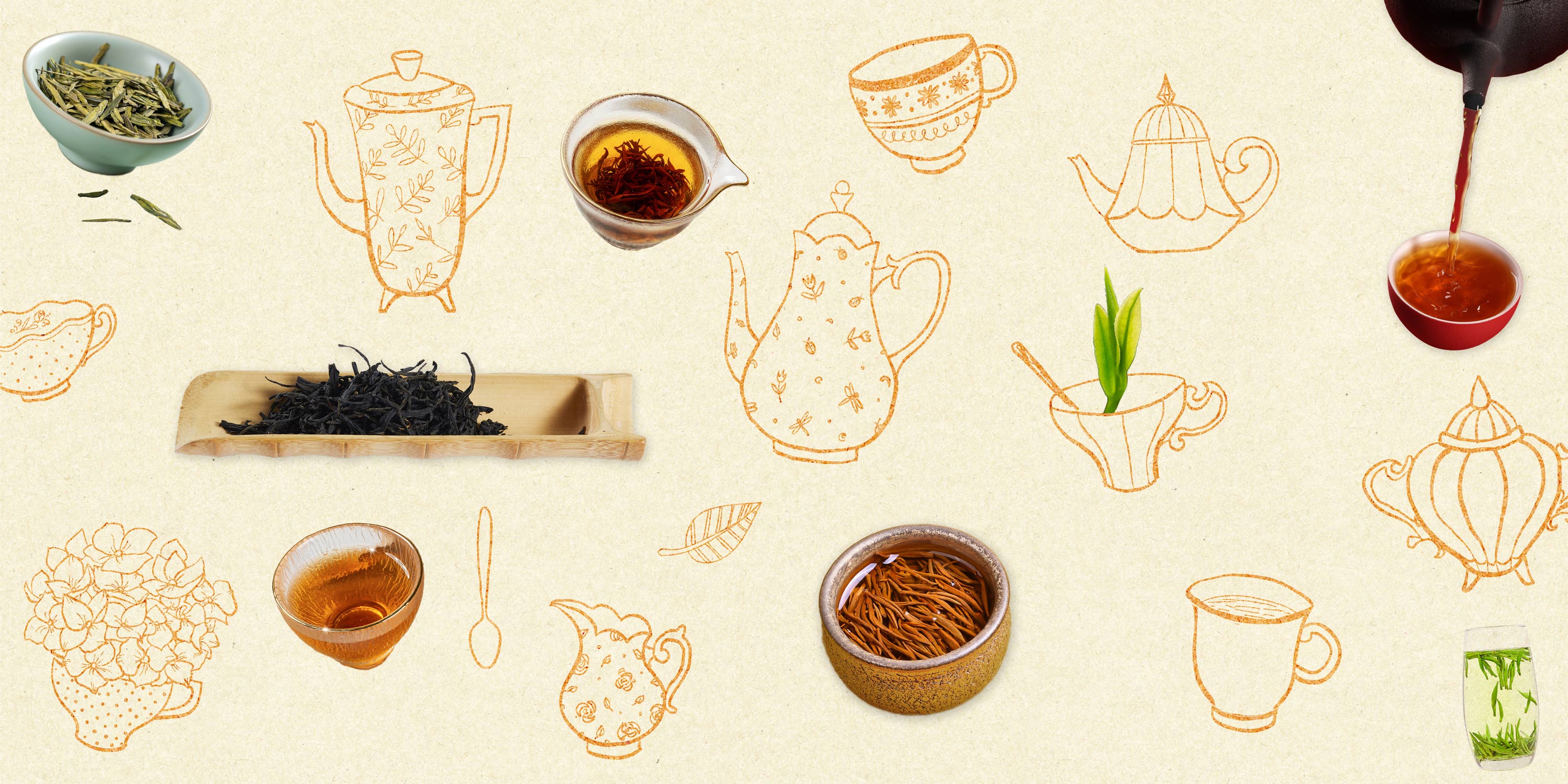
(Header image: Visuals from VCG, reedited by Sixth Tone)