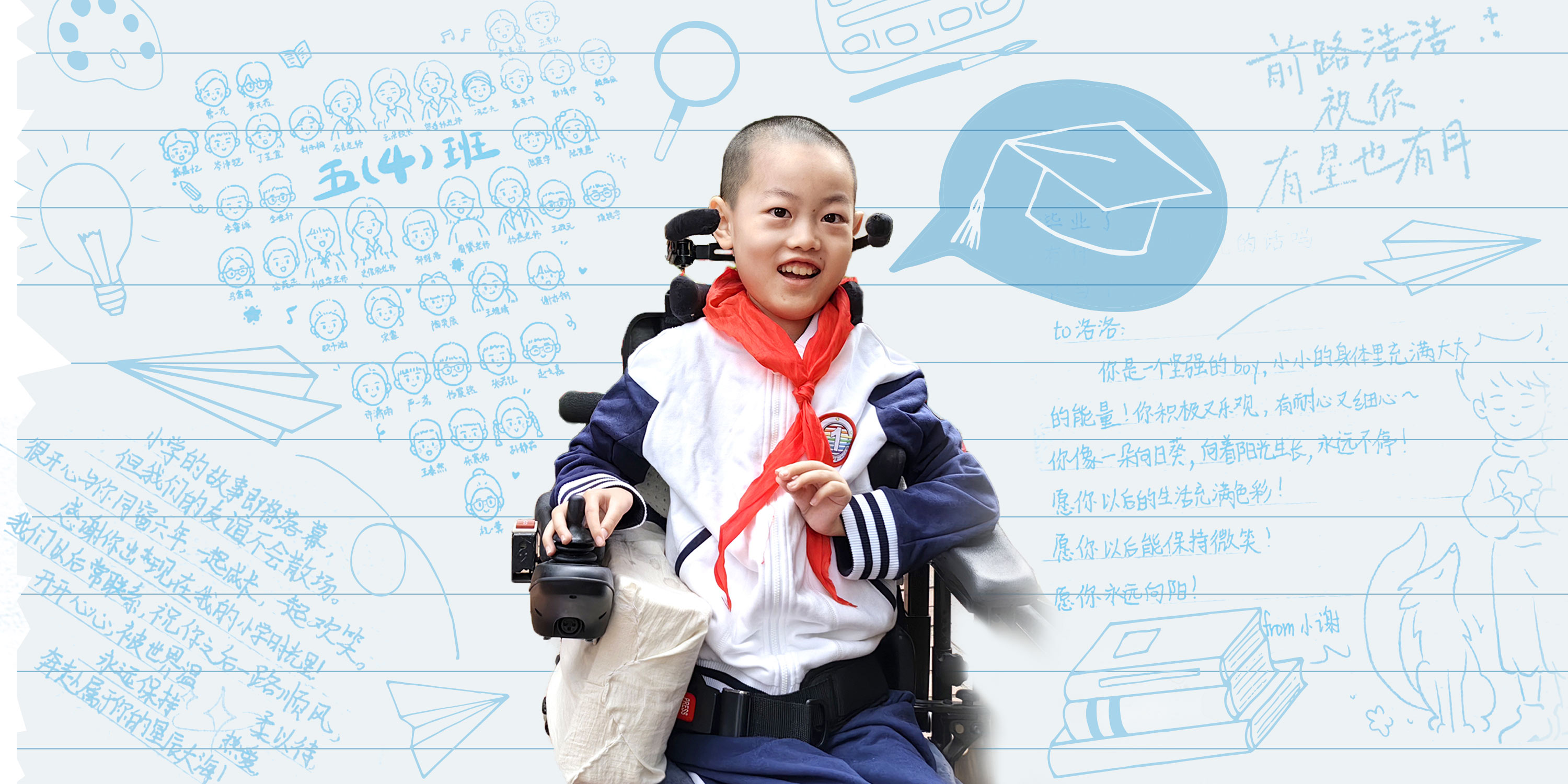
Shanghai Boy Defies Fatal Diagnosis to Become a Star Student
On the final day of school in June, Zou Weiluo was surrounded by classmates eager to leave messages in his yearbook. To his peers and teachers, he’s the “straight-A student who rides a Transformer.”
Zou was 7 months old when doctors diagnosed him with spinal muscular atrophy (SMA), a rare, muscle-wasting disease that affects mobility and respiratory and swallowing functions. They had predicted he wouldn’t see his fourth birthday.
However, this year Zou will turn 13, and he recently graduated as a star student from Luwan No. 1 Central Primary School, in Shanghai’s central Huangpu District.
“Time flies,” sighs his mother, Zhang Ying, who has accompanied her son in every class for the past five years. “It feels like only yesterday that he was a little kid just starting school.”
Despite the struggles of his condition, Zou is now preparing for a new chapter in his education — and is determined to keep succeeding against the odds.
When she first brought Zou to the school, Zhang was apprehensive. Although he was frail and had never attended kindergarten due to his illness, her son was keen to socialize and make friends. But could he adapt — and would the other students accept him?
“Every child has the right to learn,” says principal Wu Rongjin, who agreed without hesitation to enroll Zou at Luwan No. 1. After meeting with the eight first-grade homeroom teachers, she decided to let Zou rotate among classes during his first year, allowing him to mingle with other students and develop social skills, while giving teachers time to observe which environment suited him best. He was assigned to a fixed class in his second year.
“Some children were a bit scared to see him at first,” Zhang recalls. “Especially the younger kids who hadn’t seen such a situation before — a child driving an electric wheelchair.”
However, children can adapt quickly. After just a few months, curiosity transformed into friendship, and fear made way for care. Classmates would help fetch Zou’s textbooks and test papers, and assigned themselves roles such as monitoring the position of his head, to support him if it tilted, and repeating his quiet answers from the back of the class so that the teacher could hear clearly.
“He’s never alienated because of his physical condition,” said Shi Ji, his math teacher. “He’s been doing great at making friends and cherishes them.”
She believes that Zou’s involvement in class is also an educational experience for others. “The students have learned how to interact with a peer who is different from them,” she adds. “This can’t be taught by teachers — it’s formed through daily interactions in a subtle, imperceptible way.”
Zou’s battle with SMA requires the tireless support of his family. His father, a former lawyer who now runs a chain of cycling equipment stores (the name Weiluo is a transliteration of the French word for bicycle, vélo), helped customize Zou’s electric wheelchair and taught him how to use it independently. His mother and elder sister also help with his schoolwork.
Relief has also come in recent years from medical advances and policy safeguards.
In late 2021, China included nusinersen sodium — a common SMA treatment marketed as Spinraza — in its list of medicines covered by national basic medical insurance, reducing the price from 700,000 yuan ($103,000) per injection to just 33,000 yuan. Zou was the first patient to receive the drug at the Shanghai Children’s Medical Center.
He also underwent major surgery in October 2022 to implant a “growing rod” in his spine, which was then curved at 69 degrees, allowing him to sit straight and lie flat.
To calm his nerves as he waited in the anesthesia room, Zou began to loudly recite “The Difficulty of the Shu Road,” the famed eighth-century poem by Li Bai. “Ah, so high, so dangerous,” he shouted, only for the lead surgeon to take on the next line, followed by the other doctors and nurses nearby, one after another. “I suddenly wasn’t so afraid anymore,” Zou says.
The surgery corrected his spine by 10 degrees, but the rod needs to be adjusted every one to two years until he stops growing.
However, the family’s biggest scare came at the end of 2023, when Zou developed severe pneumonia and was in an intensive care unit for 10 days. Zhang and her husband kept a 24-hour vigil at his bedside. She recalls her son lying in bed, telling her, “I’m in great pain, but I really, really want to live.”
Shi says Zou has a real aptitude for math and often gets the highest scores on exams. He performs so well, in fact, that his classmates have a ritual of patting his head for luck before tests.
Outside of school, Zou is an avid reader. During second grade, he finished the complete works of Jin Yong — a master of the wuxia martial arts genre — and “The Three-Body Problem” by science fiction writer Liu Cixin. In an essay, Zou wrote, “In the world of reading, I am free. … Every reading is a journey of the soul.”
Writing is far more difficult — due to his low muscle strength, it requires all his energy. After making only a few faint strokes on the page, he is gasping for breath. In first grade, it could take him up to two hours to write six characters.
As the volume of Chinese writing increased, Zou stopped taking written exams in fourth grade. “It’s not that he didn’t want to take the exams, but he really couldn’t write anymore,” Zhang explains. “If he sat there writing continuously, it would be a huge burden on his spine and entire body.”
Yet Zou never misses an essay assignment, which he composes using an iPad. His Chinese literature teacher, He Chunqiu, has printed out almost every one to keep. “He writes very well, and I admire it very much,” he says.
After spending five years back in school, Zhang often jokes that she’s regressed to being a child again. She tells Zou, “Kid, you’d better live longer so we can go take the national college entrance exam together as mother and son.”
In truth, her son’s academic success is not a priority. “He writes very slowly, so wouldn’t be able to finish the exam papers within the given time. Although there are policies to extend the time for disabled students, I did some research and found that they might not apply to him,” Zhang explains. For her, the main purpose of Zou’s schooling is to stimulate his mind and have him socialize with peers.
After the summer break, her son will start classes at the Huangpu Experimental Middle School affiliated to Shanghai Jiao Tong University, directly next to his primary school.
Zhang recently took Zou for a tour and some trial classes. Unlike other children, Zou was chiefly concerned about the school’s barrier-free design. The elevator access was fine, but the English listening classroom had a threshold that his electric wheelchair could not cross. The principal immediately promised to renovate the facilities.
Although Zou will follow the school’s standard schedule, he will also get to choose classes based on his energy level and interests. “History, geography — these are all things he’s interested in,” says his mother. “For him, it’s purely about whether he likes a subject and whether his body will allow him to handle the course.”
On his 12th birthday last year, Zou was inundated with greeting cards and paper cranes filled with his classmates’ blessings. Now, in this next chapter, there will be new friends and new challenges. “I feel deeply gratified. He has gone further than we ever imagined,” Zhang says.
In the family’s living room is a photo taken in 2015, when Zou’s father took part in a triathlon in Shanghai. It shows the whole family crossing the finishing line together. Next to it is written, “Let our family run forward hand in hand forever. No one shall fall behind.”
Reported by Han Xiaorong, Jiang Lelai, Peng Youqi, and Zou Jiawen.
A version of this article originally appeared in The Paper. It has been translated and edited for brevity and clarity, and is republished here with permission.
Translator: Eunice Ouyang; editors: Wang Juyi and Hao Qibao.
(Header image: Visuals from The Paper and VCG, edited by Bai Lang and Ding Yining/Sixth Tone)