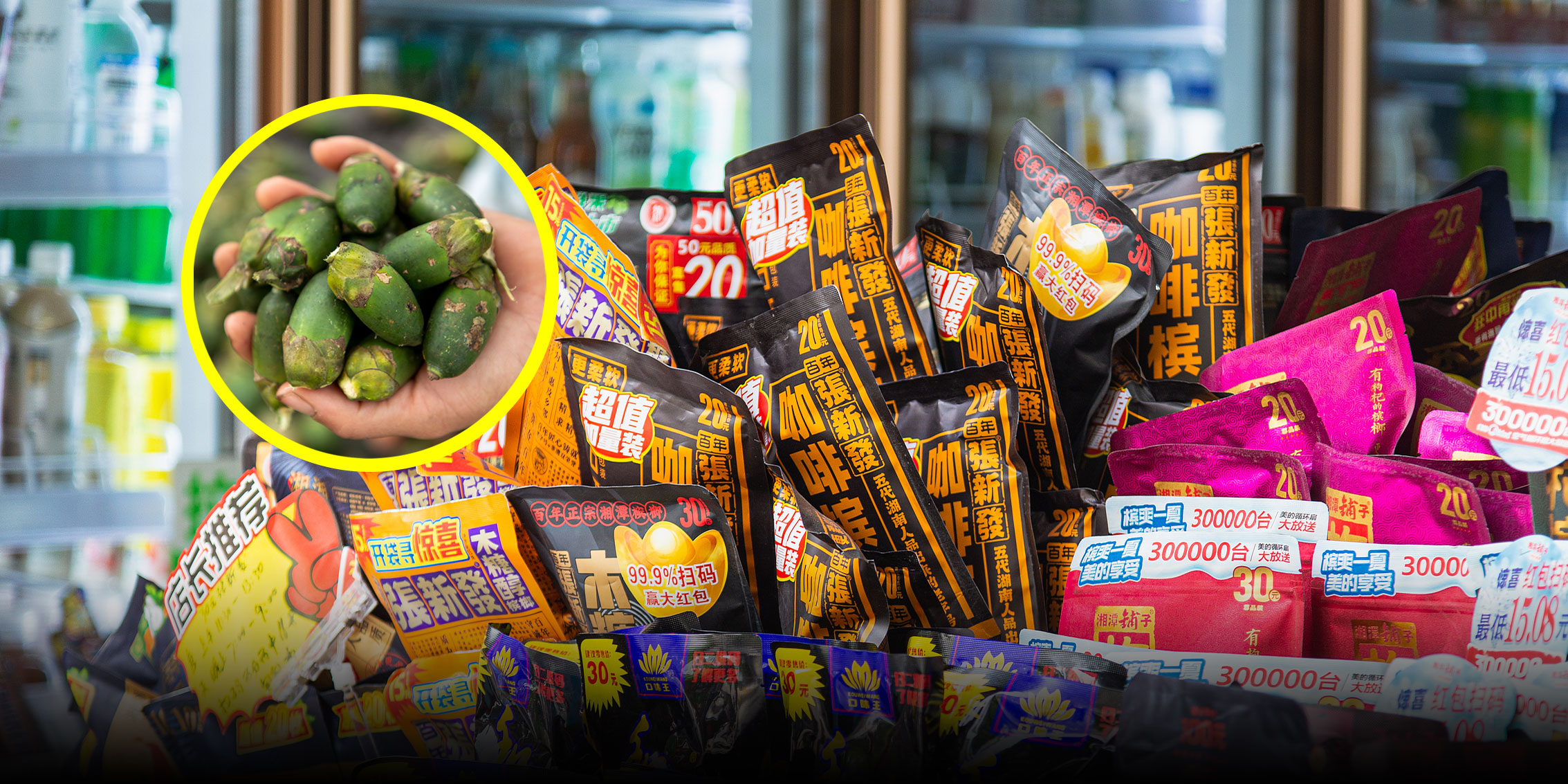
Guangdong Proposes Tighter Rules on Cancer-Linked Betel Nut
Southern China’s Guangdong province has proposed bringing the betel nut, a widely consumed but carcinogenic chewable stimulant, under stricter oversight by designating it a “specially controlled product.”
The province’s top market regulator will first evaluate the industry, enforcement challenges, consumer habits, and public safety before proceeding with legislation, the local government said in an official post on the messaging app WeChat on Friday.
The betel nut, or areca nut, is a mild, addictive stimulant that produces a brief “buzz” when chewed. It is widely consumed across China, particularly in the central Hunan province, the country’s largest consumer market, as well as in the southern provinces of Guangdong, Guangxi, and Hainan, where most of the crop is grown.
Despite its popularity, the nut has long been linked to serious health risks, including oral cancer and pregnancy complications, and is classified as a Group 1 carcinogen by the World Health Organization.
China banned advertisements for betel nut on television and online shows in 2019, and from the food regulatory system in 2020. However, the country has yet to introduce national laws or regulations governing betel nut and related products, leaving production, sales, and distribution in a regulatory gray area.
The announcement comes in response to a proposal submitted by a Guangdong Provincial People’s Congress deputy calling for authorities to strengthen oversight of the betel nut and related products. The proposal also urged authorities to expand public education about the nut.
The regulator has not specified what a “specially controlled product” — a new classification — would entail. But, according to domestic media, the designation would likely establish a dedicated oversight framework governing how betel nuts are prepared, sold, advertised, and distributed, closing a regulatory loophole.
The loophole has allowed betel nut to remain widely accessible, including to minors. State-backed media outlet People’s Daily recently reported that the carcinogen is still commonly sold at shops near schools.
Zhang Yongjian, director of the Food and Drug Industry Development and Regulation Research Center at the Chinese Academy of Social Sciences, told domestic media that sales of betel nut near schools should, in particular, be subject to much stricter controls.
“Regulators should introduce effective measures to better protect minors,” he said.
An online search conducted by Sixth Tone on Thursday found food retailers and fruit stores selling processed and fresh betel nuts across multiple e-commerce platforms. Retailers highlight the nut’s flavor and stimulating effects. Tutorials on how to consume the nut, promotional videos, and posts explaining different varieties are also widespread on social media.
China’s betel nut market was expected to reach nearly 62 billion yuan ($9 billion) by 2031 at an annual growth rate of around 5%, according to data from market analysis and consultancy agency Zhiyanzhan.
Editor: Marianne Gunnarsson.
(Header image: Betel nut products at a supermarket in Guangzhou, Guangdong province, Sept. 21, 2022. Inset: Fresh betel nuts in Qionghai, Hainan province, Nov. 14, 2021. VCG)