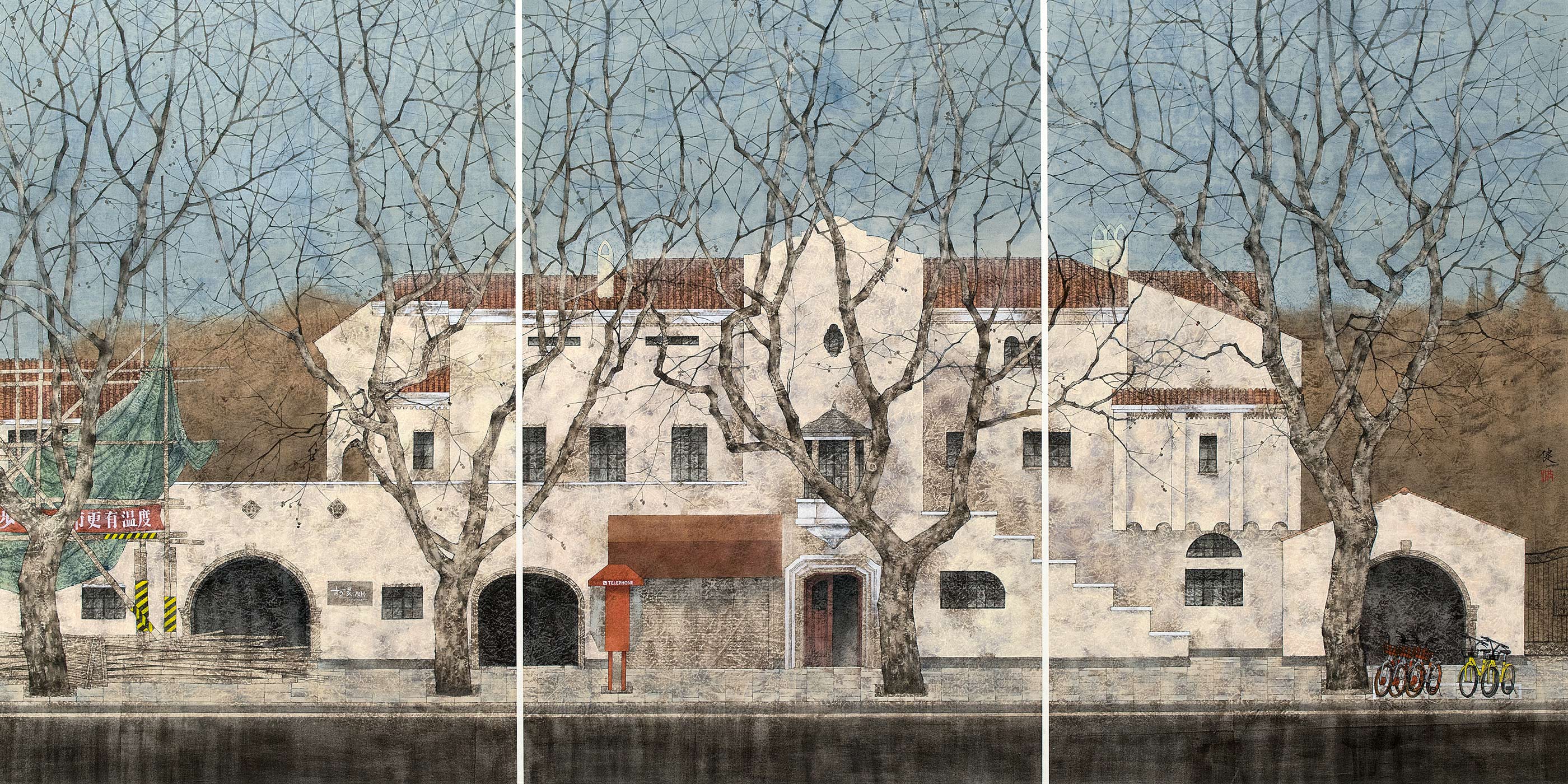
Before We Vanish: The Painter Preserving Shanghai’s Old Buildings
Editor’s note: Hong Jian, an artist in Chinese painting, began his “Shanghai Stories” series 20 years ago, and has since depicted many city landmarks including Wukang Mansion and the Sihang Warehouse, where a group of Chinese soldiers famously held out against invading Japanese troops in 1937. The following is a conversation between Jiefang Daily and Hong about this series and other works.
Jiefang Daily: What prompted you to start painting Shanghai’s modern architecture?
Hong: I used to live at the intersection of West Fuxing Road and Gaoyou Road, and worked on Changle Road. The old street scenes and buildings along Julu, Fumin, and Changle roads, as well as the Hengshan-Fuxing area, deeply captivated me. In 2006, while looking for a studio near my home, I took many photos of old buildings.
Then, to participate in a Shanghai-themed exhibition, I painted the former residence of Ke Ling (a renowned literary figure) on West Fuxing Road. That piece received a great response, which is why my focus gradually shifted from painting figures or birds and flowers to architecture.
After that, I painted a series of old buildings in the Hengshan Road-Fuxing Road Historical and Cultural Block, experimenting with scale and technique. I also infused my canvases with vivid contemporary elements like scaffolding, bicycles, and Chinese parasol trees. That was how the “Shanghai Stories” series began.
Jiefang Daily: Compared with capturing mountains and rivers, birds and flowers, and human figures, architecture is a niche subject in traditional Chinese painting — and works reflecting urban architecture are even rarer. How did you develop your presentation method?
Hong: I borrowed the jiehua technique — a traditional architectural painting style executed with the aid of a jiechi, or groove ruler — and integrated it with watercolor approaches. In the course of creating a painting, instead of treating the xuan paper in the traditional way or layering paint on the canvas over and over, I used my method to create a textured feel. This helps convey the weathered look of old buildings and creates a nostalgic and romantic atmosphere on the canvas.
Jiefang Daily: How are you able to integrate different artistic features into a single composition?
Hong: My primary workflow still follows Chinese painting conventions. However, I will integrate various methods into specific details. I believe that in painting, there’s no need to stick to one set of techniques — the barriers between different methods can all be broken down.
Jiefang Daily: Your paintings seem to share a common trait — the use of color is restrained, while the buildings always look refined.
Hong: In my observation, Shanghai’s old buildings are low-key and elegant. To convey the essence of Shanghai as I envision it, I have to break the traditional rules on color usage in Chinese painting.
The color usage and visual feel also relate to my personality. I’m a rather quiet person with a hint of melancholy deep inside. I particularly love rainy days in Shanghai. One winter night, while driving past Wukang Mansion in the rain and stopping at a red light, I looked up and saw a few warm lights glowing inside the building. I was so touched. I painted the scene, including a few wisps of smoke — the lingering breath of everyday life left by passing cars. Starting from that painting, I went on to create several pieces of old buildings at night.
Jiefang Daily: Why do your paintings almost exclusively feature buildings rather than people?
Hong: When I lived on Gaoyou Road in the 1990s, the surrounding streets were incredibly quiet. I hope to restore that tranquility through my paintings, even if it carries a sense of loneliness.
I created these works not just to paint the buildings, but to tell the stories of Shanghai. Behind every door and window is a hidden tale. Through the architecture I depict — along with elements such as traffic lights, bicycles, phone booths, and power distribution boxes — I want to evoke associations and stir up the stories buried deep in the viewer’s memories. In that sense, every person who looks at the painting can become a storyteller.
Jiefang Daily: In your painting “Taiyuan Road,” an unremarkable roadside substation takes prominence. Why conceptualize the scene in this way?
Hong: Because that’s the reality. Painting isn’t about depicting perfection — I can even destroy perfection for the sake of painting a picture.
I usually paint architecture based on my own feelings. I will go there to experience it, engage in a dialogue with it, and feel the atmosphere of the surrounding neighborhood. My first impression may ultimately be reflected in the picture.
For instance, before painting Broadway Mansions (a 22-story tower along the north bank of Suzhou Creek), I observed it at different points in time. The light and shadow across its façade differ at noon and at dusk — the building’s entire atmosphere changes. I chose a time to paint that best reflected its essence.
Jiefang Daily: In your painting of Middle Huaihai Road, there appears to be a rare human figure. Why is that?
Hong: Yes. For that work, I painted Middle Huaihai Road at dusk. The hair salon was about to close, with only one customer left inside. The salon is opposite Wukang Mansion and was once a stationery store where I would often buy art supplies. One day, by chance, I came across a photo of this hair salon taken by a friend. I used that image as a reference for my painting. I also paid homage in my color palette to the American painter Edward Hopper, whose works carry a sense of cold solitude.
Jiefang Daily: You seem especially fond of Ke Ling’s former residence, a structure you have painted multiple times. Why?
Hong: I’ve painted it three times. The first was in the 1990s. At that time, mobile phones weren’t popular, and in the painting I depicted a telephone booth by the roadside.
The second time, I drew scaffolding in one corner of the picture, showing the old building undergoing protective restoration.
The third time I painted it was for an exhibition. I enlarged the previous composition and added shared bicycles parked by the road. Through the changing details in those three paintings, I wanted to depict Shanghai’s evolution from a specific angle.
Jiefang Daily: And what appealed to you about the architecture along the banks of Suzhou Creek?
Hong: As a child, I loved riding my bike to Suzhou Creek to sit there and draw in my sketchbook. The people cooling off by the waterway in the summer and the lives of the boatmen provided me with lots of inspiration.
Starting in 2011, amid Shanghai’s urban renewal, many buildings along Suzhou Creek were demolished. I wanted to document the riverside buildings. Hence, my painting “Chun Shui Xiang Dong,” or “The Spring River Flows East,” which I named after my favorite film, “Yi Jiang Chun Shui Xiang Dong Liu.”
Starting with that painting, I traced my way from The Bund to the Zhejiang Road Bridge, attempting to preserve my generation’s memory of Suzhou Creek in art.
Jiefang Daily: In your impressive depiction of the Sihang Warehouse, why are the colors so dark?
Hong: I wanted to portray the scene of devastation after the defense of Sihang Warehouse. The structure is like a monument — its exterior walls are blackened by the flames of war, and the water in Suzhou Creek is nearly black as well. In my opinion, conveying a sense of sorrow and desolation might be more striking than a literal depiction of the battlefield.
Jiefang Daily: From “Shanghai Stories” to your “Suzhou Creek” and “Hudec Architecture” series, your paintings not only reveal a deep affection for the city but also suggest new possibilities for Chinese painting.
Hong: When I was a student, many believed that gongbi painting (a realistic style with meticulous brushwork) was too craft-oriented, but I preferred it. Compared with xieyi painting (a more emotional interpretation with freehand brushwork), gongbi is more receptive to absorbing characteristics of other styles to serve its purpose. It’s also broader in thematic expression, easier to connect with contemporary life, and more likely to resonate with younger audiences.
I believe the future of Chinese painting lies in the mindset of the artists. If we stubbornly cling to tradition and only look backward, our creations will be far from contemporary life. We should not limit our vision solely to painting, but instead maintain an open mind and broad perspective, engaging with other art forms, even literature and philosophy. Technique isn’t everything — art is ultimately driven by thought, and thought requires accumulation.
Reported by Chen Junjun.
A version of this article originally appeared in Jiefang Daily. It has been translated and edited for brevity and clarity, and is republished here with permission.
Translator: Eunice Ouyang; editors: Wang Juyi and Hao Qibao.
(Header image: The former residence of Ke Ling, painted by Hong Jian in 2019. Courtesy of Hong Jian)