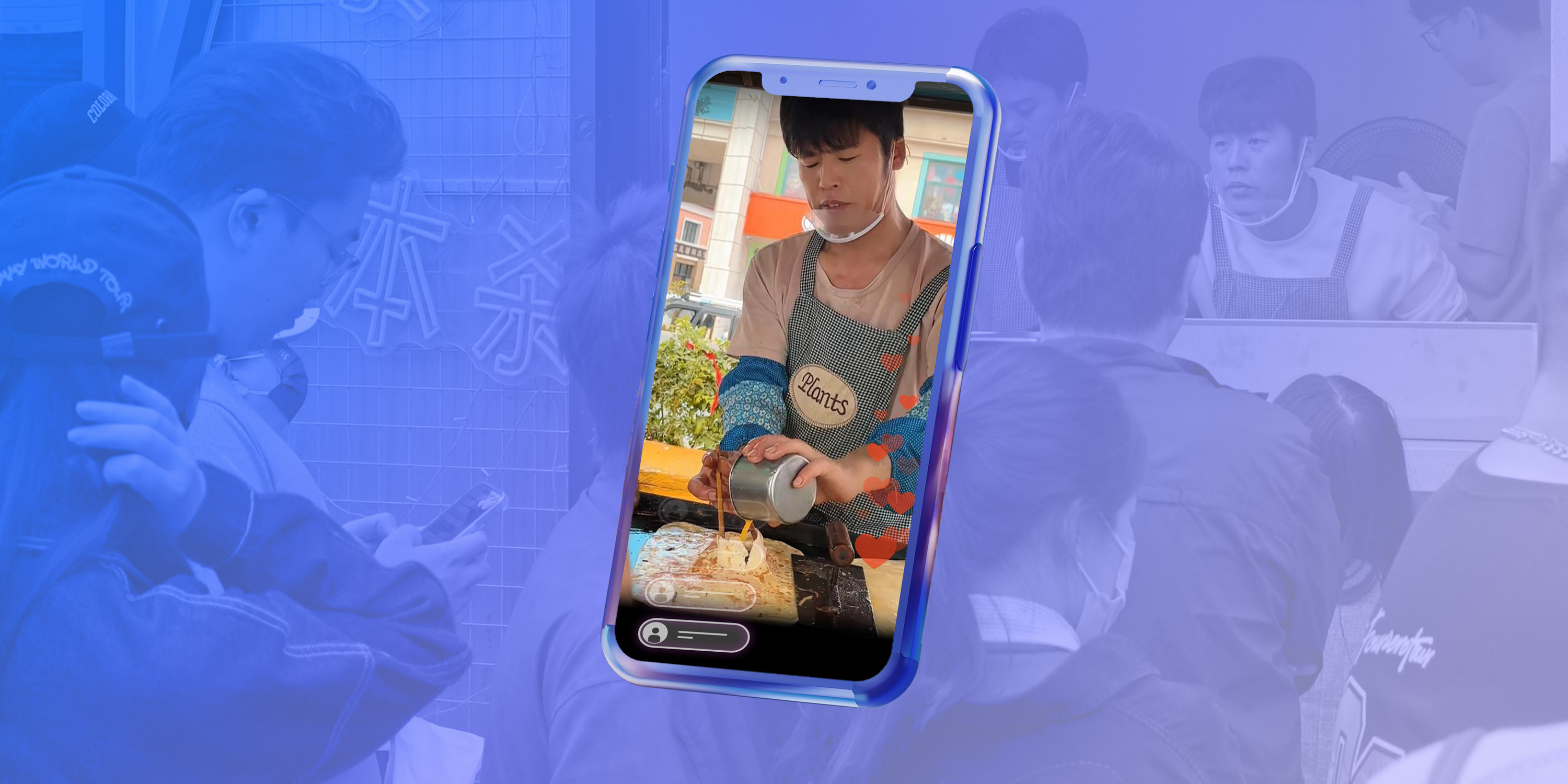
Why Jay Chou’s Viral Lookalike Is Sticking With Pancakes
Editor’s note: In the age of the attention economy, social media has the power to change lives by propelling any ordinary Joe to celebrity status in an instant. But what happens when that 15 minutes of fame ends?
Sixth Tone is republishing five stories from “After the Spotlight Fades,” a 10-part series by The Paper that revisits people and places in China whose fortunes were transformed — sometimes only briefly — by viral fame.
Just before Chinese New Year, Bai Xianying set up his food stall selling savory pancakes in his old spot outside a textiles mall in Baoding, in the northern Hebei province. In the vein of his doppelgänger — the pop megastar Jay Chou — it was somewhat of a comeback gig.
Bai, a migrant worker who rocketed to fame in 2020 for his uncanny resemblance to the “King of Mandopop,” was a fixture of the city’s Liangmatai neighborhood for roughly a decade before leaving in 2024 to open a business in the metropolis of Tianjin, a two-hour drive east.
“Everything I have, I built from the ground up running this stall for about 10 years,” the 43-year-old says, explaining why he’d decided to set up his old stall for 10 days in January. “Who can just walk away from their roots?”
Most customers were former regulars looking to grab a snack, although a few did ask for a photo with Bai, to which he always obliged.
One customer recalls, “The line to his stall used to stretch dozens of meters — there was an impossibly long wait. Now, the crowd isn’t as crazy anymore, so I’ve decided to come buy one of his pancakes.”
Bai seemed relaxed about the crowds being much smaller — and far less fawning — than at the peak of his viral fame, simply citing the old adage that “Good times don’t last forever.” But then, attention has never been his barometer of success.
Turning up the heat
Born into a rural family in Hebei’s Handan City, about 300 kilometers from Baoding, Bai left home before finishing middle school to find work. He began running the pancake stall outside the textile mall in 2015, having previously held jobs in security, at a toy factory, and selling vegetables.
Since he was young, people had told Bai that he looked like Jay Chou, the Taiwan-born singer-songwriter, who emerged onto China’s pop scene around 2000. He’d always waved away the comparison — yet it was to change his life.
In late November 2020, a random customer shared a video online of Bai making pancakes and remarked on the resemblance. The post received more than 267,000 likes and 49,000 comments.
Bai heard the next day that he was trending on social media, but he felt it had little to do with him. Then he and his wife, Huang Yonghua, noticed a sudden spike in the number of customers at the stall.
On Dec. 7, Bai released his own video on Douyin, the Chinese version of TikTok, to thank his new army of fans. He explained that while he knew of the pop star, he wasn’t familiar with his music. “But my pancake business has really picked up because of this,” he adds. The post received nearly half a million likes.
However, that was just round one.
After the initial bump in business, things calmed down for a while. Bai continued sharing videos about his life and would occasionally livestream while making pancakes. Then, in the summer of 2023, the Douyin algorithm boosted one of his videos, attracting more than 786,000 likes and sending him soaring up the trending charts again.
“That brought a real surge in traffic, and we sold a lot of pancakes,” he says, adding that customers were coming from around China, including foreign tourists, with the line sometimes stretching almost 50 meters. Worried that people might suffer heatstroke while waiting in the scorching summer heat, he provided free drinking water and sour plum juice.
Daily sales doubled, but so too did the workload.
Running a pancake stall can be physically demanding. Every night, Bai and Huang had to prepare the pancake batter, peel and shred 50 kilograms of potatoes, and wash bags of lettuce, ready for the lunchtime rush the next day. That August, the couple returned home each day utterly exhausted.
Bai also started receiving invitations to make pancakes at events across the country, receiving celebrity treatment, which he says made him feel largely uncomfortable.
The massive attention also had a knock-on effect on the surrounding businesses, though not entirely positive. As some customers’ photos and videos captured phone numbers of nearby stores posted on walls, netizens began calling them to check whether Bai had opened his stall that day, and would even ask store owners to help send them a pancake via express delivery.
Bai felt genuinely apologetic. The Liangmatai textile mall is a hub for plush toys, home fabrics, and clothing, “which are all industries completely unrelated to pancakes,” he says. “My popularity didn’t really bring any business to the surrounding shops. If anything, it just caused them inconvenience.”
Money matters
Being an unlikely influencer, Bai has found it difficult to cash in on his online traffic.
After going viral the first time, he began working with a multichannel network — a business that assists content creators with programming, products, and digital rights — but ended the partnership after a month, as he felt the contract was too complicated.
Bai also attempted to sell sausages via livestream, but soon stopped after buyers complained that they were smaller and less tasty than the ones he used in his pancakes. The incident damaged his confidence in e-commerce.
When netizens saw that Bai continued to make pancakes even after becoming famous, they praised him for being “down to earth” and “honest.” This memory makes him laugh. “It’s not that I never thought about making money from the traffic — I’m just not a smooth talker,” he says. “I earn the money I know how to earn. I don’t bother chasing the rest.”
“A lot of people assume I made a lot of money from all the online traffic, but even at the peak I didn’t earn anything,” he adds. “I don’t understand social media. I don’t do product placement or sponsored ads. I don’t know how to leverage trending topics. Where would the money come from?”
Bai and Huang’s only goal has been to provide a better life for their three daughters — one is now 20 and studying at university, another is 18, and their youngest is still in primary school. “Whether they choose to pursue higher education or go out and find a job, I just hope they can do decent work, earn money, and never have to live the life of poverty we had to endure,” Bai says.
The couple’s children rarely appear in their Douyin videos, while Bai always tries to prevent others from filming and photographing them. He tells his girls never to mention that their father is “Bing Ge,” or “Pancake Brother,” as he’s known online.
Bai explains that his caution comes from “not being particularly savvy” about the risks of online exposure. Moreover, he adds, his daughters are naturally shy and have no desire to appear on camera or be famous.
Back on the street
In late 2023, during a break to see Chou perform in concert in Tianjin, Bai and Huang noticed that the city’s snack stores all had long lines, prompting them to consider opening their own business there.
The couple eventually did the following year, establishing Zhoubinglun, which serves pancakes and millet congee. (Editor’s note: The brand name sounds similar to Zhou Jielun, the Mandarin pronunciation of Chou’s name.) They have a downtown outlet on the bustling Binjiang Avenue and another in a neighborhood shopping area.
“Business in 2025 wasn’t ideal, but we’re managing,” Bai says. “The total annual rent for the two storefronts is more than 200,000 yuan ($29,300), and we have to pay for warehousing and our own accommodation. On bad days, we barely make enough to cover our employees’ wages.”
At the start of last year, the couple opened a third outlet on a pedestrian street in Shijiazhuang, the Hebei capital, but it closed after six months. When asked who had suggested the venture, Bai laughs and points at Huang. “I thought that with so many people on that pedestrian street, business would be good,” she explains.
Bai adds that when they opened the store, it attracted little attention — but there was a lot of media coverage when it was shuttered. “That didn’t feel good,” he says. “So for now I just want to focus on running the two Tianjin outlets well.”
He also realizes that when he is physically at one of the stores, business noticeably ramps up. While he might struggle getting to grips with online traffic, he knows that people will always come back for a good pancake.
That’s perhaps why his old food stall appears such an anchor for him.
During his 10-day return to Liangmatai this year, Bai appeared happy and relaxed, often chatting with longtime customers. At one point, he even offered to give away free pancakes to anyone who could beat him in a best-of-three round of rock-paper-scissors. “I want to give something back to my regulars and fans, but I can’t afford to give everything away for free,” he says, laughing.
Whenever someone said he looks like Jay Chou, he’d always protest, insisting, “No, not at all. He has real talent. I’m not well educated and have no talent — I’ve only made it this far because of everyone’s support.”
As for the future, Bai is just taking things as they come. He hopes business at his stores in Tianjin picks up, but also wants to spend more time running his street stall in Liangmatai. “After all these years, I can’t quite let it go,” he says.
Reported by Cheng Ting.
A version of this article originally appeared in The Paper. It has been translated and edited for brevity and clarity, and is republished here with permission.
Translator: Carrie Davies; editors: Wang Juyi and Hao Qibao.
(Header image: Visuals from Douyin and VCG, reedited by Sixth Tone)