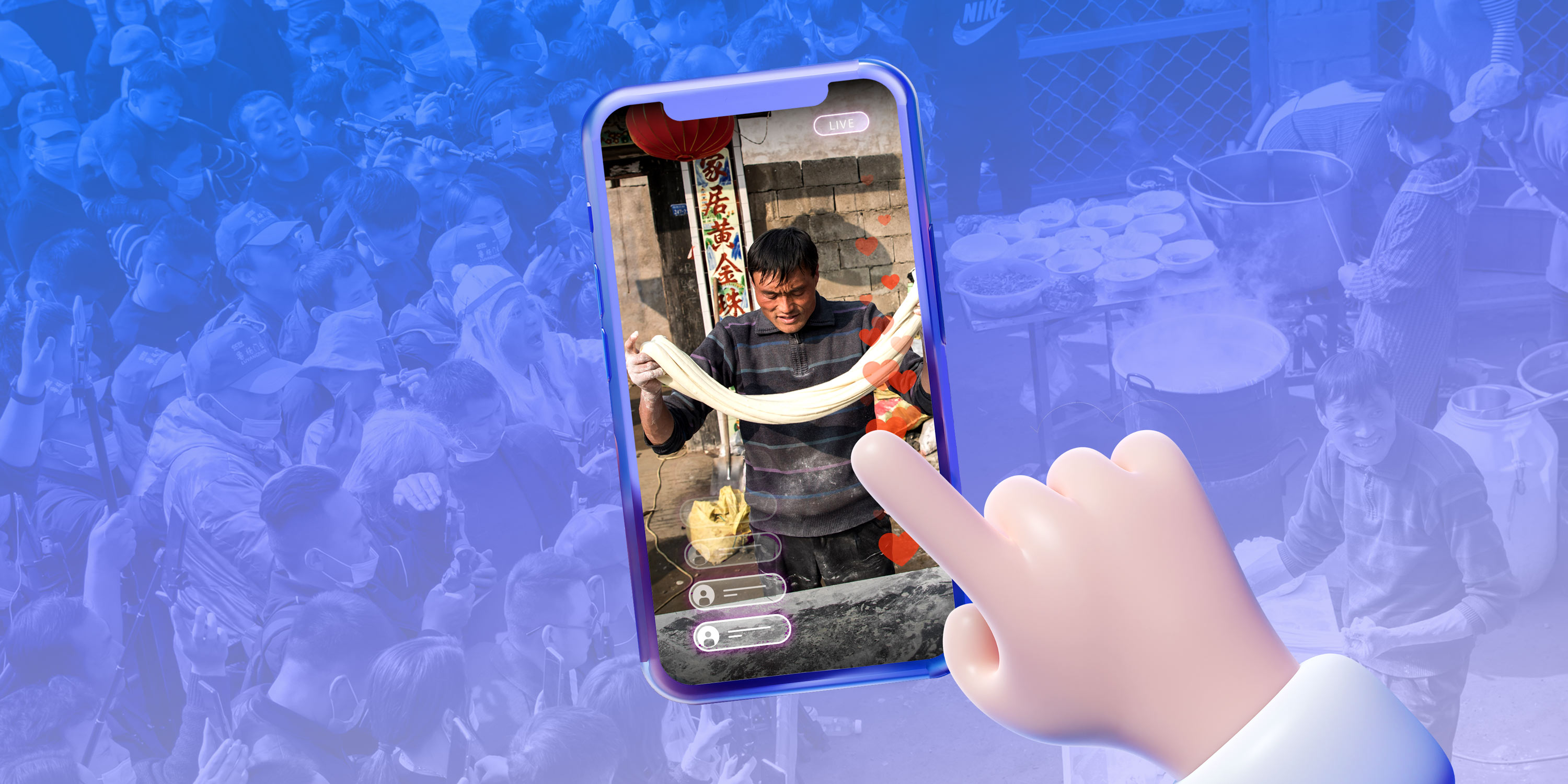
How Viral Fame Strained a Noodle Seller Almost to Breaking Point
Editor’s note: In the age of the attention economy, social media has the power to change lives by propelling any ordinary Joe to celebrity status in an instant. But what happens when that 15 minutes of fame ends?
Sixth Tone is republishing five stories from “After the Spotlight Fades,” a 10-part series by The Paper that revisits people and places in China whose fortunes were transformed — sometimes only briefly — by viral fame.
“I couldn’t step out of my front door. At one point, I was told 50,000 people had shown up at my house.”
Panic creeps into Cheng Yunfu’s voice as he recalls the spring of 2021, when he suddenly became one of China’s most sought-after celebrities. His fame had come out of the blue — the result of a few random viral posts about his pork bone broth hand-pulled noodles — and he was utterly unprepared for the attention.
There were harassing phone calls, strangers barging into his home uninvited, and relentless swarms of livestreamers, all attracted like moths to a flame. For a simple farmer like Cheng, it was terrifying.
“There were just too many people, too many things that were out of my control,” the 44-year-old says, as he looks out from his courtyard in the countryside of Linyi, in the eastern Shandong province.
Life for Cheng and his family is now far more sedate, and social media has long since moved on. But the scars from that experience have yet to fade.
Harvesting attention
Cheng started this morning like any other, kneading a mound of dough ready for whoever might drop by his courtyard for a bowl of his hand-pulled noodles. There are a few neatly arranged wooden tables, and the air is filled with the aroma of coriander and chili oil and the gurgling of pork-bone broth on the coal stove.
Gone are the crowds, cameras, and cruelty of his trending days. Now he serves just a few dozen customers a day, mainly neighbors and people from the surrounding villages, sometimes the odd fan.
Before he was known to the nation as “Noodle Brother,” Cheng had run a stall for 15 years selling bowls of hand-pulled noodles for 3 yuan ($0.45) at Linyi’s Fei County Fair, which is held almost every day and rotates among six locations. In all that time he’d never once raised his price.
On a busy day, he would sell more than 600 bowls, working from morning until 6 p.m., drawing a steady stream of regulars. “I made a tiny profit. I’d take home maybe 200 or 300 yuan – enough for our household,” he says. His family also sold crops grown on a patch of land in their village.
But that all changed during the Chinese New Year holiday in 2021, when a food vlogger posted a series of short videos about Cheng and his super-cheap noodles on the Chinese short-video platform Kuaishou. Together, the posts were viewed 200 million times, garnering 350,000 likes and 18,000 comments.
For the next few months, Cheng’s stall was swamped, as crowds of vacationers hollered and jostled to get a photo with him, even climbing on cars and blocking traffic. He recalls feeling no excitement — just fear.
Worse than the adulation was the torrent of abuse that came with it. “We heard every kind of nonsense imaginable,” he says. “Some accused me of staging the whole thing for attention. Others took my words completely out of context, twisting a casual remark into proof that I had forgotten my roots. And there were those who said I was chasing traffic to cash in on my fame.”
Hu Lirong, his wife, remembers that the pressure became so much that Cheng would break down in tears as soon as he was behind closed doors. “He’s just a farmer. All he knows is how to make noodles,” she says. “How was he supposed to handle all that gossip and slander?”
Cheng eventually released a message asking for privacy on Douyin, the Chinese version of TikTok, where he had 2.7 million subscribers at the time. “Thank you all for your support,” he says in the video, “but my biggest wish right now is to just live a normal life and keep making noodles.”
Today, reflecting on the past, Cheng knows that it was his family’s strength that ultimately helped him survive the worst times, and even emerge more resilient. “You can’t live your life worrying about the judgment of others,” he says. “You have to live for the people under your own roof.”
Today, the Fei County Fair is as lively as ever, but Cheng is no longer part of it. He stopped attending three years ago and instead set up a permanent stall outside his home, which he opens daily after finishing his farm work. “I just couldn’t go back there,” he says. “There are too many unpredictable things at the market, and the shadow of the abuse lingers on. It’s peaceful here at home, and I get to spend more time with my family.”
There were some positives from his viral fame. For Cheng, the most meaningful thing was being able to leverage the attention to help a father, Guo Gangtang, spread the word about his abducted son. The pair were eventually reunited, and Guo made a special trip to thank Noodle Brother in person.
The attention also led to the local government upgrading the pothole-riddled dirt road in Cheng’s village. In 2022, it was resurfaced and widened, making travel far easier. “There’s only so much one person can do. I never imagined I’d be able to make a difference even in my hometown,” he says.
A vendor surnamed Wang, who sells steamed buns and pastries at the fair, used to set up next to Cheng’s stall. She smiles when his name comes up. “His was always the busiest spot. People still come up to me asking why he doesn’t show up anymore,” she says, adding that he is “as genuine as they come.”
Rural idyll
Cheng’s life these days is full but unhurried. In a video posted on March 24 to Douyin, where he still has about 2.2 million subscribers, he and his wife are seen working a field near their home — hauling water, spreading fertilizer, and planting seedlings. Afterward, he takes his mother to a local restaurant, where they crack beers and chat.
The video hasn’t got many likes, but the comments are supportive. “Watching your life makes me feel grounded,” writes one viewer.
Cheng scrolls through the comments, but rarely replies. Filming his life isn’t about gaining followers; it’s simply a way to chronicle his days and, sometimes, help villagers promote local agricultural products like millet, sweet potatoes, peanuts, and hawthorn berries.
“It breaks my heart watching good produce go to waste in the field,” he says. “We have so many incredible specialties in the Yimeng Mountains, but so few people know about them.”
There’s no content production team — usually just his 21-year-old son with a basic camera and tripod. Cheng has taught himself video editing, while he and Hu have also tried their hand at livestreaming, “although I don’t want to make money that way,” he insists.
“If people watch, great. If not, that’s fine too. I’m just being myself,” he says. “What matters is that people genuinely support you. Attention on the internet is fleeting. Once the novelty wears off, people move on. That’s just how it is.”
The financial windfall that one might expect for being an overnight celebrity never materialized for Cheng. His commission for any agricultural products he sells is just 10%, leaving little after e-commerce fees are deducted, and he still refuses to increase the price of his noodles.
However, in the past two years, he has been able to afford to build a three-story house in nearby Liangqiu Town, intended as his son’s future home after marriage.
“People say I’ve made tens of millions, but that’s nonsense. I’m just a regular guy making an honest living,” Cheng says.
One area where he does feel richer is inner spirit. “I’ve grown stronger in myself. Some people follow you online, then lose interest — there’s no point trying to hold onto them,” he says, adding that navigating life is like making noodles: it’s essential to stay grounded.
In hindsight, he can see that going viral was a blessing and a curse.
“At first, I thought it might introduce my noodles to more people and help me earn a bit of extra money,” he recalls. “But I soon realized that internet fame is like duckweed without roots — it arrives fast and leaves fast — and it puts every corner of your life on public display.
“Privacy is our most precious thing. Once you’re famous, you’re scrutinized under a magnifying glass. The tiniest misstep gets blown out of proportion; the slightest error invites a chorus of condemnation.”
Cheng says he will never forget the suffocating feeling of that spring: Eating, working, talking with his family — all of it caught on camera to be discussed and dissected by strangers, to be twisted or amplified.
In recent years, Cheng’s fame has created opportunities for him to venture beyond the Yimeng Mountains to various cities across China, not simply as a tourist but to “check out local specialties elsewhere and bring the best things back home.”
Looking ahead, his only plans are to stay put, keep selling noodles, and hopefully pass on his skills to the next generation. “You won’t make a fortune, but feeding yourself with hard work is always better than sitting idle,” he says.
And to those who dream of becoming internet celebrities, he offers a simple message: The internet is a beast — don’t exhaust yourself trying to tame it.
“You can do 10 good deeds and make one mistake, and that mistake will be all anyone remembers. But someone else can do 10 terrible things and one good deed, and suddenly they’re a saint,” Cheng adds. “Whatever you do, just don’t go against your conscience and principles, and you keep your feet on the ground.”
Reported by Zhang Yilin.
A version of this article originally appeared in The Paper. It has been translated and edited for brevity and clarity, and is republished here with permission.
Translator: Chen Yue; editors: Wang Juyi and Hao Qibao.
(Header image: Visuals from VCG, reedited by Sixth Tone)