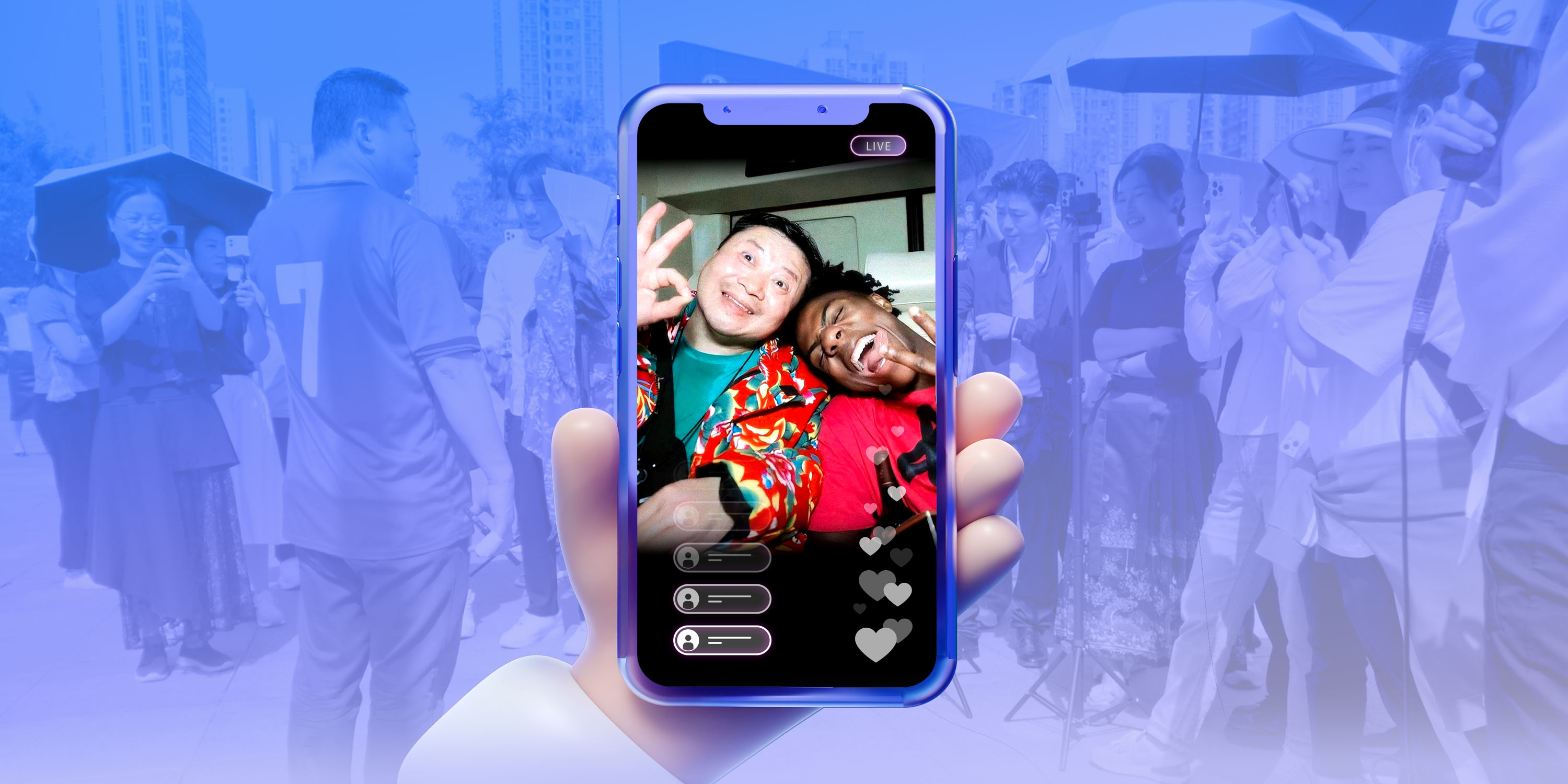
After the IShowSpeed Bump, Chongqing’s Uncle Goose Is Back Chasing Traffic
Editor’s note: In the age of the attention economy, social media has the power to change lives by propelling any ordinary Joe to celebrity status in an instant. But what happens when that 15 minutes of fame ends?
Sixth Tone is republishing five stories from “After the Spotlight Fades,” a 10-part series by The Paper that revisits people and places in China whose fortunes were transformed — sometimes only briefly — by viral fame.
It’s already 10 in the morning when Lin Jiang — better known as “Uncle Goose” — arrives at his deli in China’s southwestern megacity of Chongqing for our interview. His eyes are bloodshot, the result of livestreaming until the early hours the night before.
Lin has been a content creator since 2019, but the 50-year-old hit the big time in early 2025 when he appeared at several stops on American YouTube star IShowSpeed’s China tour brandishing a Rongchang braised goose.
For the next month, Chongqing’s once-obscure Rongchang District was a major trending topic, with related social media posts generating 60 billion views across various platforms, up by almost 5,000% year on year. Subscribers to Lin’s channel on Douyin, the Chinese version of TikTok, surged above 1 million.
However, by this spring, the tourist wave that followed Lin’s antics had tailed off dramatically. “Last year’s May Day holiday was insane — the streets were packed with cars from all over the country,” says a local ride-hailing driver. “But that peak has passed.”
Many of the 600 or so braised goose stores that opened to capitalize on Rongchang’s sudden popularity have already closed.
Viewers to Lin’s channel have plummeted, too, but he hasn’t given up on recapturing the fame he enjoyed just 12 months ago. In June, he launched his own braised goose brand — unsurprisingly called Uncle Goose — and now operates outlets in Chongqing’s Rongchang and Beibei districts, Leshan in neighboring Sichuan province, and Shanghai.
“Of course, I’d like to be a bit more popular than I am right now,” Lin says.
During the Chinese New Year holiday, his Rongchang store remained open throughout, welcoming a steady stream of tourists who had made the trip just to see him. He also continued to livestream every night, often well past midnight, snacking on braised goose and chatting with viewers, which helped secure several bulk orders.
Although Lin’s numbers are down compared with last year, it’s a lot better than when he started in 2019. Back then, his live room was usually dead. He only began gaining traction the following year when he switched to “hijack marketing,” making uninvited appearances at events organized by other influencers across the country. In just two days, he added 6,000 subscribers.
“That kind of growth is highly motivating for any content creator,” says Lin, who used to run a store selling agricultural products. “Physical outlets need online traffic. I felt that if I could figure out how social media works, I could use it to support my offline interests.”
Lin continued to chase new trends, traveling to more than a dozen cities in one year to follow big-name influencers. Along the way, he studied the mechanics of online traffic — which content tended to trend, which visuals grabbed attention, and which kind of language struck an emotional chord.
Rongchang’s culture and tourism administration had the same idea, and in 2023 began organizing events and meetings for local content creators to brainstorm ways to help the district go viral.
“I really thought about what other places had done,” says Lin, who took part in several of these government-led sessions. “When the moment comes, you have to be ready. You need to know exactly what product to showcase, what to say, and how to react on screen.”
In 2025, he finally spotted the perfect opportunity. IShowSpeed, one of the world’s most influential online streamers, was embarking on a food tour of China.
Produce the goose
Lin first approached the American influencer during his public appearance in Chengdu, the Sichuan capital. Dressed in an eye-catching red, floral-print jacket, Lin squeezed between two security guards and handed IShowSpeed a cooked goose in a plastic bag, shouting, “Rongchang braised goose — the world’s braised goose!”
He says he decided to use this hometown favorite because it’s “hearty, tastes great hot or cold, travels well, and really pops on screen.”
Lin repeated the stunt at IShowSpeed events in the cities of Changsha, Chongqing, Shenzhen, as well as Hong Kong.
The subsequent media coverage sent feathers flying in the braised goose market. Sales of the delicacy in Rongchang hit 10 million units last year, up from 3 million in 2024. Other local businesses also enjoyed a surge in demand, as 28 million tourists began flooding in, a near 50% increase from the previous year.
To ride the wave, the district government worked with more than 100 influencers to create short videos showcasing local attractions and intangible cultural heritage. Scenic spots witnessed a 743% boom in visitor numbers.
Rongchang’s culture and tourism channel on Douyin went from 50,000 followers to more than 190,000, ranking it No. 1 among the districts and counties across Chongqing.
Looking back, Lin can see it was a period of wins and losses for him. “There were too many events. They drained my time and energy, and I was exhausted,” he says. “My content suffered — I didn’t have enough time to plan or make it, which is why I lost followers. I was also slow in opening physical stores.”
Ye Peng, founder of the long-established Auntie Goose chain, was quicker off the mark. As soon as he saw the footage of Lin with IShowSpeed in Chengdu, he called to offer financial support for Lin’s burgeoning brand. “It was the golden time,” Ye recalls. “If you could produce the goose, it was going to sell.”
Lin opened his first Uncle Goose outlet in May, with lines of people spilling into the street. At its peak, it was selling 1,000 units a day. But it didn’t last. By the weeklong National Day holiday in October, the tourist crowds had thinned and the influx of new braised goose businesses had sparked a price war.
Ye has attempted to stand out in the market by selling meat from geese slaughtered after 150 days, rather than the usual 90 to 120 days, which is said to produce firmer, more flavorful meat. He has also called for more professional support with content creation, adding, “The influencer training sessions organized by the government are great in theory, but when it comes to putting things into practice, no one really knows where to start.”
The district’s commerce commission has recently unveiled plans to build an umbrella brand for Rongchang braised goose, with licensed products subject to tiered management and a dual certification system, and is helping local businesses partner with supermarket networks to expand offline sales channels.
Rise and fall
Huang’er Chicken Soup Noodles, which has been running for 20 years, was among the many non-goose-related businesses to benefit from the Rongchang craze last year. At one point, the line of waiting customers stretched the entire street, forcing owner Huang Zujun to extend the opening hours.
“The craziness has passed, but business is still a little better than it was before we got famous,” she says.
Li Xinyue at the Rongchang Investment Promotion Bureau also feels that the exposure has opened doors to fresh investment. Last spring, the bureau launched a channel on Douyin and quickly amassed more than 20,000 subscribers. “Many businesses that had never heard of Rongchang before began contacting us,” Li says, adding that interest in a 2025 investment conference was so strong that attendance had to be capped at 200 companies.
Meanwhile, Zhang Zhixiu, deputy director of the Rongchang Culture and Tourism Administration, says the viral attention has pushed authorities to accelerate upgrades to local infrastructure and services.
“We aren’t just waiting for our next celebrity. Instead, we’re shifting focus to high-quality products and genuine experiences,” he explains, adding that the goal is to turn first-time buyers into repeat customers.
However, evidence suggests there is much work to do. On a cool weekday in March, most stores along Rongchang’s once-buzzing commercial strip known as Xiabu Town were still shuttered at noon.
“Traffic always fades eventually,” Lin says, with an air of resignation. “Since I first began creating content, I’ve seen plenty of influencers rise and fall. I’ve learned to stay grounded.”
His schedule today still revolves around algorithms. He makes sure to engage with trending topics and organizes charity events to stimulate interest, knowing that waves often start from a ripple. “But if there’s no solid response plan or policy in the event of going viral, it’s very hard to sustain momentum,” Lin says.
On the exterior wall of the Uncle Goose store in Rongchang is a mural of Lin with IShowSpeed, a reminder of that fateful first meeting. Yet the man himself is moving on. As soon as our interview ends, Lin rushes out to catch a train to Chengdu — another influencer event, another opportunity to drive online traffic.
“The more buzz this place gets, the more vitality and hope there is,” he says, with a flash of excitement in his eyes. “If everyone comes here, ordinary people can make a better living, right?”
Reported by Diao Fanchao.
A version of this article originally appeared in The Paper. It has been translated and edited for brevity and clarity, and is republished here with permission.
Translator: Chen Yue; editors: Wang Juyi and Hao Qibao.
(Header image: Visuals from Lin Jiang, Lü Xiao, and VCG, reedited by Sixth Tone)