1 in 2,000: The Long Odds of Becoming a Pro Gamer in China
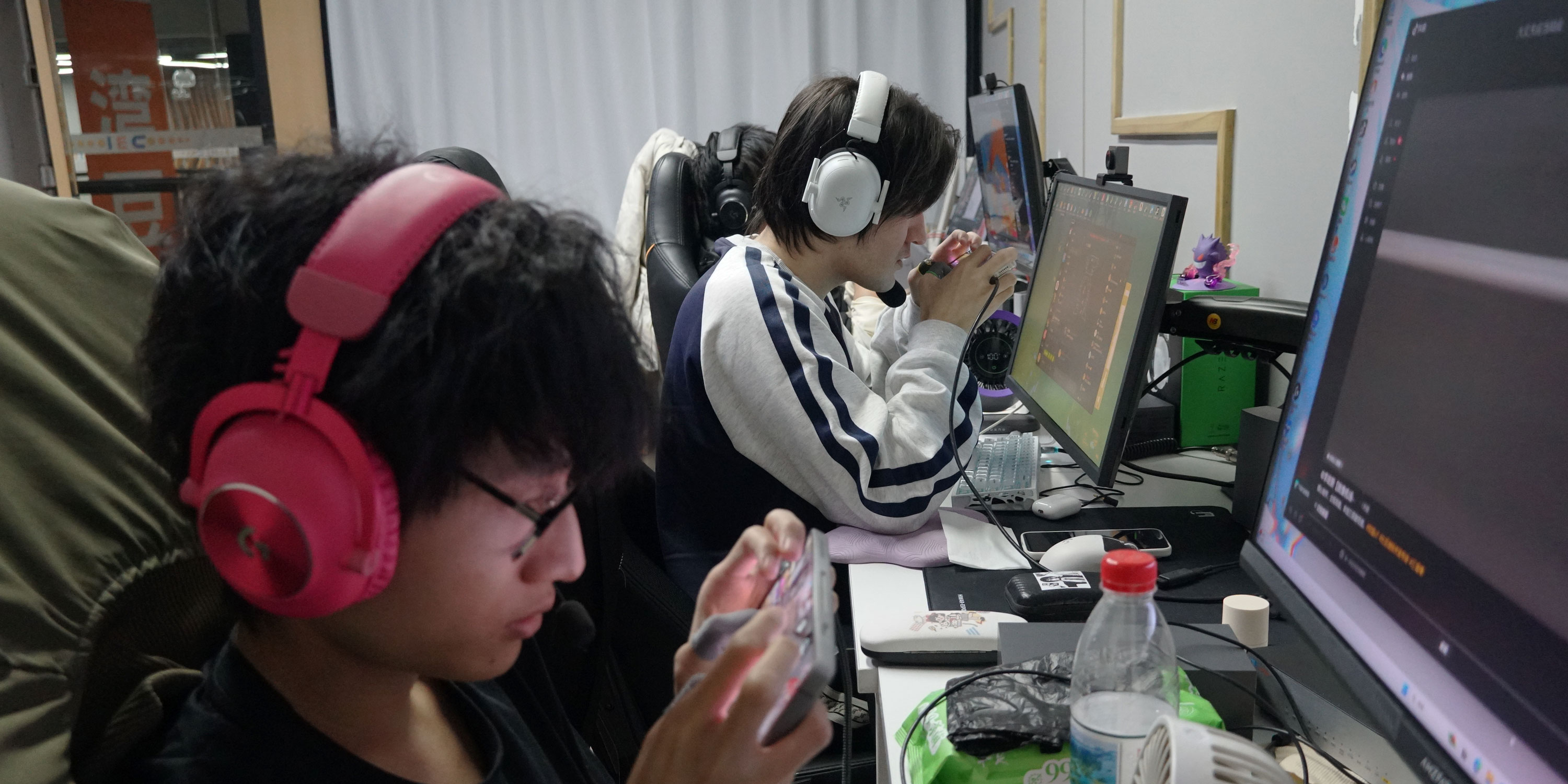
ZHEJIANG, East China — Inside Wei Yuan’s training center in a Hangzhou esports complex, players sit shoulder to shoulder beneath strip lights, thumbs flicking across phone screens in finger sleeves as coaches pace behind them. Slogans on the walls urge students to train like Olympic champions.
Yet much of Wei’s job involves showing would-be pro gamers just how far they are from making it. In his office, banners from grateful parents thank him for helping their children give up gaming.
When teenagers arrive, Wei starts with a paid assessment: reaction-speed tests, in-game observation, and, in some cases, sessions with a psychologist. For those still convinced they have what it takes, he arranges scrimmages against trained players, letting the result speak for itself.
“The key isn’t us convincing them to quit,” Wei tells Sixth Tone. “It’s letting them see the gap for themselves. That’s more convincing than anything we could say.”
At 24, older than many active pro players in China, Wei knows that gap from the inside. He entered the scene in 2017, when money was pouring in and clubs were expanding fast.
By the time his own shot at a professional career began to fade in 2021, the industry that had pulled him in was already harder to survive in. Investment was thinning, weaker clubs were struggling, and anti-addiction rules had made the old path into esports far more difficult for minors.
Moving behind the scenes was one way to stay in esports. “I receive roughly 400 inquiries a week,” Wei says, “but only about 0.5% qualify for offline testing, and only around one in 10 of those goes on to receive further training.” That works out to roughly one in 2,000.
Wei understands the odds now. At their age, he believed he could beat them.
First shot
By 15, Wei Yuan’s parents had already labeled him “a future delinquent.” He had dropped out of school two years earlier and spent most of his time playing Game for Peace — Tencent’s licensed Chinese adaptation of battle royale shooter PUBG Mobile — a habit that only confirmed their worst fears.
So when an esports club invited him to an offline trial in Shanghai in 2017, his parents said it was a scam, smashed his phone, and locked him in the house. Wei got out anyway, slipped away with 200 yuan ($29) in his pocket, and boarded a train to Shanghai alone.
He failed the tryout and returned home to his village in the eastern Jiangsu province. “When I got back, my parents sent me to work on a factory assembly line,” he says.
Looking back, Wei describes his younger self as “a hedgehog” — hard on the outside, fragile underneath. “At that time, gaming was the only place where I felt seen,” he says.
He eventually climbed into the game’s top 20, only to be accused of cheating. Going pro, he felt, was the only way to prove to his parents — and to himself — that he was not a lost cause.
Two months after returning from Shanghai, he spent his factory wages on a new phone and went all in again. Before long, he had pushed his kill-death ratio to 20-to-1, enough to catch the attention of another team.
Wei entered esports at what he calls “a lucky moment” in 2017. Clubs were expanding fast, professional leagues were taking shape, and for teenagers like him, going pro no longer felt impossible.
“I think we were actually a very fortunate generation,” he says. “Players before us had to compete in internet cafés. We had professional clubs, proper training facilities, and formal competitions.”
By 2019, Wei had played his way onto one of the 100 teams that qualified for the inaugural Peacekeeper Elite League, Tencent’s top professional competition for Game for Peace. With millions of yuan in prize money on offer, the tournament showed how quickly the industry was professionalizing.
For Wei, it was the first time he had flown — to Xi’an, capital of the northwestern Shaanxi province — taken professional publicity photos, or competed in a large arena. He even printed his target transfer price — 850,000 yuan — on his clothes.
Crash course
But Wei had aimed too high. In Xi’an, his team fell short by a single point and was eliminated in the breakout stage.
Soon after, his club disbanded, and no other team was willing to meet the transfer price he had set for himself. Rather than lower it, Wei walked away from Game for Peace and switched to Call of Duty: Mobile, then a newer international title on the rise.
“I was too young and impulsive,” he says. “My former teammates in Game for Peace went on to win championships. I didn’t.”
Fan Chenhui, 27, head coach of Ultra Prime Esports in China’s top League of Legends circuit, says the investment wave inflated salaries and warped the market. Star players, he says, were earning tens of millions of yuan — nearly 10 times what top players make today.
“Overnight, someone who used to earn 2,000 yuan a month could suddenly make millions a year,” Fan says. The boom years, he adds, left behind distorted values, unhealthy training systems, and a market driven too heavily by profit.
Many clubs had expanded fast on sponsorships, streaming deals, and investor appetite, but never built durable revenue streams of their own. As the hype cooled, salaries and budgets tightened, and some were left scrambling to survive — turning to merchandise, personal branding, events, or training programs to stay afloat.
At Ultra Prime, Fan says, one star on a top team can earn more than his entire roster combined. In 2024, his team came within one win of the playoffs before two players cracked in a pivotal match.
“The moment they walked into the break room, they burst into tears,” he says. The losing streak that followed stretched to nearly 10 matches, neither player appeared in competition again, and the club cut back investment further. “If we had won that match,” Fan says, “things could have been completely different.”
Wei had already learned how quickly a career could stall. After competing from 2019 to 2023 without winning a championship, he began looking for another way to stay in esports. “I never won a championship,” he says. “That’s something I really regret.”
He moved into training, putting young players through the kind of high-pressure regimen that once drew him in — at first to scout talent and later to show others they were not suited to the industry at all.
Cut off
Then, in 2021, China introduced some of the world’s strictest limits on gaming.
Framed by the government as a response to a growing public health problem among children, the rules limited under-18s to one hour of gaming from 8 to 9 p.m. on Fridays, Saturdays, Sundays, and official holidays. Major professional leagues then raised the minimum age for players to 18.
Despite loopholes, China had about 40 million fewer young gamers almost a year after the policy took effect than it had in 2020. The restrictions also cut straight into esports, which had long depended on teenagers starting young.
“The immediate impact on competition was limited, as most players were already over 18,” says Fan, who had begun coaching by then. “The real impact was felt in youth training.”
Programs that once recruited players at 14 or 15 were thrown off course, stretching development timelines and raising the cost of training talent.
“It’s difficult for clubs to maintain players at their peak as they get older,” Wei says. “Their reactions and mechanics can decline.” Many teams, he adds, now recruit newcomers only after 17.
And though parents are more accepting of esports than they once were, Fan says they are far less willing to let older teenagers abandon school for gaming. “If someone is still in school at 18 or 19, it’s very difficult for families to agree to let them pursue esports,” he says.
For the same reason, he no longer encourages teenagers to leave school for gaming. He believes it is too difficult to quickly tell who is truly suited to a professional career, whereas education leaves more doors open.
Today, more than five years after the policy change, both Wei and Fan say it has become harder to cultivate top players at all. In China’s top League of Legends league, Fan says, many players are now 20 or 21 — an age that once would have been considered close to retirement.
Even Wei, who had already moved behind the scenes, was invited back into competition in 2021 by a Baidu-backed Call of Duty: Mobile team.
“It was a surprise for me,” he says. “But actually unfair to other players.”
Second life
One of those players was Zulipkar Kasmujan, a 16-year-old from northwestern China’s Xinjiang Uyghur Autonomous Region, who had only just begun his professional career.
Kasmujan had only recently joined a Shanghai-based Call of Duty: Mobile team when it traveled to an offline tournament in the southern tech hub of Shenzhen, his first in-person event with the club. If they won, his boss told him, he would get the starting sniper role.
They did. But the next day, new limits on under-18 gamers took effect, and Kasmujan was told he could no longer compete professionally.
“I was completely confused,” he tells Sixth Tone. “We had just won a championship. Why couldn’t I play?”
The other 16-year-olds were sent home. Kasmujan stayed. “My home was too far away,” he says. The club agreed to keep him until he turned 18, covering his food and housing and giving him 1,500 yuan a month.
For the next two years, he worked part time as a waiter and took occasional paid gaming gigs while he waited to compete again. “I didn’t know what the esports scene would look like in two years,” he says. “I didn’t know anything. I could only take a gamble.”
Before gaming, Kasmujan had wanted to become a professional soccer player and join the national team. He trained almost every day until a pain in his chest sent him to a doctor, who told him he had a small hole in his heart and that intense exercise could be dangerous. “It freaked me out,” he says. “So I stayed at home after that.”
Gaming filled the space soccer left behind. He started with Game for Peace, then moved to Call of Duty: Mobile, drawn by what he describes as its richer mechanics. “Real life felt too hard,” he says. “In the virtual world, I felt better.”
When the Shanghai club invited him for a trial, he went without hesitation. Like Wei before him, he set out alone with little idea of what would happen next. His mother bought him a one-way train ticket, and the 4,000-kilometer journey took two days. He left with little more than a T-shirt and a charger in his bag and, he says, “never thought about how I would get back.”
He turned 18 in 2023 and finally made his professional debut. During the match, the pain in his chest came back. “Maybe I was too nervous, shouting too loudly,” he says. “I felt terrible, like I was going to faint — or even die.” He asked the referee for a break. Since then, he says, he has tried to keep his emotions under control.
Wei knows that feeling well. “In some of the teenagers who come through the center,” he says, “I see myself: outbursts during matches, anger at teammates, and little structure in daily life beyond the game.”
By the time Kasmujan finally returned to professional esports, the job was testing him from every side. On one former team, wages were paid only once every two months. The club refused to raise his salary and was lax in training.
“I didn’t even feel like playing anymore,” he says. “I wanted to retire. It felt meaningless — earning a small salary each month, wasting my life.”
He is still in the game. His current deal at Stand Point Gaming (SPG) runs for three years. “My base salary is around 4,000 yuan a month, with bonuses tied to results,” he says. “The most I’ve ever made in this industry is around 6,000 yuan.”
At his center, Wei now sees that pressure from the other side. The facility is designated by the Zhejiang Game Industry Association as a gaming addiction prevention base, and some teenagers arrive carrying more than competitive ambition.
“A lot of them are dealing with psychological struggles,” Wei says. “They turn to games for a sense of achievement and gradually lose interest in school. What we want is to guide them back.”
But the center still sends some on. Over the past five years, he says, his center has also trained more than 100 professional players. “Without esports, I’d probably still be in a factory tightening screws,” he says. “But this industry has given me a lot — a car, a house, a good reputation. Seeing the players we’ve trained come back to thank us makes me genuinely proud.”
Kasmujan is still trying to make the same gamble pay off. In a regular-season match this March, he set a new season record for kills in a single game. “I want to find that passion again,” he says. “And change everything.”
He has not been home in five years, spending every Spring Festival alone. His parents are divorced, and his mother has started a new family.
Going back, he says, would mean returning with nothing. “I’d have to ask for food if I went back,” he says. “I have to succeed. I don’t have a way back.”
Additional reporting: Lü Xiao; editor: Apurva.
(Header image: Zulipkar Kasmujan (center) and his teammates practice at an esports training center, Hangzhou, Zhejiang province, March 2026. He Qitong/Sixth Tone)