How a Buddha Got Its Sight Back
In Buddhist art, Buddhābhiseka refers to the ritual consecration of an image or sculpture — the moment it becomes more than just an object.
Although the ritual can take different forms, one of the most common in China is the addition of eyes. Known as kaiguang, literally “opening the light,” it symbolizes the figure’s awakening. Before the eyes are in place, the Buddha is considered inert. Only afterward do believers see it as possessing spiritual power.
Carved into sandstone cliffs near the modern-day northern city of Datong during the Northern Wei dynasty (386–534), the Yungang Grottoes offer an awe-inspiring look into the influence Buddhism once held in China. Consisting of thousands of Buddhas ranging from the small to the monumental, the grottoes’ beauty — and their appearance in popular media like 2024’s Black Myth: Wukong — continue to draw believers and tourists to this day.
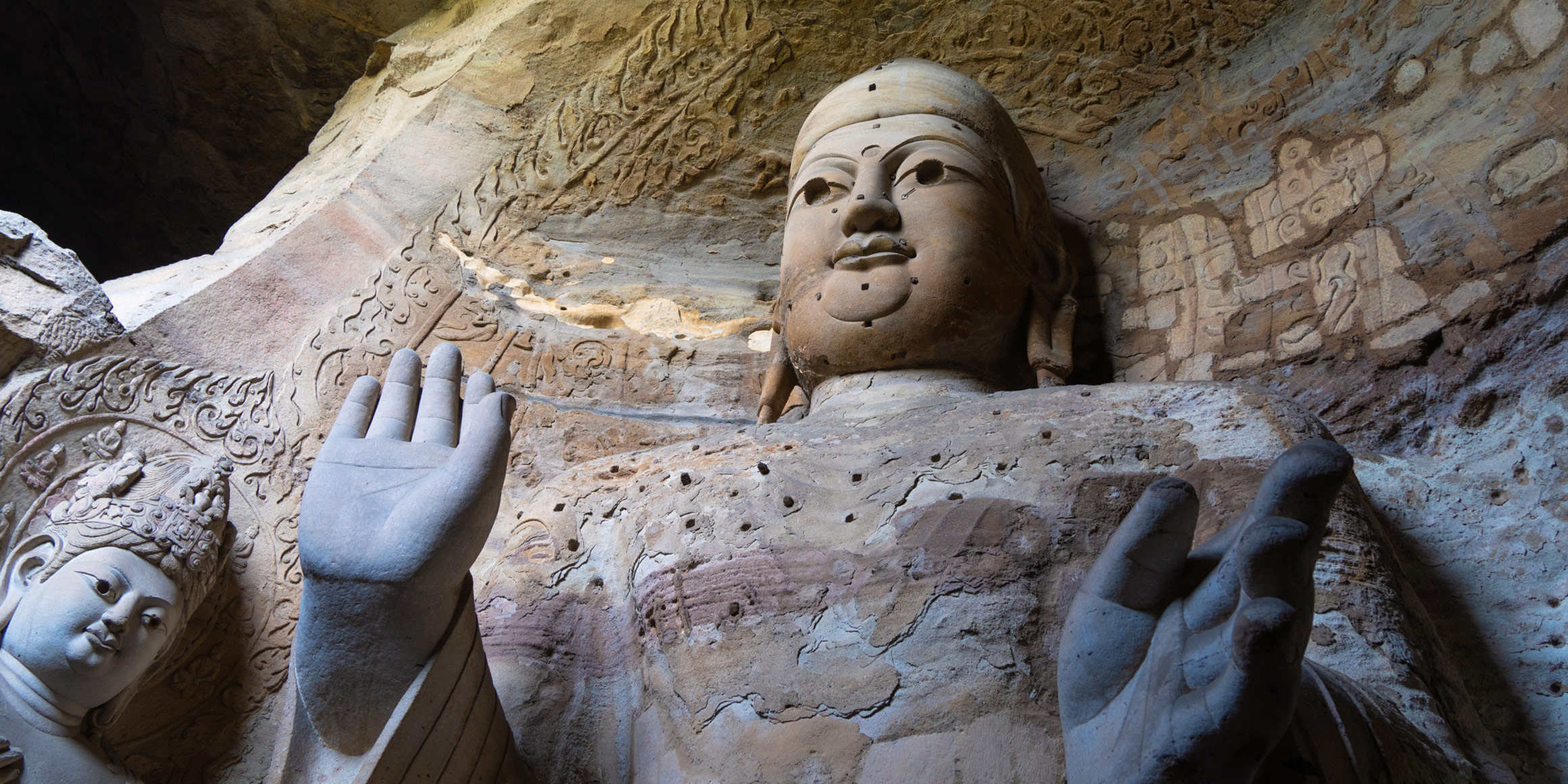
Yet visitors who look closely will find something unsettling: A large number of Yungang’s Buddhas now stare back with hollowed-out eyes.
The small circular cavities visible on their faces once held inlaid ceramic or glass pupils. These were fixed in place using a technique known as qianmu, in which the eyes were inserted into carved sockets. Over the centuries, as Yungang’s soft sandstone yielded to wind and rain, and later to war and theft, these fragile elements loosened, slipped free, and vanished.
Much about these inlaid eyes remains unknown. The chaos of the 19th and early 20th centuries left the Yungang Grottoes in severe disrepair, with some caves even repurposed as dwellings and stables. Once a symbol of imperial and religious power, Yungang’s eyes are now obscured by the dust of history. How many once existed, how many were lost, and how many may still survive are all unknowns.
Now, however, some have begun to make their way back. In 2006, Tian Yijun, a resident of the nearby city of Taiyuan, was on a business trip when he stopped at a flea market near Datong Stadium, where vendors sold calligraphy, paintings, and other curios. Among the clutter, a small ceramic object caught his eye. Half-spherical in shape, with a patch of black glaze clinging to one side, it looked, he later recalled, “a bit like a mushroom.”
Neither the vendor nor Tian knew what it was. Still, drawn by curiosity and his fondness for ceramics, he decided to buy it. It remained in his collection for two decades, until, while reading about the Yungang Grottoes’ missing eyes, Tian felt a jolt of recognition. A photograph in one of the articles looked strikingly similar to the object in his collection.
Tian contacted the Yungang Research Institute and asked them to assess the object. After an initial on-site assessment at Tian’s home and further study at Yungang, the ceramic object was confirmed to be a missing Buddha eye. Once he knew what he had, Tian didn’t hesitate: He donated the eye, without compensation, back to the Yungang Grottoes.
The return of Buddha eyes to Yungang is not without precedent. In 1932, the American art historian and sinologist Laurence Sickman visited the grottoes while in China on a fellowship from the newly established Harvard-Yenching Institute. At the time, he also served as an acquisitions agent for American museums. Despite strict anti-looting regulations, Sickman managed to purchase a single ceramic eyeball from local villagers for one silver dollar.
More than half a century later, Sickman, by then a retired director of the Nelson-Atkins Museum of Art in Kansas City, expressed a wish to see the eye returned to China. In the spring of 1985, the archaeologist Su Bai wrote to Lü Jimin, then head of the Cultural Relics Bureau under China’s Ministry of Culture, conveying Sickman’s desire and proposing that the eye be transferred to Yungang for preservation. The two sides worked together to facilitate the artifact’s return, and Sickman’s purchase remains the largest ceramic eyeball in the Yungang Grottoes Museum’s collection.
Today, in addition to Tian’s, six Buddha eyes are held in the collection at the Yungang Grottoes. They include Sickman’s, another recovered during archaeological excavations in the early 1990s, and four obtained through public donations. Others remain abroad. Two eyes from Yungang’s famous Cave 8, collected in the late 1930s and ’40s while much of China was under Imperial Japanese occupation, are housed at the Institute for Research in Humanities, Kyoto University.
Many more may be hiding in plain sight. In Tian’s case, neither the vendor nor Tian recognized what they had. Ordinary in appearance and seemingly without practical use, the lost eyes are always at risk of being discarded or destroyed. In place, they are a vivid reminder of the Buddha’s presence. But once separated from their original settings, their paths become impossible to predict.
From this perspective, the story of Tian’s eye feels almost miraculous. It was only because he chose to look twice, and then to act, that it found its way home. Tian describes his approach to collecting with four words: “authentic, refined, rare, and unusual.” He often repeats a simple saying: “What others take, I leave behind. What others discard, I take.” It was this instinct, he said, that led him to bring home an object he could not immediately identify — and which ultimately set the Buddha eye on its way back to Yungang.
When visiting Chinese collections in museums abroad, Tian tells me he often feels a mix of emotions. There is regret over the way many cultural artifacts left China due to war, social instability, or looting. But there is also a sense of reconciliation. What matters, he says, is that these objects survive, and that they can still be seen.
For Tian, the repatriation of cultural artifacts is about national ownership as well as restoring the past. Because these objects are irreplaceable carriers of cultural meaning, he believes that even small acts of recovery are important. At the same time, he emphasizes that it should ultimately remain a matter of individual choice.
As such, to return a Buddha eye is more than just a material gift. It is a gesture. In the face of erosion by elements both natural and human, every lost piece that finds its way home represents a small victory against time.
Each eye’s homecoming allows a Buddha, in a sense, to see again. It completes not only a physical restoration, but also a restoration of relationships: between past and present, an object and its creation, and a people and their history.
Portrait artist: Wang Zhenhao.
(Header image: Buddha statues with hollowed-out eyes in the Yungang Grottoes, Datong, Shanxi province, 2025. Liu Fan/VCG)