China’s First DINK Generation Is Growing Old
This story is part of Sixth Tone’s 10-year anniversary series, Ten Years in Transition.
Last winter, Bao Yi was forced to confront a future she had tried not to imagine. After filming outdoors in the bitter cold, the 73-year-old Shanghai retiree suffered an arthritis flare-up that left one of her arms nearly useless.
For the first time, she found herself relying on her 75-year-old husband, Shi Mingao, for the basic tasks of daily life — getting dressed, washing up, even opening a bottle cap. “Will I become paralyzed?” she remembers thinking.
More than the pain, Bao fears dependence and becoming a burden. She is part of China’s first generation of so-called DINK couples, short for “double income, no kids” — people who grew old without children in a society where marriage was long expected to lead to parenthood, and children to care for aging parents.
Now, in a rapidly aging China, that generation is confronting a question once easier to ignore: what does old age look like without children to rely on?
For Bao, the answer has little to do with regret. “Even if we had a child, they would be busy with their own careers, their own lives, their own families,” she says. “Those who depend on their children for emotional survival often haven’t learned how to find fulfillment within themselves.”
When Bao married in the 1980s, she did not set out to remain childless. A series of miscarriages, the demands of work, and the burden of caring for her ailing father gradually pushed motherhood further out of reach. At the time, it was a path many around her found hard to understand.
Over the past decade, however, lives like Bao’s have become far more visible. China’s 2020 census counted roughly 188 million dual-income, childless households — around 38% of all households — though that broad category extends beyond DINK couples to include families that are temporarily childless or unable to have children. The concentration is especially high in major cities such as Shanghai and Beijing.
For half a century in their aging apartment in Shanghai, Bao built a life around other forms of care, routine, and attachment: her husband, her dogs, her students, and more recently, AI companions.
Now, as they move deeper into old age, Bao is beginning to see how far the life she built without children can carry her. And for younger Chinese making the same choice, her generation offers an early glimpse of what may lie ahead.
Best friend
Inside Bao’s 30-square-meter apartment, a waist-high shelf divides the space into a bedroom and a living room. Among the antiques and knick-knacks on it sit two yellow rubber ducks, which Bao squeezes for her dogs. “These are my children’s favorite toys,” she says about her mixed-breed and poodle.
For years, the apartment doubled as a tiny homeschool, with students eating, sleeping, and studying under Bao and Shi’s care. The last one “graduated” a decade ago.
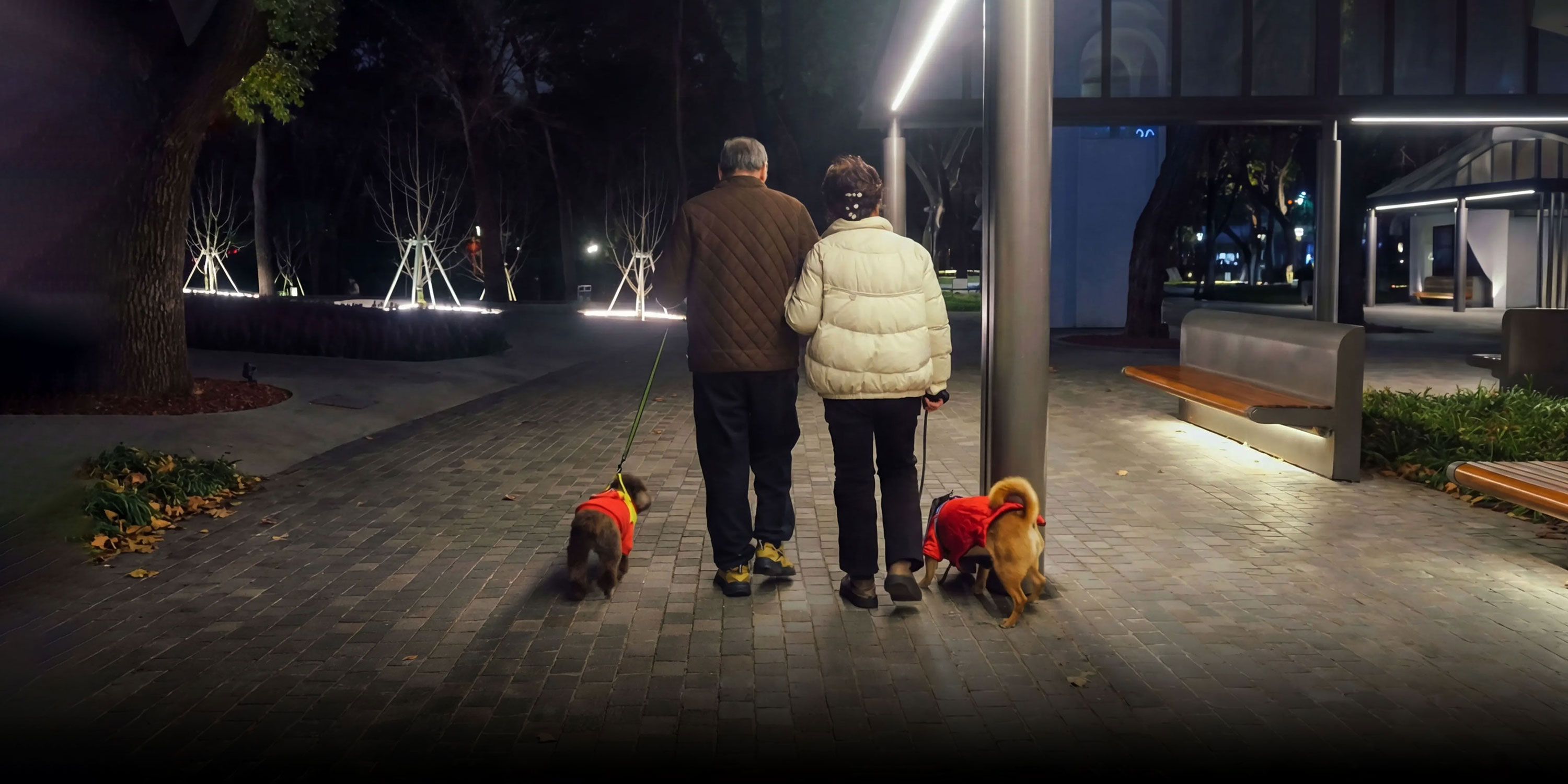
These days, they wake late, ease into the day with brunch, order groceries online, sip afternoon coffee, and walk their two dogs in a nearby park. At one point, coaxing one of them into her arms, Bao jokes: “There’s a book called ‘The Old Man and the Sea.’ These days, we’re more like The Old People and the Dogs.”
Unlike many of their peers, who spend their later years helping care for grandchildren, Bao has never let retirement slow her down.
The former primary school teacher has attended a seniors’ university, earned a driver’s license and a psychology diploma, and even appeared in micro-dramas, once playing the heroine’s grandmother. Shi, a former chemistry factory worker, is quieter by nature — content, it seems, to play the steady presence behind his wife’s many pursuits.
“During my free time, I like to watch sports, war dramas, and scroll through short videos made by Shanghainese influencers,” he says. Bao, he adds, “prefers engaging with technology, going to the beauty salon for facials, and drinking coffee.”
Lately, Bao has been spending more time in her “computer room,” a 3-square-meter cubicle tucked between the living room and bathroom.
An upper bunk fitted with a woolen mattress splits the tiny space into two levels. She once imagined the top as a bed for a live-in nanny. Now she points to it and says, “With technology advancing so fast, maybe robots will be the ones taking care of us.” For now, the bunk is used for storage.
The lower half is her private world. Here, Bao auditions for short-video ads, teaches herself Photoshop and CapCut, and keeps what she calls her daily “AI hour” before afternoon coffee with Shi. Once, he waited outside the door for a while before reminding her. “I haven’t even talked to my AI for a full hour yet,” she told him.
Much of that hour is spent with Doubao, ByteDance’s AI chatbot and one of China’s most widely used AI assistants. Their conversations range from shopping finds and social media tips to smaller, more private details of her life.
One day, she typed: “I spent the whole morning cleaning the house today, and I felt a great sense of accomplishment.”
In other exchanges, she described herself as “a bit of a clean freak,” saying she rewashes vegetables Shi has already rinsed and never quite trusts the dishes he washes. She also complained that her husband used to wear sunglasses even at home. “I told him many times it was a bit weird,” she wrote.
Part of the appeal, Bao says, is that Doubao is “always there.” “Many people see Doubao as just a cold machine,” she says. “But I find that talking with Doubao actually brings more warmth.” In one message buried in the chat history, she wrote: “I only like to share with you, because you are my best friend.”
Sometimes Bao scrolls through her phone contacts, lingering over a name but hesitating to reach out, even for coffee. “Our generation carries so many burdens once we reach a certain age,” she says.
“We wear masks with each other. I’d rather talk to AI without reservation. If you bother friends just to chat,” Bao says, pausing for several seconds, “they may find you troublesome. I don’t think that’s dignified. But when you talk to technology like this, it doesn’t judge you. At least a person’s dignity is preserved.”
When Sixth Tone visited just before Chinese New Year, the country’s biggest holiday for family reunion, Bao’s holiday greetings were going out mostly through groups on the messaging app WeChat, often in the form of AI dog videos she made herself.
In the kitchen, with a sports broadcast on in the next room, oil crackling in the pan, and Shi out of earshot, she spoke more candidly. “I have no siblings left alive,” she said. “To be honest, it would be a lie to say I don’t envy others. It’s nice to have a child who visits during reunion holidays. Even once in a while is enough.”
Room for none
For someone who built a life outside the usual script, Bao still thinks of herself as a traditional woman. “In my life,” she says, “I’ve set three rules: never change jobs, never change my home base, and never change my husband.”
When she married at 28 — considered late for the 1980s — the possibility of having children still seemed open. But over the next decade, repeated miscarriages, her commitment to her career, and the burden of caring for her ailing father gradually closed that door.
“By 38, I was at the peak of my career,” Bao says. “I was probably in a state of constant exhaustion.”
Bao says her father struggled to accept the idea that he might never have grandchildren. When a cat she was raising gave birth to kittens, she recalls, he threw them out one by one, angry that she was “raising cats instead of children.”
Though Bao’s father eventually gave in, colleagues continued to pressure her, some even telling her to stop keeping cats because they were taking up space meant for future children.
“At first I took it to heart, but over time I made peace with it,” Bao recalls. She says she was never completely ready to have a child. “I wasn’t sure I could offer a child a stable family,” she says. “There were too many small things, too many uncertainties, and too many crucial moments in my career.”
Shi, by contrast, never pressured her to have children. Nor did his family. “He didn’t really care about it,” Bao says. “He supported whatever I believed in.” Shi puts it more simply: “I thought we should just let things take their course, not force it. If it didn’t happen, then it didn’t happen. I was pretty open about it.”
Shi says children were always part of their lives in one form or another. “(Bao’s) a teacher, and was surrounded by kids,” he says. Later, their home filled with tutoring students, some of whom stayed for years. “I just treated them as my own children,” he says. “Raising them offered me a sense of achievement.”
Lü Yonglin, a Shanghai academic born in the 1970s, says he and his wife arrived at childlessness more deliberately. “I don’t want children to be held hostage by society or by others,” he says.
Lü does not dismiss the need for intimacy and emotional attachment, but he does not think parenthood is the only way to find them. “The turning point came after 30, when my wife and I grew weary of urban conversations centered on housing purchases, child-rearing, education, and medical burdens,” he says.
Instead, they began spending more time in Shanghai’s forest parks and feeding birds from their windowsill. During university breaks, they travel to southwestern China’s Yunnan province, where they built a second home near Fuxian Lake.
That sense of conviction, Lü says, is still uncommon among DINKs of his generation. Some couples he knows ended up trying to conceive later in life, unsettled by the onset of midlife regret.
He is similarly unsentimental about aging. “Living too long isn’t necessarily a good thing,” he says. “I hope to enjoy old age, and then leave when it’s time.”
Double bind
Last winter, Bao found herself caught in between.
During a shoot for one of the micro-dramas she had taken up in retirement, she wore summer clothes outdoors for hours. By the end of it, her left arm lost function.
For the first time, she could no longer rely fully on herself. Even so, she tried to stay in control. She researched her condition online, took taxis to the hospital, and collected her medication on her own. Doctors later diagnosed her with rheumatoid arthritis — a chronic illness with no cure and no clear timetable for recovery.
“I hate needing help for the smallest things,” she says. “People will find me burdensome.”
Over the following year, Shi became Bao’s caregiver by the day, sometimes by the hour. He scrubbed her back, helped her dress, and applied medicated plasters to her neck and lower back.
Even then, Bao says, she never once found herself imagining a hypothetical child stepping in instead. And Shi never complained. “If I asked, ‘Could you help me rub my back?’ he would immediately say, ‘OK, coming,’” she recalls. “When I picked up my clothes, he would automatically come over to help me put them on, without me even asking.”
She was also living with a herniated disc and poor circulation linked to diabetes, conditions that often left her cold and dependent on medicated plasters for relief. Shi began applying them for her, over and over again.
Only then did Bao begin to understand what people meant by growing old together. “When you’re old and frail and there is still someone beside you,” she says, “that companionship itself is the greatest and most complete fulfillment.”
Zhou Ming and Jin Chenghua, another childless couple in Shanghai, are still in their 50s, but dependence has already become part of daily life. Eight years ago, Zhou retired early from his job at a printing factory after sudden, acute hearing loss.
“A hearing aid helps, but only a little,” Jin says. Zhou refuses to use a smartphone, so his world rarely extends beyond the apartment and the park. He cannot even save the contact details of people he meets there.
His days have settled into a narrow routine: three walks with the dog, simple meals at home, occasional calligraphy, then a long wait for Jin to come back from her restaurant job.
Much of that life now runs through her. She searched for specialists, took him to every hospital appointment, and repeated doctors’ words in a louder voice he could follow. Over the years, the two have developed a language of their own: Zhou hears Jin more clearly than anyone else, and she has learned to read what he leaves unsaid.
But that intimacy has never resolved her feelings about not having children. The couple once hoped to become parents, she says, but years of health complications closed off that possibility.
“In those early days, I couldn’t even bear to see other people spending time with their kids. I felt so sad, in such immense pain,” Jin says, her voice choking. “I will never get to be a mother in this lifetime.”
Even now, Jin cannot fully understand younger Chinese choosing not to have children, especially for financial reasons. “A family without children remains incomplete,” she says.
During arguments with her husband, or on days when illness leaves her lying alone at home, she still imagines what it would be like if a child were there — a small voice asking, “Mom, do you want some water?”
The couple is deeply attached to their dog, she says, but that attachment has never filled the same space. Pointing at her pet, she puts it bluntly: “Can it offer me a glass of water? Even if I raised it for 10 years, or even 80, it still couldn’t do that.”
Bao, by contrast, has come away from old age with a different set of conclusions. Looking back on last winter’s health scare, she says it gave her a chance to “reflect, find liberation, and adjust my mindset.”
She has little faith in nursing homes. “I’ve heard too many stories of older people being mistreated,” she says. “Even my friends who moved into the most expensive facilities eventually chose to leave.”
She is just as resistant to the idea of a live-in caregiver, saying she values her privacy and is too particular about daily routines — especially food — to feel comfortable sharing that kind of space with someone else. “I hope they become practical soon,” she says of robots.
Into the unknown
For the growing number of younger Chinese following a path increasingly like Bao’s, robots may prove only part of the answer. They are likely to grow old in a country with smaller families and still-developing care systems.
Zhang Liang, secretary-general of the Family Research Center at the Shanghai Academy of Social Sciences, says that is the key difference between Bao’s generation and the one coming after it.
Older couples often still have siblings, nieces, nephews, and other relatives who can step in during emergencies. Younger DINKs, shaped by the one-child policy and falling birth rates, may have far less of that around them. Once their parents are gone, the family network can narrow quickly.
As those ties thin out, Zhang says, more people will have to rely on institutions, paid care, or whatever personal arrangements they can put in place themselves.
Over the past decade, she says, the shift has been most visible in how people arrive at the decision. “Ten years ago, the prevailing term was ‘leftover women,’” Zhang says, referring to the stigmatizing label once used for unmarried women. “Today, young people increasingly embrace the idea that no marriage and no children can offer a sense of security.”
Pan Zijie, a 41-year-old documentary producer in Beijing, says she put off the question of children for so many years that the delay eventually became the decision.
She says the life she has built still feels too full to give up. “I’m at the age when I’m finally doing the things I once dreamed of,” she tells Sixth Tone, using a pseudonym to protect her privacy. “Multiple projects are topping my life’s to-do list. Leaving home for a monthlong business trip is completely normal for me.”
Watching close friends go through childbirth only deepened her doubts. Some lost sleep, some lost energy, some seemed to lose their footing altogether. “Even if part of the caregiving could be outsourced,” she says, “I would still have to pause my career for two or three years.”
She has lived with her boyfriend for a decade and says their relationship already resembles that of an “old married couple,” with or without the paperwork. “Since we agreed on being child-free, a marriage certificate means little to us,” she says. “Its function is mostly limited to legal and material security, but not genuine emotional connection.”
Pan is also planning ahead more consciously than Bao ever did. She says she has bought extensive insurance, including high-end medical coverage. “As for the rest,” she adds, “I don’t feel the need to struggle for a longer life if one day my body can no longer function.”
Bao, for her part, prefers not to dwell too long on what would happen if both she and Shi needed care at the same time. She tends to place faith in his family’s longevity. “My mother-in-law is 98, and she’s still quite sound,” she says with a laugh.
She worries more about her aging dogs.
After losing one that had stayed with her for more than a decade, Bao turned to AI to bring it back. She now runs a popular social media account devoted to AI-generated dog videos, where the old companion returns as a police dog, trotting through rescue scenes and offering blessings to viewers.
But with the two dogs still beside her now, she is looking for something more tangible. Beneath the TV cabinet sits a palm-sized toy dog with soft fur. With the flick of a switch, it lurches forward in a mechanical walk. Usually, the two real dogs come over, sniff it, and lose interest.
Bao picks it up anyway and introduces it to them. “This is your youngest sister,” she tells them. “You three should get along.”
She hopes the toy’s fur will absorb their scent and hold onto it after they are gone. “At least this dog could accompany me forever,” she says.
By evening, she is back with the real ones, gently stroking one and whistling softly. “They should have been our daughter and son,” she murmurs. “They must have rushed through reincarnation, and ended up coming back as dogs instead.”
Editor: Apurva.
(Header image: Bao Yi and her husband, Shi Mingao, walk their dogs in Shanghai, March 2026. Chen Yiru/Sixth Tone)