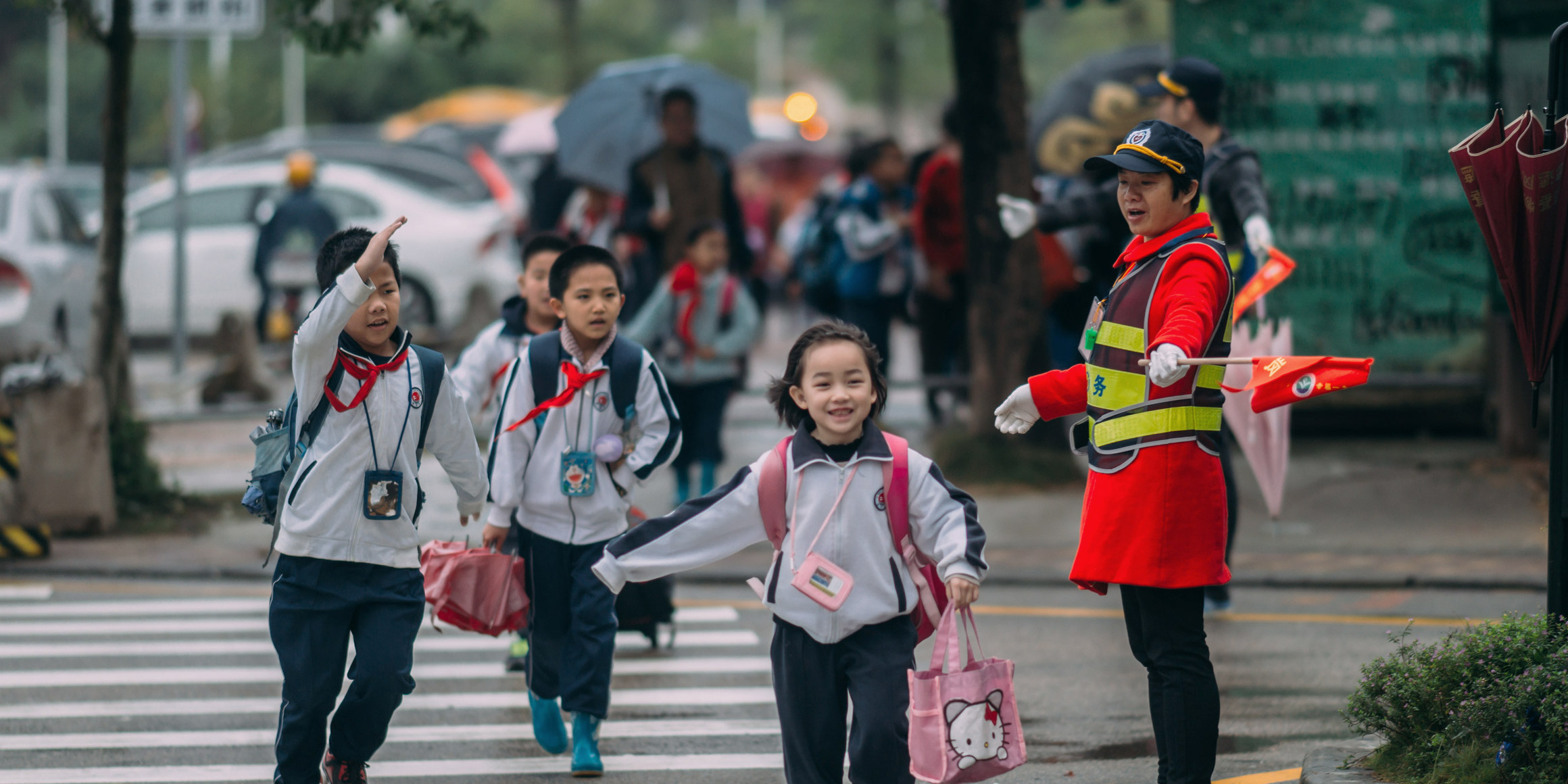
The Quiet Pressure of School Guard Duty in China
On a winter morning in 2023 in Changsha, capital of the central Hunan province, it was not yet 7 a.m. when Jia Mei bundled her 1-year-old in a stroller and set off on the 20-minute walk to her older child’s school. When she arrived, she collected the “School Guard” vest from the security kiosk and took her post on the pedestrian overpass outside the school gate. Her husband was supposed to be here, but work got in the way again. She was relieved that the baby didn’t cry in the biting wind.
Huxuegang — school guard duty — is a volunteer program established by the Chinese public security authorities to maintain safety around school campuses. During drop-off and pick-up times, guards help direct traffic and watch over students at kindergartens, primary schools, and middle schools. The team typically consists of police officers, school staff, and willing parents.
The word “willing” is where things get complicated.
Across China, parents say they feel coerced into a system that is technically voluntary. Teachers say they are already drowning in responsibilities that have little to do with teaching. And a debate that had simmered for years boiled over when a 45-year-old parent collapsed and died while standing guard outside a school gate.
On social media, a single question began circulating: Hasn’t this been abolished yet?
How it started
One of the original intentions behind establishing school guards was to ease congestion around school gates during peak hours. The model can be traced back to 2011, when a kindergarten in Ningbo, in the eastern Zhejiang province, pioneered a straightforward idea: parents’ vehicles would stop about 10 meters from the school gate, and parent volunteers would walk children safely inside.
This approach proved so effective that it was quickly adopted in primary and secondary schools throughout Ningbo, and the Ministry of Education later began promoting the “Ningbo Method” nationwide.
In 2015, the Ministry of Public Security and the Ministry of Education jointly issued formal guidelines incorporating school guards into national policy, explicitly encouraging schools to recruit community members, residents, parents, and volunteers to participate in joint prevention efforts. What began as a local experiment became a nationwide expectation.
The reasoning was grounded in reality. Mei Zhigang, an associate professor in the School of Sociology at Central China Normal University, explains that the system emerged as private car ownership in China surged — more than 15-fold over two decades, according to national statistics.
Pedestrian risk around schools rose with it. “The police are responsible for ensuring smooth traffic flow, and the pressure on them is enormous. It’s impossible for them to deploy unlimited manpower to every school gate,” Mei says.
From a policy-design standpoint, the school guard was meant to be genuinely voluntary, intended as community mutual aid.
Standing there, waiting
Now that Jia’s younger child has started kindergarten, her family’s school guard obligations have doubled. At her older child’s primary school, the homeroom teacher draws up the roster. Jia or a family member must arrive at the designated time, sign in, and take a photo as proof of attendance. The morning shift runs 40 minutes, and the afternoon shift runs 140. A second photograph is required at the end of each.
No training was provided. No safety briefing was given. “You just show up and stand there,” Jia says. What exactly she was supposed to do while stationed on the overpass was never spelled out. She assumed it meant “not letting kids linger and play up there.”
In practice, the children’s grandmother steps in to cover about half of Jia’s shifts.
When her youngest fell ill with a fever, Jia messaged the teacher to explain she couldn’t make her shift. Her husband was at work. Her mother-in-law was taking the older child to school. She had a sick baby to care for. The teacher’s response: swap shifts with another parent. When Jia explained that swapping would be difficult with two children, two schools, and overlapping drop-off and pick-up times, the teacher’s solution was to “make it up next time.”
Jia does not oppose the system in principle. What grates on her is the pretense of choice. “Traffic police and teachers are paid to stand guard, but parents on school guard duty may have to take unpaid leave from work to do it. There are even parents who pay people to stand in for them.”
On secondhand platforms, “stand-in school guard” listings appear from sellers across the country, with prices ranging from tens to hundreds of yuan per shift.
No real excuse to refuse
Yang Yun also feels the pressure of being unable to refuse school guard duties.
When her child entered kindergarten in 2024, she received a duty roster listing her child’s name. No one had consulted her or explained the purpose. The teacher posted the schedule in the group chat, and within minutes, the screen filled with a stream of identical “got it” responses.
When one parent said they couldn’t make their assigned day, the teacher asked them to find a way to “work it out,” suggesting they request leave in advance or coordinate with other parents to swap shifts. The message was polite. The expectation was clear.
Yang and her husband both work full time. Their elderly parents live with them but are too frail to stand a shift. Her husband usually takes the monthly 45-minute morning shift before heading to work. His post is inside the building, near a sink or a stairway corner. His job is to remind children to walk slowly and help them wash their hands.
“Most of the time, he just stands there,” Yang says. “Occasionally, a child he knows will say hello.”
She finds it hard to understand what the arrangement is meant to protect against. Her child’s kindergarten sits inside a residential compound already patrolled by security guards and police officers. The environment is safe enough, and in her opinion, there’s no need for parents to stand guard.
But she goes. The reason is not conviction, but social arithmetic. “It feels like there’s no real excuse to refuse. If you don’t go, the teacher might call and ask where you are, and that would be pretty embarrassing,” she says.
“If parents sign up to volunteer, then the class arranges school guard positions for them,” Professor Mei says. “If no one signs up, then that class simply doesn’t arrange them.” The problem, he acknowledges, is that implementation has rarely honored that principle. “If the execution becomes overly crude and coercive, that should be criticized.”
Yang sometimes channels her frustrations through the parents’ committee. In her experience, the committee tends to side with the school. She once considered filing a formal complaint with the local education department. Her husband discouraged her, worried that their child might be singled out.
It is difficult to trace exactly how this mindset takes root. But in the accounts of parent after parent, a common thread emerges: schools and teachers hold the dominant position and have grown accustomed to assigning tasks, while parents have grown accustomed to accepting them.
Sometimes those tasks extend well beyond child safety.
Shen Zhicheng, a father in the northwestern Gansu province, served briefly as a member of his child’s parents’ committee. The homeroom teacher asked committee members to take turns recording extracurricular homework scores for students in their group — every school night, for a full semester each. When Shen said he didn’t have time to continue, the teacher replied: “If you don’t do it this semester, you’ll have to take a turn next semester. If your child doesn’t participate, then you don’t have to participate either.”
Shen resigned from the committee. “It feels like the rules set by schools or teachers cannot be challenged,” he says.
Where the system works
Not every parent resents the arrangement. One parent from Zhejiang province believes the system is necessary. Morning drop-off coincides with rush hour, and she has observed unaccompanied children crossing the road at a red light or suddenly dashing across the street. When she takes her turn on school guard duty, she uses a sign to block vehicles near the school gate and guides children toward the sidewalk.
“It is useful for parents on guard duty to block drivers on scooters and prevent people from running red lights,” she says.
Hu Haoyu, a homeroom teacher at a middle school in Shanghai, describes a setup that appears to function as intended. The school gate opens directly onto a main road, with no crosswalk at that section. At present, during drop-off and pick-up times, four parents and one teacher are on guard duty, and traffic police are also present. The parents stand at the four corners of the sidewalk, stopping vehicles and keeping an eye on students. Once a certain number of students have accumulated, they let them cross together.
In Hu’s view, since most students commute by bicycle, they need even more protection. “Nowadays, kids ride very fast; it’s far less safe than walking.”
He explains that the school’s guard system has been in place for at least four years. In theory, each student’s family takes about two shifts per semester. If a parent cannot take their assigned shift due to exceptional circumstances, such as working late, members of the parents’ committee fill in for them.
Opposition gaining ground
Recently a growing number of parents across the country have posted appeals on regional education department websites calling for the school guard system to be abolished or better regulated. Most have gone nowhere, deflected by the official insistence that participation is voluntary — an argument that rings hollow to the parents being told to show up.
During this year’s national Two Sessions, a deputy to the National People’s Congress suggested that schools should fulfill their own responsibilities and proposed scrapping the school guard system.
Changes are beginning to emerge. This spring, several kindergartens and primary schools in the eastern Jiangsu province, southern Guangxi Zhuang Autonomous Region, and other areas notified parents that their guard shifts were being discontinued. One school in Guangxi even announced that school guard duties would be handled by teachers, security staff, and police officers. Parents were off the roster.
Wang Yue, a homeroom teacher in the northern Shanxi province, understands how parents feel. “They’re already busy with their day jobs and family responsibilities, and then they’re asked to take time off just to go stand at the school gate and maintain order — it’s very frustrating.”
She is candid about her own doubts. Parents have had no safety training, yet they are asked to manage traffic and crowds at a school entrance, tasks that should belong to traffic police or trained security staff. Getting that wrong carries legal as well as physical risk.
“The whole arrangement isn’t very convincing,” Wang says. But when parents miss their assigned shifts, the burden lands back on the school — and on her.
The burden keeps growing
Wang believes another reason the school guard system exists is the growing responsibilities that schools and teachers are expected to bear, so parents are encouraged to participate in school life as much as possible to share some of the burden.
As a homeroom teacher of more than 50 students, Wang spends significant time tracking parent-supervised homework: assignments that require children to watch videos and submit photographic proof, with teachers following up by phone when parents don’t comply.
A teacher friend of hers at another school is required to patrol the nearby riverbank during winter and summer vacations to prevent students from drowning — a duty with no obvious connection to teaching.
Wang often feels unable to focus solely on teaching. “People joke online that any government department can assign tasks to teachers,” she says. “It’s actually true.”
Researchers at Beijing Normal University put numbers to this feeling in a paper published in 2023. Beyond local education authorities, the teachers interviewed said they received directives from county Party committees, health commissions, transportation bureaus, and police stations.
The paper coined the phrase “limitless responsibility” to describe the situation primary and secondary schools find themselves in — a condition felt most acutely when it comes to student safety.
Under the current system, researchers noted, if a student is injured and parents seek accountability, schools and teachers are almost certain to be blamed. Undefined rules about the scope of schools’ responsibilities keep teachers in a permanent state of vigilance that extends far beyond the classroom.
Wang has sensed an increase in disputes between schools and parents, and in parents’ distrust in recent years. She has had parents storm her office over a chipped tooth because the student tripped and fell, accusing her of negligence and saying she should be “kicked out” of the job.
Passing the pressure down
Hu Ling, an associate researcher at the Shanghai Academy of Educational Sciences, watched this dynamic play out for years. Many teachers expend enormous amounts of energy on non-teaching administrative chores, while families are coerced into becoming the school’s “external enforcement department.”
When it comes to the problem of arranging school guards, “schools, as the main implementing body, must find the lowest-cost solution,” she says. When purely voluntary participation fails, the duty roster appears in the class group chat, and what is technically optional hardens into what feels mandatory.
“Faced with overwhelming pressure, schools pass that pressure on to parents,” she says.
For Hu, the school-guard debate is a surface-level argument about something deeper. The ideal boundary, she says, is one that both sides can actually honor: schools take primary responsibility for education and the campus environment, while families take primary responsibility for daily care, character development, and emotional support.
“What worries me most,” she says, “is that the current situation — in which both parents and teachers are constantly busy and exhausted — may cause invisible harm to children.”
She puts the stakes plainly. How this question gets resolved is not just a matter of logistics or liability. It is a collective choice about what kind of generation the society is raising: a fragile generation that avoids risk, lacks trust in society, and is accustomed to being managed, or a resilient generation with stronger autonomy, responsibility, coping skills, and awareness of the public good.
(Due to privacy concerns, all names except Mei Zhigang and Hu Ling are pseudonyms.)
Reported by Chen Lei and Sun Xiaowen.
A version of this article originally appeared in The Paper. It has been translated and edited for brevity and clarity, and is republished here with permission.
Translator: Carrie Davies; editors: Wang Juyi and Elise Mak.
(Header image: A parent on school guard duty (in red) guides students crossing the road, Huizhou, Guangdong province, 2016. Zhou Nan/Dongjiang Times/VCG)