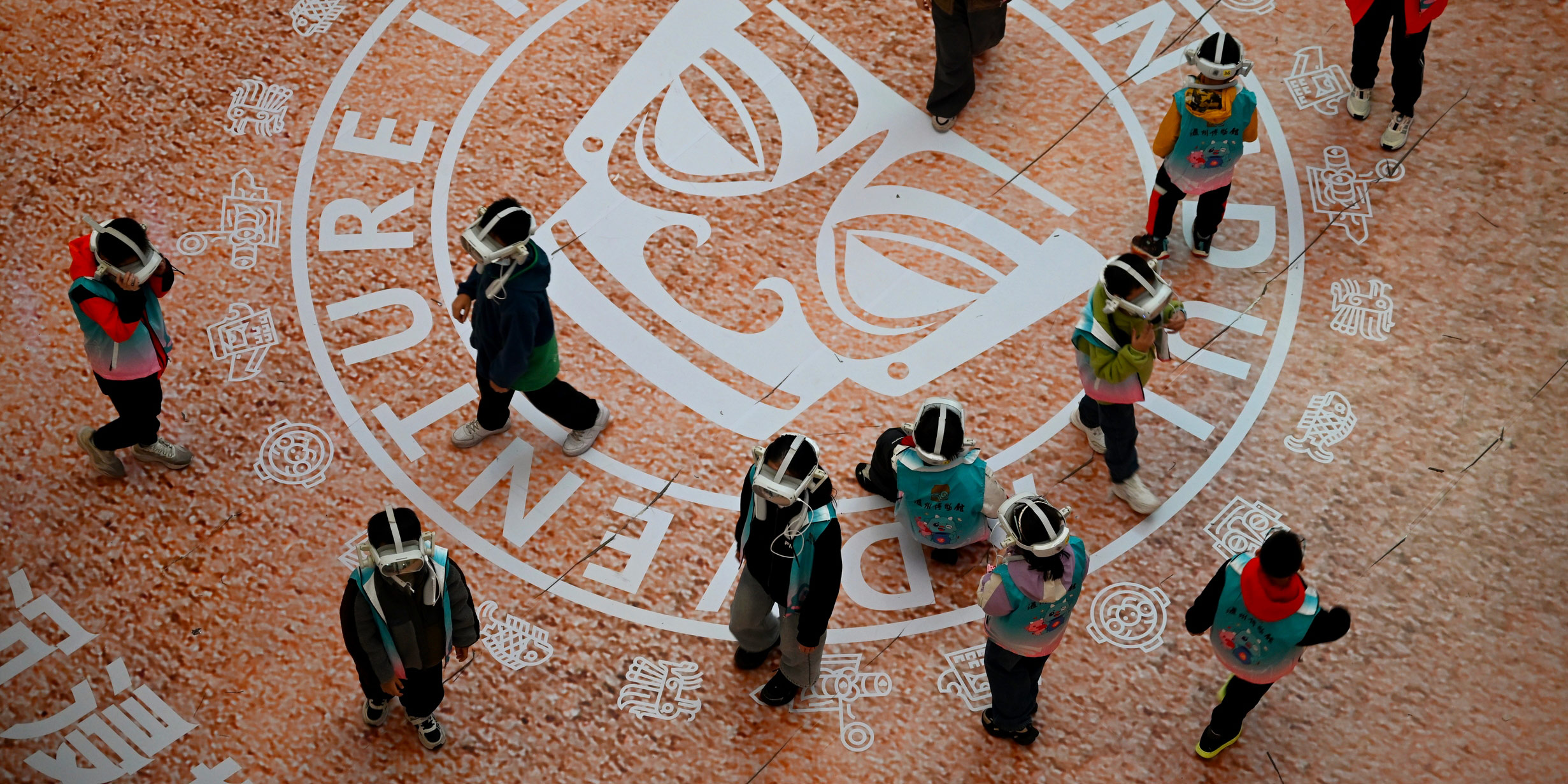
The Simple Trick Behind China’s VR Boom: Walking
Virtual reality has long disappointed me. I remember playing the VR game Half-Life: Alyx, a shooter. It was fun, but not entirely convincing. While my character moved through the game, it was hard to ignore the fact that I was sitting down at home.
But this summer, I visited Shanghai’s Museum of Art Pudong for my first immersive VR experience: “Tonight with the Impressionists: Paris 1874.” Inside an emptied-out part of the museum, visitors can don headsets and explore a digital world. I walked down the street in front of the Opéra Garnier at dusk in 1874, and later admired Claude Monet’s resplendent “Impression, Sunrise” alongside the artist himself.
The ability to freely walk through this historic art exhibition made my preconceived notions about VR vanish: the simulated world moved and came alive — it became real. As I looked into the headset, I felt like I was seeing the future.
When I say “the future,” I mean it. Last year was a milestone in China’s development of location-based entertainment, or LBE, the acronym by which these immersive VR experiences are known. In Shanghai alone, nearly 20 VR experience venues opened during last year’s May Day holiday. Visitors entered simulated worlds, exploring distant times and faraway places — from ancient cities to the origins of life on Earth. Growth has continued. Last month, three new experiences opened up in my home city, the eastern Nanjing, alone.
However, when I visited some LBE projects, eager to enjoy more immersion, I was disappointed. Whereas the “Paris 1874” show was a continuous experience from start to finish that gave visitors the freedom to roam around, other less polished productions took inelegant shortcuts between scenes that broke the feeling of immersion. Such unnecessarily shoddy details threaten to dim the public’s enthusiasm for what is quickly becoming an enormous entertainment industry in China.
LBE is a relatively recent concept. In June 2022, “Horizon of Khufu: Journey in Ancient Egypt” — which in China is called “The Lost Pharaoh” — launched in Paris, allowing the public the opportunity to experience a fully developed LBE for the first time. Users are transported to Cairo via a head-mounted display and follow a life-sized 3D “guide” inside a full-scale Great Pyramid of Khufu, ride a floating stone platform to the top of the pyramid, and finally, led by the cat goddess Bastet, take a boat tour along the Nile, attend Khufu’s funeral, and eventually fly over the top of the pyramid to return to reality. In 45 minutes, visitors experience a journey that even a trip to the actual pyramids couldn’t provide.
In China, many LBE developers have placed their VR experiences in historical Chinese cities like Xianyang and Chang’an, both located in northwestern China’s modern-day Shaanxi province. Visitors can stroll along bustling streets, experience the lives of ancient Chinese people, and meet figures from the past such as Tang-dynasty (618–907) poet Li Bai. Several international projects focusing on art and cultural relics have also launched in the country, including “The Lost Pharaoh” and “Paris 1874,” whose earnings in China make up a significant percentage of their global takings.
But how did VR go from an expensive and relatively uninteresting form of home-based entertainment to nearly stealing the spotlight from the film market in China? In my view, the most significant breakthrough of LBE over traditional VR, and also the key for its shift from a niche pursuit enjoyed by technology enthusiasts to a mass-market phenomenon, lies in its adoption of that most basic of human movements: walking. Traditional VR often confines users to their seats. After putting on a VR headset and entering a virtual environment, users may appear to “see” reality in 360 degrees, but they are very definitely not moving — the spatial changes that define everyday life cannot be experienced through actual physical behaviors in VR space, only by turning one’s head.
Today’s LBE enables users to perceive and explore space with their feet, which massively enhances how believable these virtual worlds feel. These VR spaces are constantly making calculations and corrections in real time, then reproducing the results based on users’ movement trajectories and positions. This creates a much more immersive world that not only lets people experience the illusion of movement, but actually move as if they inhabit the virtual world.
Meanwhile, the physical burden on users is also being reduced. Early VR experiences required bulky headsets — which necessitated physical fitness — and suffered from issues such as frequent malfunctions and less-than-perfect human-computer interaction. In the Parisian version of “The Lost Pharaoh,” however, users need only to wear a 600-gram head-mounted display and a backpack weighing around 3 kilograms, while the human-computer interaction has also been greatly upgraded. In 2025, the Chinese production of “The Lost Pharaoh” adopted wireless technology, allowing players to roam freely without backpacks. Meanwhile, lightweight headsets weighing at most 200 grams have also started to appear on the market. These technological improvements have cut down on the distractions, gradually allowing VR experiences to approach the physical sensations of reality.
Advancements that allow for the visuals to change based on a user’s movements have also allowed for much more flexible spatial designs. LBE projects located within shopping complexes in China can be as small as 100 square meters, while the experience area at Hangzhou International Expo Center in eastern China’s Zhejiang province covers nearly 1,000 square meters. Having such a large space means people can move around freely and forget the real world.
However, despite what is now possible, some LBE projects that I’ve experienced pay too little attention to movement, even though it’s an essential human need and an important selling point. Their scenes are set in small activity areas, preventing players from freely walking and exploring. In one VR experience, for example, the virtual tour guide wanted me to go from point A to point B. I could even see point B, but I wasn’t allowed to walk there — instead, there was a sudden black screen transition. Apart from laziness on the side of the production team, I struggled to think of a reasonable explanation for this.
The loss caused by this kind of laziness is immense, since the quality of experience for LBE users is directly correlated to their distance walked. The joy felt when entering a scene and seeing a vast area just waiting to be explored can be said to be the main attraction of LBE. Theoretically, through clever route design, an entire LBE project could be completed in a single take without any transitions, providing users with both ample freedom of movement and a real sense of immersion. When I experienced “Palace Banquet in Tang Dynasty” in Hangzhou, I was amazed at how much potential for exploration and freedom of movement it provided. For instance, even though the main action takes place inside a tavern, the developers allowed users to walk out of the venue and go shopping without interrupting the experience. This degree of freedom on its own was enough to elevate the work above the crowded field of Tang dynasty time-travel themed works.
Ultimately, compared with other forms of entertainment such as movies and video games, the essential difference of LBE lies in its embodied nature — users’ experiences within the virtual space can fully approach those experienced in real space. To what extent this can be achieved will determine the future of LBE. In addition to walking, industry-leading VR manufacturers offer experiences that require a sense of gravity and vertical space to enhance the physical experience, such as climbing stairs, walking across a log bridge, clambering over obstacles, and diving underwater. Meanwhile, VR headsets will undoubtedly only continue to get lighter, perhaps one day eventually even blending into the human body like contact lenses. And as computer graphics improve, the virtual world that players see will get infinitely closer to reality.
LBE has made enormous progress in the less than four years since “Horizon of Khufu” launched, but it has still only scratched the surface of what is possible. As long as developers continue to prioritize users’ free movement, the journey to even more immersive experiences will be much faster than we can even imagine.
Translator: David Ball.
(Header image: Visitors try out VR headsets in Luzhou, Sichuan province, 2025. Zhang Lang/CNS/VCG)