Virtual Reality Is Taking Off in China — as Immersive Shows
This article is part of Sixth Tone Voices & Opinion’s end-of-year series reviewing how China’s AI, film, game, and VR industries evolved in 2025.
Virtual reality has proven less popular than American tech companies once hoped. Facebook rebranded to Meta with the expectation that everyone would be donning headsets to enter “the metaverse.” More than $70 billion in losses later, the company is changing strategy. Apple’s Vision Pro also failed to gain traction.
But in China, 2025 was the year VR saw explosive growth — not as headsets for people to use at home, but as interactive shows that allow participants to visit foreign landmarks, explore digital recreations of historical events, or enter the universe of their favorite animated movies. According to market analysis company IDC, China has become the core growth driver of what it expects to be a $12 billion global market this year.
The Chinese boom in this kind of immersive experiences — also called location-based entertainment virtual reality, or LBE VR — started with “The Lost Pharaoh.” In it, users can explore ancient Egyptian ruins like the Great Pyramid of Giza, and witness the burial ceremony of a pharaoh.
After the show opened in Paris in 2022 — as “Horizon of Khufu: Journey in Ancient Egypt” — it launched inside a Shanghai mall in May of 2023. It received more than 100,000 visitors over a 10-month period, and also drew crowds when it subsequently toured other Chinese cities. So far, the earnings from the Chinese market have accounted for almost half of the experience’s total global revenue.
As with other such shows, visitors don a VR headset and are free to walk inside a giant and mostly empty room. As people roam around to explore the story, other participants are also displayed inside the headset to avoid collisions.
The success of “The Lost Pharaoh” kick-started a craze for LBE VR experiences in China. International projects that have since opened in China allow participants to visit places such as Paris’ Notre-Dame or Spain’s Prado Museum, explore the wreck of the Titanic, and even return to the streets of 19th-century Paris to visit an art exhibition together with impressionist painters.
A wide range of domestic institutions and companies — including tourism sites, museums, and game developers — are also getting in on the act by developing their own VR experiences.
Many Chinese film festivals have now added sections dedicated to VR or XR productions — the latter an umbrella term that stands for “extended reality.” Since this October, I have attended the 4th Golden Rooster XR Showcase, the 2025 Xi’an International Virtual Reality Film Week, and the 9th Shanghai International Film Special Effects Innovation Forum.
By my count, more than 200 domestically produced VR experiences have been rolled out nationwide. Tickets are typically priced around 100 yuan ($14), and the shows usually last 30 to 45 minutes.
Most of these projects focus on Chinese cultural heritage, including ancient mythology, imperial dynasties such as the powerful Qin (221–206 BC) and the prosperous Tang (618–907), and a variety of historical sites and buildings. Other popular themes include natural history — dinosaurs have proven a summer vacation hit among teenagers — and sci-fi and space. These often integrate space exploration, lunar missions, and adventure battles.
An interactive VR version of the popular animated movie “Chang An” was a highlight of several film festivals. Participants take the role of young Tang-era students. They can take the imperial examinations, stroll through the ancient capital, eavesdrop on legendary poets having a drink, and — with the help of hand-tracking technology — fight bravely on a frontier battlefield. In the end, they arrive at the banks of the Yellow River, where the famed poet Li Bai recites his timeless masterpiece “Bring in the Wine.”
Similarly, this year’s hit animated fantasy movie “Nobody” has also been turned into an interactive VR experience. When participants don the VR headset, the movie’s fantastical world with ink-wash-style mountains spreads out beneath their feet. The story continues where the movie ended, with participants fighting alongside the characters they previously could only watch on a screen.
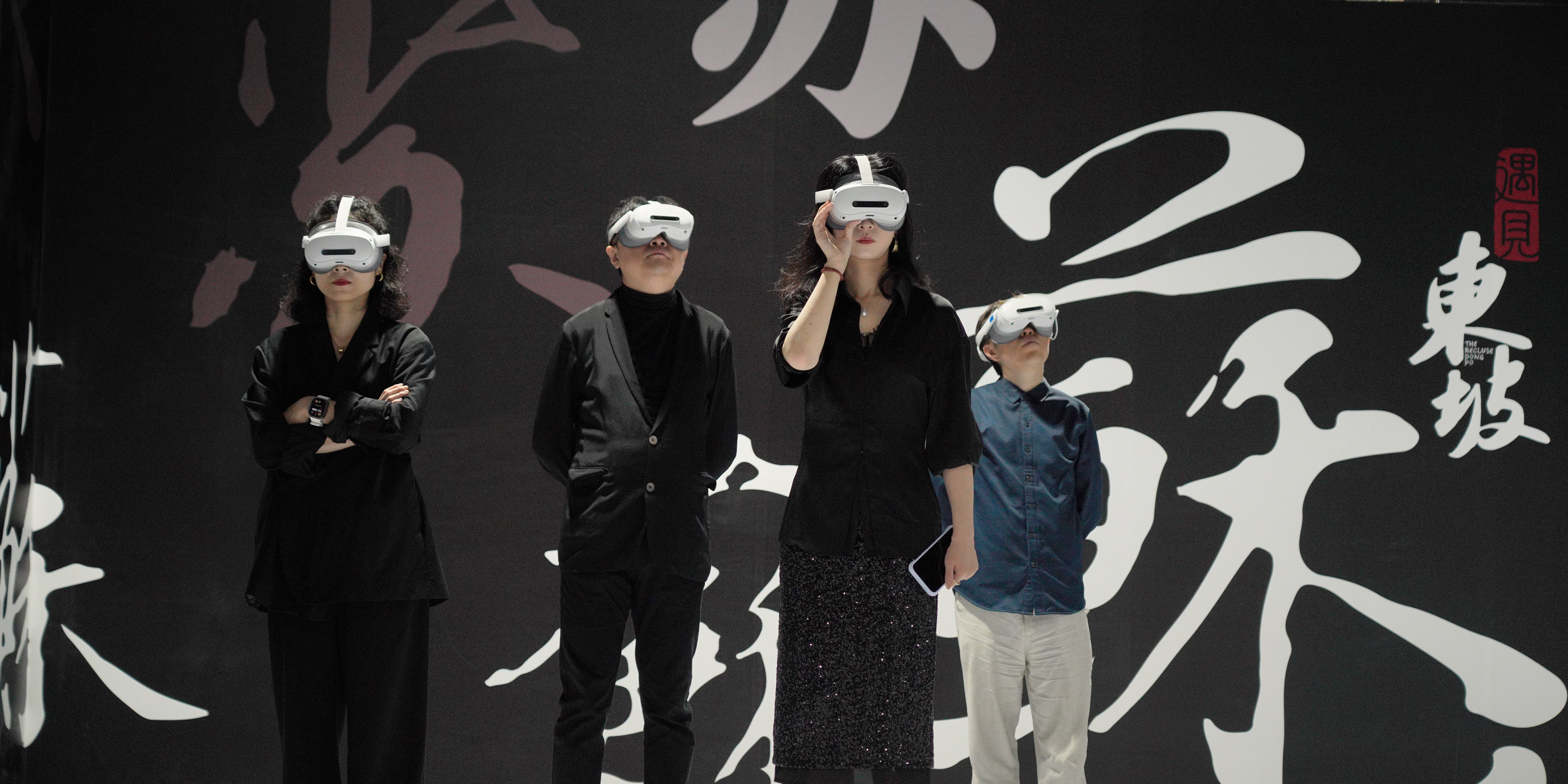
There is also “The Recluse Dongpo,” developed in conjunction with the Shanghai Library, which was named the best artistic exploration at this year’s Golden Rooster XR Showcase. Participants play the role of an old friend of the famed poet Su Shi, also known as Dongpo, and follow him as he experiences the ups and downs of his official career and his subsequent exile and wanderings across China. The standout scene is a nighttime visit to the Yangtze River’s Red Cliffs, which Su wrote about in his masterpiece “Musings on the Red Cliff.”
However, apart from these few outstanding works, the overall quality of VR experiences in China is, at present, still not particularly high. First, shows are often similar in subject matter and narrative design.
Many VR productions center around Chinese cultural heritage, such as the Terra-cotta Army, the Dunhuang grottoes, or the Sanxingdui archaeological site. And most experiences follow the storytelling framework established by “The Lost Pharaoh”: A digital tour guide leads the participant into sites, laboratories, palaces, or other such places. Next, various characters appear and help lead the participant to “travel” to specific historical periods and locations, providing explanations in the style of a guided museum tour.
Second, the immersive quality of many productions remains limited. Ideally, LBE VR experiences should integrate technologies that can minutely track participants’ real-time movements to allow for interactions with the virtual world and multi-person collaborations. However, most VR experiences in China still have a limited understanding of interactive concepts to take full advantage of the medium’s potential, preventing people from becoming fully immersed.
Finally, the companies behind the productions seem to have trouble thinking outside their own boxes. VR experiences developed by film and TV companies tend to resemble VR movies, while those led by game studios generally resemble computer games. Developers in the GLAM — galleries, libraries, archives, and museums — industry often treat large-scale VR as an extension of exhibitions. Tourism departments approach them as add-ons for scenic spots rather than independent artistic creations. In other words, relatively few products are currently able to effectively balance content quality, technological innovation, and user experience.
The boom in large-scale immersive VR experiences shows no signs of slowing, but I hope that investors, producers, and operators will not solely consider their potential revenue — they should also recognize that only high-quality works will stand the test of time. Only by focusing more on content, respecting the logic of this new technology, and understanding users’ emotions can we create digital experiences at the intersection of virtual and real that genuinely move people.
Translator: David Ball.
(Header image: Visitors try out VR headsets at the “The Recluse Dongpo,” Shanghai, November 2025. Courtesy of the Shanghai Library)