The Dominance of East Asian Pianists, Explained
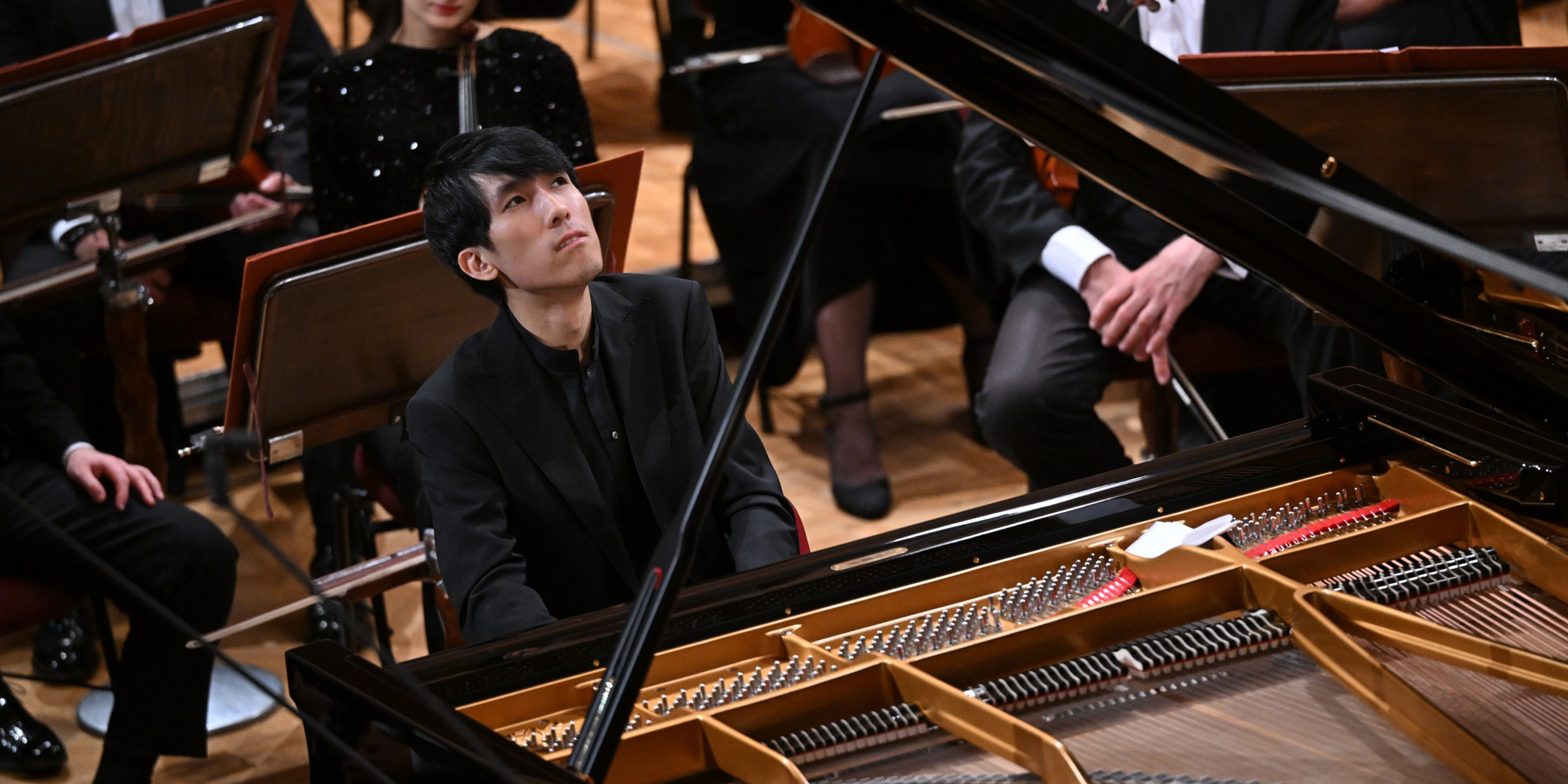
For a venerable European musical institution, the 19th International Fryderyk Chopin Piano Competition wasn’t all that European. Of the 11 finalists this year, East Asian faces occupied a staggering nine slots, representing China, Japan, Malaysia, the United States, and Canada.
Why do East Asians figure so prominently in the realm of classical music, a field historically dominated by white Europeans and Americans?
East Asians’ fascination with Western classical music goes back further than you might think. After the 1868 Meiji Restoration, Japan began importing Western culture in an effort to modernize. Parisian cafés began popping up in Tokyo, and noble Japanese families began to regard classical music from the West as “high art.” Likewise, as early 20th-century Chinese and Korean intellectuals envisioned their countries’ paths to modernity, art became part of their plans to educate and inspire the public.
This fascination was unmistakable in a particular demographic group: the middle classes, who had a longing for anything that seemed newer, more refined, and closer to their perception of modernity. For them, going to a concert hall to enjoy an evening of classical music became an accessible and symbolic portal into the high art realm. The gilded interiors, the musicians in black-tie attire, and the Italianate terminology — concerto, allegro, pianissimo — all carried an unmistakable aura of cultural refinement.
At the center of this trend stood the piano. It made its way from the concert hall to the household, where it evolved from a luxury good to the essential furnishing of a middle-class home. Performance skills were the social behavior de rigueur for children at family gatherings.
In the 1950s, East Asian classical musicians began to make a name for themselves on the international stage. The first high mark was when Chinese pianist Fou Ts’ong (1934–2020) took third prize at the 1955 Chopin Competition. (In subsequent years, China’s embrace of Western classical music would loosen, as it came to be seen as bourgeois.)
Eight years later, Japanese violinist Ushioda Masuko (1942–2013) placed sixth at the Queen Elisabeth Competition in Belgium. Koreans soon followed. The Chung siblings — who played the piano, the violin, and the cello — rose to prominence in the 1970s, symbolizing South Korea’s entry into global musical culture.
The 21st century saw the true emergence of East Asian pianists, a generation who directly benefited from the region’s economic boom and dramatic expansion of the middle class. Prominent competition winners like Uehara Ayako (b. 1980), Li Yundi (b. 1982), Zhang Haochen (b. 1990), and Cho Seong-Jin (b. 1994) didn’t just win prizes but reshaped the very demographics of classical performance. East Asian classical musicians had visibly evolved from a few prodigy unicorns into a large cohort of meticulously prepared and conservatory-style trained young men and women.
Though this cohort is too often stereotyped as relying on rigid drills more than individual expression, the tough East Asian style of parenting does play into this phenomenon. Asian parents and teachers identify commonalities between instrumental training and their philosophy of education: diligence, perseverance, mastery of fundamentals, and meritocracy.
To demand of a playful 7-year-old the patience for hours of monotonous technical exercises might be considered unreasonable, if not cruel. But for Asian parents with high expectations of their children, it is a necessary step for developing musical talent and an effective method for cultivating dispositions that may help them in their later life, such as delayed gratification, attention to detail, and a tenacious character.
One infamous example is Amy Chua, the Yale Law professor who authored “Battle Hymn of the Tiger Mother.” In the book, she describes forcing her daughters to attend piano and violin classes, barring them from bathroom breaks, and threatening to burn their toys if they faltered.
Such parents do not see innate passion as a prerequisite for music training. This utilitarian view is shared by many piano teachers, who may half-jokingly remind you that “no child actually likes to practice.” Still, Asian musicians’ global successes have fueled a virtuous cycle, drawing even more Asian parents and their children to classical music.
Winning major titles in the “artistic sanctuary” of Western culture can catalyze waves of national pride in societies once subjected to Western imperialism — either directly, through Japan’s push for “Europeanization,” or because of the postwar American military presence. When Li Yundi won the Chopin Competition in 2000, Chinese piano sales surged to record highs. After Cho Seong-Jin’s victory in 2015, his album briefly outsold even leading K-pop idols in South Korea.
These sentiments echo the response to American pianist Van Cliburn winning the 1958 Tchaikovsky Competition in Moscow. He restored America’s cultural confidence just one year after the Soviet launch of the Sputnik satellite had inspired fear that the big communist rival was winning the space race.
And yet, the once-fervent Asian enthusiasm for piano study has shown signs of waning, at least in China. In 2021, China’s Ministry of Education abolished university entrance exam bonus points for students who have won awards in music, dance, and fine art. The effect was immediate and brutal: within a few years, piano sales and class enrollment declined sharply.
For goal-oriented Chinese parents, who had long understood that it would be a long shot for their children to join the elite leagues of Juilliard or Curtis apprentices, music training had been a pragmatic investment to increase the chance of gaining admission into an elite university. When that door closed, the piano lid closed with it.
Even without the cancellation of favorable college admission policies, it is doubtful whether the three-decadelong piano fever would have persisted. The deeper truth is that in a globalized, “flat” world, the piano is inevitably losing the luster it once bestowed upon Chinese families: as a marker of a middle-class lifestyle, a medium for an advanced education, and a halo of high-art taste.
Unlike 30 years ago, the piano, as well as instrumental study in general, is no longer a rarity in Chinese society, therefore losing its appeal as a form of conspicuous consumption and a promising investment of cultural capital — much like a postgraduate degree. In parallel, Chinese families are also rethinking their philosophy of education, shifting toward one that places greater value on children’s diverse personal interests, whether that is an instrument, programming, or sports.
This shift, however, could be a positive development. Once the piano is stripped of its status as a middle-class symbol, a calculated investment, or merely a luxurious piece of furniture, it can return to what it is: a delightful instrument that demands both talent and diligence to master, and one that will continue to allow East Asian children with a passion for music to find their unique artistic voice.
Portrait artist: Wang Zhenhao.
(Header image: Pianist Eric Lu of the USA performs during the 19th International Fryderyk Chopin Piano Competition at the National Philharmonic in Warsaw, Poland, Oct. 18, 2025. Radek Pietruszka/EPA vis VCG)