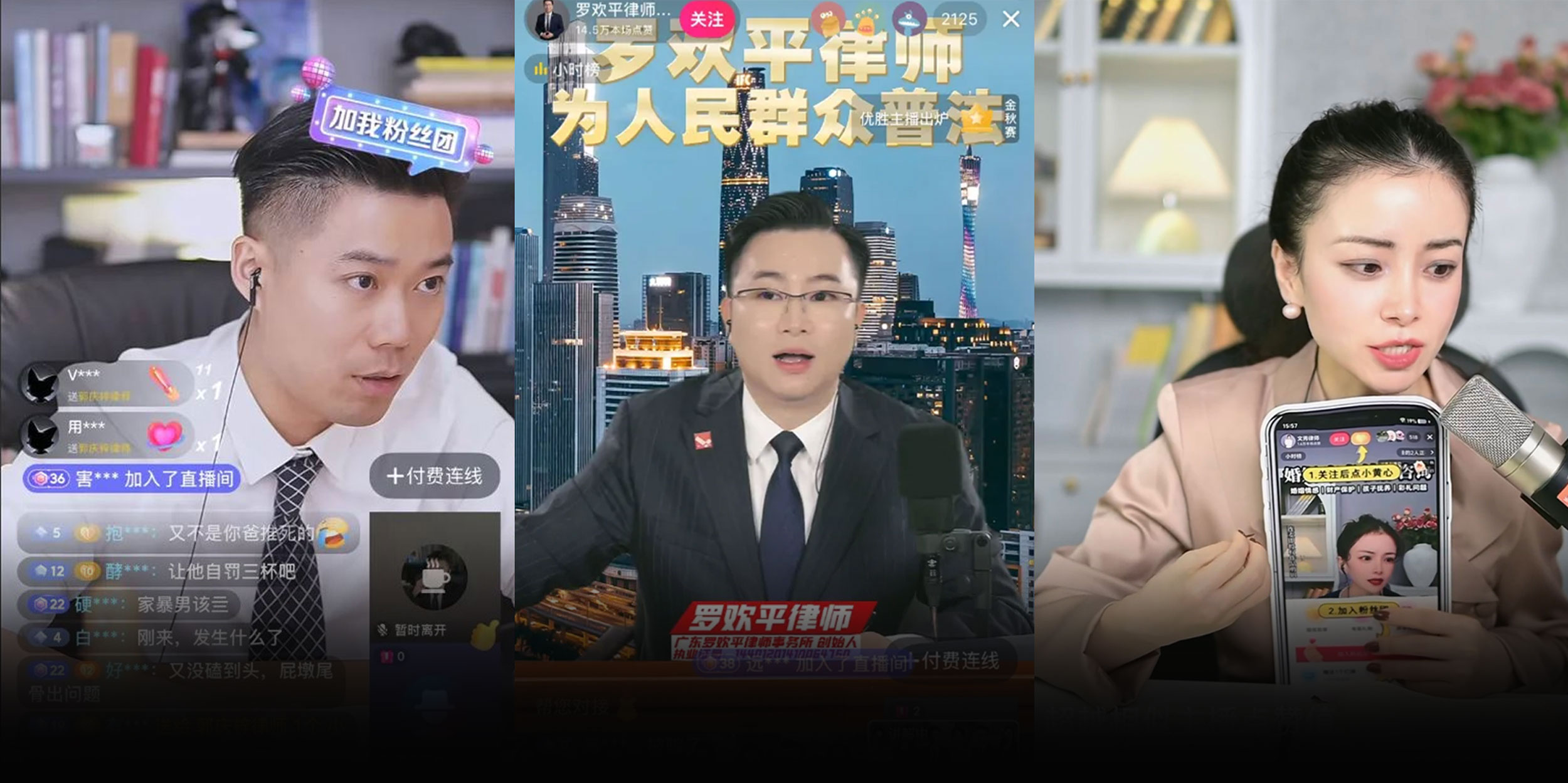
Livestream Law: Why China’s Lawyers Are Taking Their Practice Online
“My husband bought a house before we married. Do I have any claim to it?” “Can I get custody of my daughter if I don’t have a steady income?”
As soon as Wen Xiu starts her daily livestream, the questions come flooding in, each one a quick crisis from someone seeking answers she can deliver in real time.
Offscreen, hundreds more watch in silence. Some pepper the chat with questions; others simply listen. For three hours, 32-year-old Wen works through the emotional fallout of other people’s lives with measured calm — explaining legal risks, mapping options, pointing out the traps they never saw coming.
Across China, an increasing number of lawyers are moving their practice online, turning platforms such as Douyin, China’s version of TikTok, and Xiaohongshu, known globally as RedNote, into real-time legal clinics.
With demand surging for quick, low-cost legal guidance, and a growing pool of young lawyers competing for clients, legal content has become one of the most active categories on Chinese social media, drawing billions of views and a steady stream of inquiries.
Wen, a Shanghai lawyer who now focuses on family affairs cases, feels the squeeze. “Young lawyers like me don’t have the same resources or client networks as senior ones,” she tells Sixth Tone. “Social media opens a new channel, bringing traffic, exposure, and opportunities that used to take years to build.”
For many lawyers, the online audience now dwarfs the clients who walk through their doors. Yet the rise of legal influencers is forcing the field to adjust: from firms drafting social media rules to authorities tightening oversight as the line between expertise and performance grows harder to regulate.
Public practice
Wen’s turn to social media came from watching her own clients.
After getting her law license in 2020, she left the northwestern city of Xi’an for Shanghai, where she handled intellectual property cases for photographers and online influencers.
Seeing how they used short videos to raise their profile, she started making her own legal clips in 2021 and later transitioned into livestreaming to reach a broader audience. Now she spends most afternoons livestreaming from her office, answering questions from viewers nationwide. “Welcome to the livestream,” she tells them. “If you have questions about marital property, divorce, or inheritance, feel free to join the call.”
What began as a small test is now central to her practice. As her online audience grew, she shifted her focus to family affairs cases and has provided thousands of livestream consultations, many of which later turned into formal representation.
“My online clients now outnumber offline walk-ins five to one,” she says. She adds that attitudes inside the profession have shifted just as fast, from early curiosity to tentative experiments to a broad rush onto the platforms by both young and senior lawyers.
Legal hashtags covering everything from family disputes to labor conflicts now pull in billions of views on Douyin. The demand online stands in sharp contrast to the wider profession, where the number of lawyers has surged to 830,000 — growing more than 10% annually — while court cases rose just 1% last year.
“In the past, lawyers relied on websites, business cards, or personal networks. Now, new online traffic hubs like Douyin, Xiaohongshu, and WeChat channels have taken their place,” says Shanghai-based lawyer Ren Chuanqian.
He began posting short labor-law videos on Xiaohongshu earlier this year and has since seen a steady rise in inquiries and commissions coming through online channels.
While most online inquiries still come from individuals, Ren said small businesses are reaching out more often as well. Administrative staff sometimes find his videos on Xiaohongshu and contact him directly; in other cases, owners approach him after seeing a post that touches on their own disputes.
According to the Douyin 2025 Legal White Paper, more than 80% of law firms on the platform reported that their online marketing efforts had led to an increase in offline case referrals.
Zhang Bochao, an associate researcher at the Shanghai Academy of Social Sciences, sees short videos and livestreams as a new extension of China’s long-running efforts to raise legal awareness.
“Traditional efforts like National Legal Publicity Day, school lessons, and legal aid programs reach people only at certain times,” Zhang explains. “Social media offers something continuous, interactive, and far more accessible.”
For viewers, that means quicker and more affordable access to basic legal advice than formal consultations or dense texts can provide. For lawyers, it opens a path to audiences far beyond their immediate networks, blending public education with their own professional visibility.
“Regular exposure to professional content works almost like a long preconsultation,” says Zhang. “It lowers the barrier to trust and helps ordinary citizens navigate issues they might otherwise avoid.”
Gray zone
Mi Yanyan stumbled across Wen’s livestream at a difficult moment. It was 2024, her marriage was falling apart, and she was weighing a possible divorce when a video on family affairs appeared as she scrolled through shopping streams on Diantao, Alibaba’s livestream e-commerce app.
“Before finding the livestream, getting even basic legal information meant digging through books or searching online without knowing what to trust,” she says. The stream gave her quick, plain-language answers she could follow. “After a few weeks of watching, I asked Wen to represent me in the divorce.”
Wen didn’t resemble the lawyer Mi had pictured: not stern or distant, but calm, warm, and able to explain things with both clarity and empathy.
“Most people don’t show up knowing their legal questions,” Wen explains. “They come because they’re lost and need help with both the emotions and the law.” She jokes that some of her fee should be a “spiritual compensation fee,” given how much time she spends listening to people talk through their worries.
She sees that emotional work as part of the case. “You can’t solve a case without understanding the feelings behind it,” she says. Livestreaming, she adds, speeds up trust: “People don’t just hear what you say but see who you are. They decide if they trust your tone, your patience, your way of thinking.”
Beyond livestreams, Wen also makes short, topic-based videos on inheritance, marital property, and other common questions. “If we use internal jargon, people tune out,” she says. “I try to explain things in everyday language.”
The approach reflects a wider change in China’s legal services market, which hit 300 billion yuan ($42 billion) in 2024. As more people seek help online, lawyers are combining expertise with clearer, more accessible communication.
Across legal feeds, however, quality varies sharply, and the line between legal guidance and performance often blurs. Some clips lean on shock or exaggerated storylines to pull in views, including cabian content — videos that “skirt the edge” with suggestive framing or performances meant to grab attention without violating platform rules.
One recent case drew particular criticism: a Shanghai lawyer, replying under a post from a local legal association, encouraged peers to try cabian livestreaming. Several of her videos — later removed — opened with viral dance clips before shifting abruptly into legal advice.
Few lawyers go as far, but many borrow the platform’s entertainment playbook to chase traffic.
Shanghai-based lawyer Ren underscores that digital popularity doesn’t always translate into real legal guidance. “I’ve seen lawyers use humor or cabian content just to pull in views,” he says. “I can’t say it’s wrong, but it doesn’t match the tone of a lawyer.”
The traffic, he adds, rarely brings serious clients. He sees a clear divide online: lawyers posting dance videos for engagement, and those offering steady analysis of labor disputes, recent cases, and practical challenges.
“Most people, I believe, choose the second type,” Ren says. “It’s not about going viral but about showing expertise and reliability.”
Not everyone offering legal advice online is actually qualified to do so. In Chengdu, capital of China’s southwestern Sichuan province, for instance, an influencer known as “Xilv” built a following of about 140,000 this past September by presenting herself as a lawyer until city officials confirmed she wasn’t licensed.
Regulators have since moved to tighten the space, requiring influencers to hold degrees in the fields they talk about, including law. According to Wen, Douyin now enforces strict verification for legal accounts: platform-verified users must submit proof of law-firm employment, professional certification, and annual inspection documents. Going live requires an additional layer of approval confirming that the lawyer is actively practicing and verified by their firm.
Firms are making their own adjustments too. Ren says many have begun drafting internal guidelines for lawyers who post online, though enforcing them is difficult in partnership structures where individuals operate with wide autonomy.
The risk is obvious. A single careless post can undercut a lawyer’s credibility, yet avoiding social media is no longer an option. “The challenge,” Ren says, “is staying accessible without slipping past the line of professionalism.”
The shift is also changing how lawyers define their specialties. Early online content covered broad topics; now creators are narrowing their focus to areas like family law, labor disputes, small-business cases, or inheritance. Wen sees that as the natural direction of the field.
“In the future, lawyers won’t try to speak to everyone,” she says. “They’ll go deeper in specific areas to reach the clients who need them most. The more focused the content, the clearer the professional identity becomes.”
Editor: Apurva.
(Header image: Screenshots of lawyers livestreaming on Douyin.)