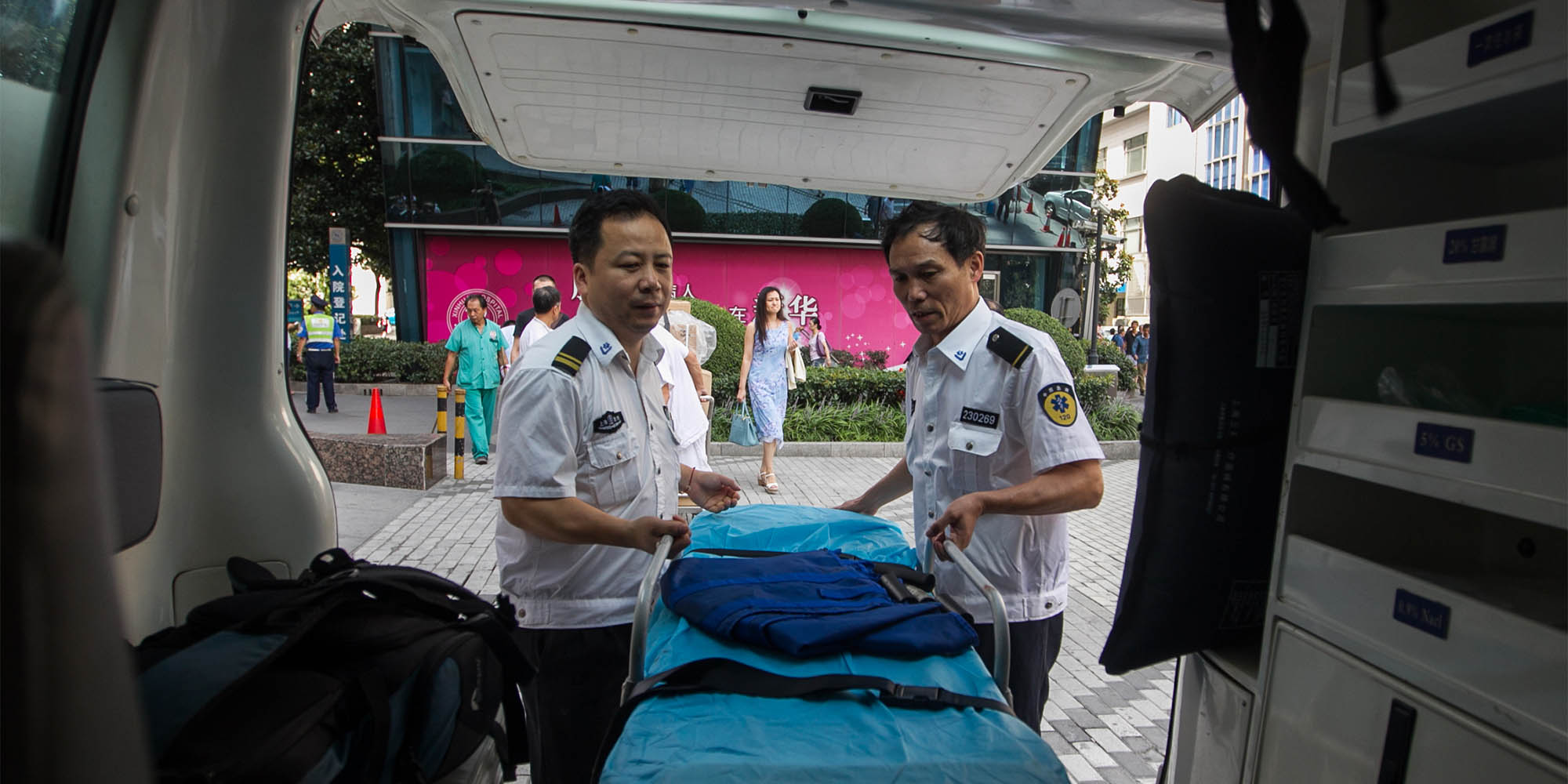
The Heat Is on for Shanghai's Ambulance Workers
Seasoned Shanghai residents know that calling for an ambulance can be a gamble.
Waiting times vary from minutes to hours, and patients have no guarantee that making that emergency phone call will be more effective in the long run than finding their own way to the hospital.
On paper, Shanghai residents actually have it better than most: The city runs at least one mobile medical unit with three trained staff for every 40,000 people, while the national standard is one ambulance for every 50,000 people.
Yet 26-year-old ambulance doctor Xiao Liu, who works for the Shanghai Medical Emergency Center, told Sixth Tone that the city’s regular summer temperatures of 38 degrees Celsius will be a severe test for him and his colleagues in the coming weeks.
Extreme temperatures prompt medical emergencies. In the summer of 2014, the continuous heat led to a significant rise in patients suffering from cardiovascular diseases, respiratory failure, and heat strokes. The center said they had to cope with more than 1,100 emergency calls a day in July that year.
“Things were similar in the summer of last year,” said an official from the center surnamed Zhang. “On an average day, the minimum number of call-outs is around 600,” he told Sixth Tone. “In summer and winter, the peak numbers are over 1,200.”
While the need for more help is there, the center is having difficulty recruiting enough personnel to keep the fleet of more than 600 vehicles fully staffed. “We have at most 130 vehicles running on the streets at one time,” Zhang said.
Ambulance staff typically work 12-hour shifts during the day or night, but in practice their days can be longer.
“You have to go out for a mission even if there are only a few minutes to go before it’s time to get off work,” said Xiao Liu, who added that his personal record was picking up 16 patients during a single shift. “The peak days normally fall on extreme weather days and on weekdays when young people are working outside and there’s no company for their elderly family members.”
On the website of the Shanghai Medical Emergency Center are a couple of recruitment advertisements that are never removed.
According to Zhang, his team has been looking for medical staff for ambulances for years.
“It’s always easy to buy the vehicles,” he said. “The tough part is to ensure that there are sufficient medical professionals working on them.”
Despite its continuous efforts in recruiting, the center lost 166 employees between 2011 and 2015, and hired just 121 new staff.
Ambulance personnel said the poor staff retention rate is linked to low wages and to the fact that trained medical hospital workers with comparable qualifications receive higher salaries. They also complained about working conditions, which put their personal safety at risk. Two years ago Beijing Youth Daily reported an ambulance team was attacked by a patient’s relatives because the vehicle arrived later than expected.
Inside hospitals, conditions can be similarly hazardous, but ambulance staff believe their peers are at least better paid and more respected.
An ambulance worker who chose to remain anonymous told Sixth Tone that he makes around 5,000 yuan ($760) a month.
“Most other people in the city earn more than I do,” he said. “Without subsidies from my family, I couldn’t cover my basic daily expenses with this income.”
In February this year, the municipal government of Shanghai announced reforms to improve the situation, including promises to hike salaries and provide better training and career opportunities.
The scheme will be implemented by the city’s health commission, and most of the specific measures remain confidential.
Officials have said that the city hopes to ensure one ambulance for every 30,000 people and to guarantee an average response time of 12 minutes by 2020.
Yet a news report in 2014 suggested that the average response time of Shanghai’s ambulances was already around 12 minutes, making the 2020 goal rather less ambitious.
However, Zhang did reveal that most of the ambulance staff in Shanghai have already seen a significant rise in their salaries. “That’s why so far this year we haven’t seen a single resignation,” he said.
At least for now, though, the service remains under-resourced.
“It sounds quite promising, but I’m not sure if I can persist on the job until new rules are implemented,” said the anonymous ambulance worker. “The job means you cannot lead a regular life. I seldom have a normal weekend given my shifts, and it’s not easy to leave work on time.”
Given the pressure on Shanghai’s stretched ambulance service, non-local patients have, unsurprisingly, found alternatives to reach the city’s hospitals.
Official ambulances charge 14 yuan per kilometer for any trip outside Shanghai, as well as toll road fees. Then there are additional charges for the use of medical equipment and tests. If a patient needs to travel back home after major surgery to a city that is 300 kilometers away, for example, an ambulance would cost 6,000 yuan.
For these patients there is a black market of unlicensed vehicle operators who will offer patients a similar service for a discounted price.
Despite a recent crackdown by the authorities, Sixth Tone spoke with illegal ambulance owner Hang Lin, who has turned his medium-sized Iveco van into an “ambulance.” For a 300-kilometre trip, Hang charges at least 4,600 yuan.
“I know how much an official ambulance will charge,” Hang said. “We are always around 1,000 yuan cheaper, but we have the same equipment and similarly experienced doctors.”
The official from the medical emergency center, Zhang, told Sixth Tone that new schemes to split the allocation of ambulances for different categories of patients are now in trial stages.
In an interview with state news agency Xinhua at the end of 2015, Zhu Qinzhong, director of the Shanghai Medical Emergency Center, revealed that a high proportion of ambulance journeys can be classified as non-emergencies.
“I found the prices completely acceptable,” said a city resident surnamed Zhao. She called an ambulance to Ruijin Hospital the other day to transfer her mother, who had just undergone a knee surgery, to a recovery center just a few blocks away.
Xiao Liu the doctor said families like Zhao’s have taken up a large share of resources at the ambulance center, and that his team are now experimenting with offering patients a vehicle with no medical staff included.
“But we cannot reveal the details until we see how they really work out during the summer peak,” said Zhang.
(Header image: Emergency medical staff unload a stretcher from the back of an ambulance, Shanghai, Aug. 7, 2014. Sun Zhan/Sixth Tone)