Retired Party Official’s Mission to Spike Mega-deal
The largest ever foreign acquisition by a Chinese company is facing stiff opposition from a 92-year-old Chinese man, who says the deal poses a threat to China’s food security.
The dissenter, Qin Zhongda, is no ordinary senior citizen, and he is not alone in his fight against a $43 billion acquisition by state-owned China National Chemical Corp., or ChemChina, of Switzerland-based agriculture company Syngenta. The purchase, which was announced in February, is expected to be completed by the end of the year.
“I am strongly against it,” Qin said in a phone interview with The Paper, a sister publication of Sixth Tone. He cited fears over the proliferation of genetically modified organisms (GMOs), referring to crops and foodstuffs developed by scientists who modify the genes of animals and plants.
During the 1980s, Qin, a native of China’s eastern Shandong province, was Chemical Industry Minister. He is also a former representative of the National People’s Congress, China’s legislature, and a high-ranking member of the Communist Party, serving as a member of the Central Committee, a top body of party leaders.
Typically, genetic modification can yield benefits such as increasing resistance of crops to certain diseases. As such, proponents have heralded the development of GMOs as an important way to increase and secure the world’s food supply. They see GMOs as a particular boon for developing countries with large populations such as India and China.
Opponents say genetically modified foodstuffs are potentially dangerous to public health, and argue that their broader use in agriculture could reduce biological diversity.
Wang Jing, environmental organization Greenpeace East Asia's senior campaigner for food and agriculture, told Sixth Tone that the Chinese government is not paying enough attention to ecological agriculture, which she described as “more sustainable.”
“The government needs to be more transparent about its GMOs policy and relevant information,” Wang said. “In addition, there are loopholes in the food-safety system,” she said pointing to the sale of illegal genetically modified foodstuffs in China as an example.
In a press conference Wednesday, Wu Kongming, executive member of the State Agricultural Genetically Modified Organisms Safety Committee of China, which oversees safety evaluations of GMOs, dismissed Qin’s views as either unscientific, or as rumors. In his interview with The Paper, Qin had said that many mice in the northern Chinese province of Shanxi had died after eating genetically modified corn.
Wu said that in terms of evaluating the safety of GMO products, China applies the world’s strictest system of technical standards and procedures.
Wu said China has only approved the commercial planting of genetically modified cotton and papaya. Commercial planting of genetically modified soybean, corn and rice had not yet been approved, despite the issuance of safety certificates for these agricultural produce, he said.
Qin said Chinese people already eat a lot of genetically modified foods, but that people were often unaware of what exactly they were consuming. “Some people don’t even care,” he said.
Concern over the deal was sufficient to prompt Qin and close to 460 other people to get together and send a signed letter opposing the deal to the State-owned Assets Supervision and Administration Commission of the State Council, which oversees state-owned enterprises, including ChemChina.
Qin’s name appears first in the list of signatories. He could not be reached immediately for comment by Sixth Tone on Wednesday.
“This deal is a disaster to Chinese people and the whole human race. Chinese people along with people all around the world firmly oppose this deal!” the letter said. It first appeared in Chinese and foreign media late last week. “ChemChina must terminate this suicidal deal that will destroy generations to come!”
In the interview with The Paper, Qin said he that he himself is not a biologist, and that his knowledge of GMOs and their related issues comes mainly from scientific journals and periodicals.
Beijing-based ChemChina is one of China’s largest chemical companies. Of late it has been on something of an international shopping spree. Its other recent acquisitions have included Italian tire manufacturer Pirelli.
ChemChina spokesman Ren Kan told Sixth Tone in an email response that the deal with Syngenta would have a “positive impact” on the global supply of food and food quality. ChemChina and Syngenta will continue to use Syngenta’s experiences and advanced technology to provide China and the world with products and services of the highest standard, he added.
Syngenta in China did not immediately respond to an email request for comment by Sixth Tone.
Additional reporting by Yan Jie.
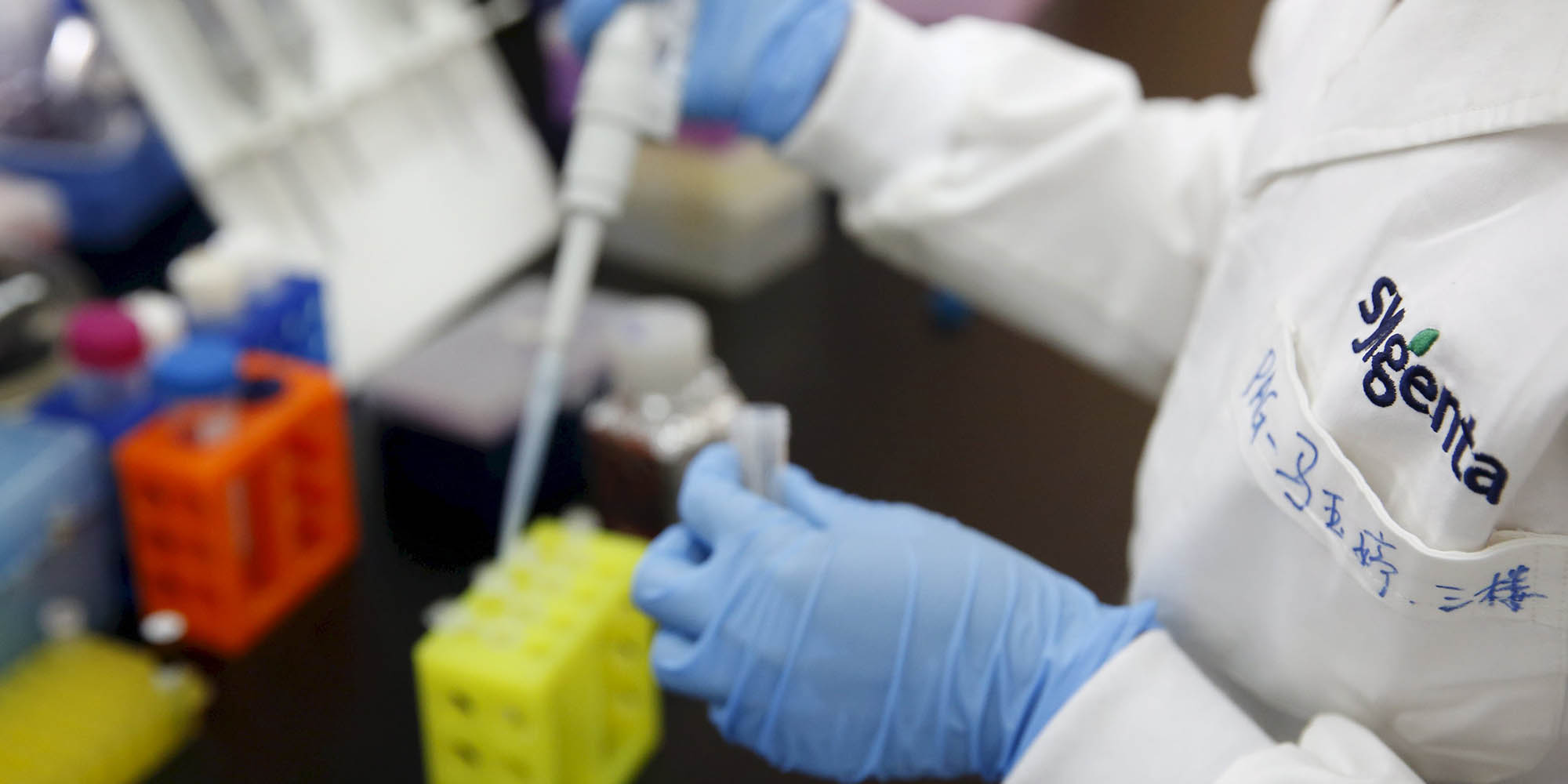
(Header image: A researcher carries out tests on corn genes at a lab in Syngenta Biotech Center in Beijing, China, Feb. 19, 2016. Kim Kyung-Hoon/Reuters)