Why I Traded Smokestacks for Skyscrapers
The walk home from my office in Lujiazui, Shanghai’s financial district, always brings back memories of my hometown. Harbin, the capital of Heilongjiang province in northeast China, is home to around 9 million people — less than half of Shanghai’s population. Harbin is a sprawling city reliant on heavy industry. Winter brings subzero temperatures, and the thick smell of coal smoke hangs in the air as people rev up their household heating systems. As a result, like many similar cities, Harbin often lies under a blanket of smog. It is home, but it’s hardly the most attractive place to live: Nearly all of my high school classmates have left Harbin for bigger cities or immigrated to the U.S., and many are loath to return for reunions.
Just a few blocks down from where I work, the financial district peters out, and I’m back in authentic Pudong, the name given to the vast area of Shanghai east of the Huangpu River. As I walk home every night, I cast a glance at the little lanes of nondescript houses nestled up against rows of fruit and vegetable shops, while small stands selling steamed buns and tea-preserved eggs line the roadside. If I don’t look back at the soaring towers behind me, I can trick myself into thinking I’m back in the northeast.
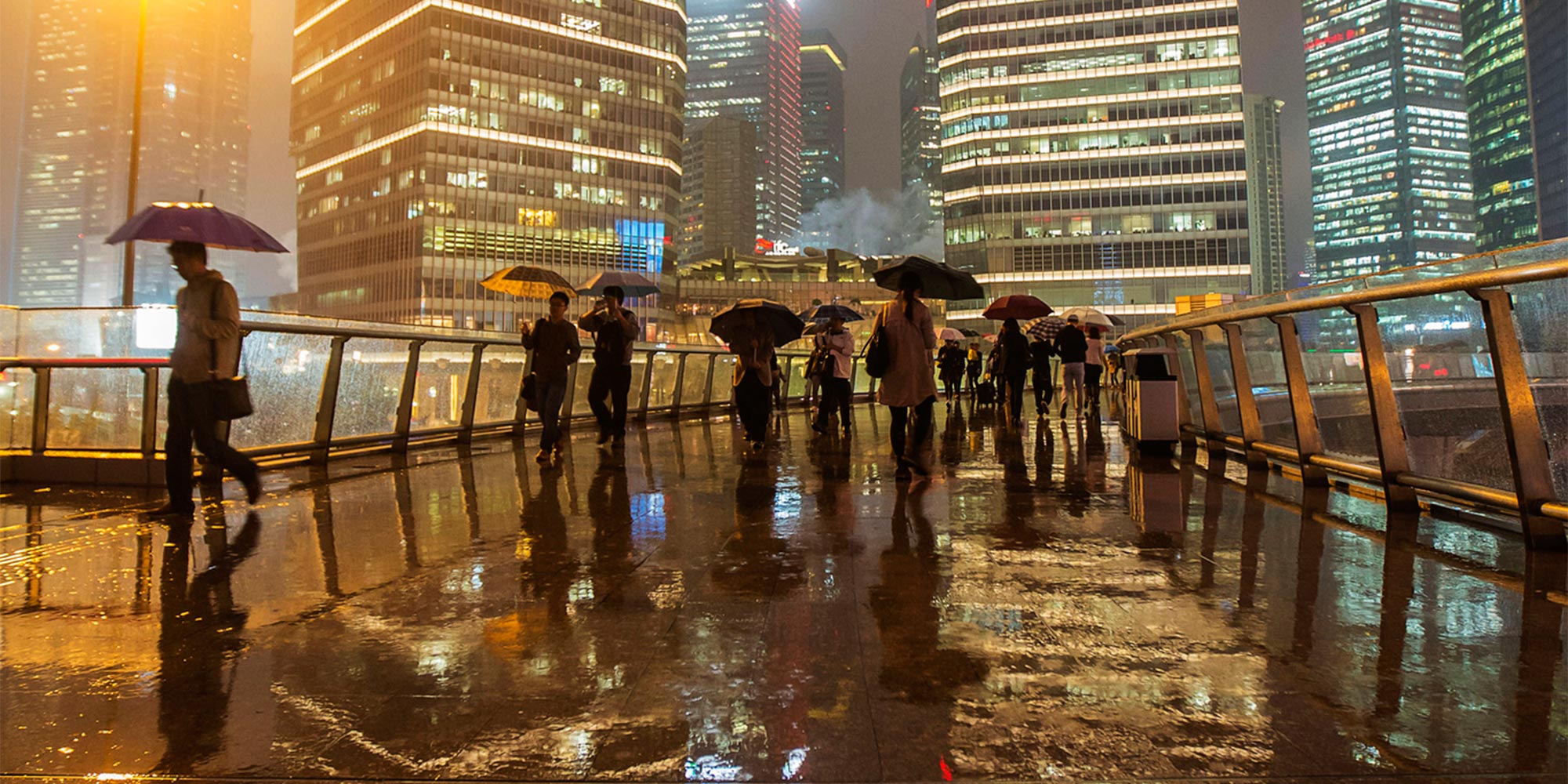
I’m not, of course; the massive skyscrapers behind me, making up the stunning skyline of Lujiazui, are a dead giveaway. This area of around 32 square kilometers, known the world over for its eye-catching design and vertiginous height, frequently draws comparisons to the City of London and Wall Street. Its famous “Big Three”— the Jin Mao Tower, the Shanghai Tower, and the Shanghai World Financial Center — house all types of financial institutions dealing in fields like domestic and foreign banking, securities, private equity, venture capital, and insurance.
The first time I came to Lujiazui was on a crisp autumn afternoon in 2015; I had a job interview at a Fortune 500 insurance company located in the World Financial Center. I remember standing agape in front of the building, craning my neck to see the top of its sheer facade. Once upstairs, I saw the Huangpu River meandering below me, a glittering belt bisecting the maze of geometric towers. A week later, I got a job as assistant to the general manager, and officially joined the white-collar hordes that converge on Lujiazui each morning.
Generally speaking, well-educated women in Harbin prefer to settle down once they graduate from university. They find stable jobs in teaching, the civil service, or large state-owned enterprises and marry nice young men from similar family backgrounds. Their parents will have found an apartment for them to live in after marriage. These girls know that life won’t be exciting, but it will at least be stable. However, not everyone wants this kind of lifestyle, and the pull of somewhere more glamorous can prove too strong to resist.
I chose a different path, though my daily responsibilities at work comprise a somewhat less glamorous to-do list. Making tea, booking flights and accommodation, drawing up budgets, translating confidential documents, copywriting, communicating with staff — you name it, I do it. My schedule is bound up with the fortunes of the company, and I rarely expect to call it a day at 6 p.m. Working overtime or not, I seldom get home before 8.
Though I feel lonely at times, I feel freer here than in Harbin. Similarly, while my salary is higher here than what I would earn back home, I still struggle to save money in expensive Shanghai. My parents have always supported my “escape” from the northeast ever since I left for college at the age of 19. From then on, I have seldom spent even one month out of the year at home, especially after I started working. I am very grateful for my family’s open-mindedness and occasionally feel a certain amount of guilt for pursuing my own ambitions at the expense of spending time with them. However, they understand that my life down in Shanghai, while less secure, is more fulfilling. It is important to them that I discover the “real me,” and if it doesn’t work out, I can always go back to Harbin.
I feel closer than ever to discovering my true self in Lujiazui. I know that underneath its chrome-and-steel, suited-and-booted exterior, my life here is more meaningful. Leading industry insiders come to give lectures in our building, while the constant hum of the global markets helps me keep my finger on the pulse. As a district geared toward making — and spending — large amounts of money, Lujiazui doesn’t allow you to become indifferent toward wealth. For those so inclined, concerts are held near my building every week, and weekends will see some of our meeting rooms and auditoriums occupied by family activities or healthy lifestyle seminars.
Sometimes, sitting beside the floor-to-ceiling windows after work, I cast my eyes upon the illuminated billboards turning the darkness into an ever-changing kaleidoscope of color and feel like I’m in a TV show. Each illuminated square in the buildings around me tells a story. Some storytellers are high-flying companies’ senior executives, who may be older than the financial district itself. Most, like me, are the white-collar workhorses. We have left our hometowns, our comfort zones, to further ourselves. Despite the exhaustion, loneliness, and high cost of living that accompany our new surroundings, we remain undeterred. Compared with the undesirability of working back home in provincial cities, Lujiazui offers us a wealth of fascinating possibilities.
Life here is not perfect. The work can be long and grueling, and wages, while high enough, don’t always leave much breathing room. But in terms of my working environment, the people around me, and the possibility for self-actualization, I wouldn’t want to be anywhere else. This, in a nutshell, is what makes Lujiazui such a seductive place: It can make people and break people. I can’t wait to see what lies in store for me.
(Header image: Pedestrians holding umbrellas stroll on an overpass in front of Lujiazui’s nighttime skyline, Shanghai, Oct. 29, 2015. Shen Qilai/Bloomberg via Getty Images/VCG)