The Day That Shook China: A Soldier’s Story
Forty years ago on July 28, an 8.2 magnitude earthquake tore through the industrial city of Tangshan in northern China’s Hebei province. Although death tolls for the Tangshan earthquake vary greatly from 250,000 to above 600,000, the disaster is regarded as one of the 20th century’s most destructive earthquakes in terms of lives lost.
Striking at a time of acute political turmoil as the Cultural Revolution was nearing its end, the disaster was not widely reported at the time, with authorities refusing all relief efforts by foreign organizations and prohibiting those who took part in rescue operations from taking photographs. To commemorate four decades since the disaster, historian Jin Dalu teamed up with the Shanghai Cultural Publishing House to collate the personal accounts of those who took part in rescue efforts.
This is part two in a series. For part one, click here.
The 38th Corps was still in training when we received our orders. The tremors, though weakened, made it all the way to the farming village where we were based, around 280 kilometers west of Tangshan.
We all immediately ran out and gathered at headquarters. Each company was assigned their respective tasks and immediately dispatched to Tangshan, not even given the time to return to barracks first.
A little after five in the afternoon, we reached Tangshan. The entire city lay in ruins. The rail tracks that hadn’t disappeared into the caved-in ground lay twisted and knotted.
When the road became impassable by car, we had to make our way on foot. All of the houses we passed had collapsed, and there were bodies everywhere. The wounded, many mutilated beyond recognition, were sent to the local military airport where they were laid on the grass fields ready for medical attention.
The bodies of the deceased began to bloat and rot with the rain, and we had to move them. Since we had set off earlier in the day without so much as a briefing, none of us seriously comprehended the gravity of the disaster — we had no idea how many casualties there would be. The suddenness of the assignment also meant we were desperately underequipped. There were no masks, gloves, or tools. We used our hands to dig.
Many relatives dug out pits for the corpses of their loved ones in the athletics fields of local schools. But this was only a temporary solution. We were sent back a month later — this time with gas masks — and ordered to dig up the bodies and transport them to another location.
Honestly, most of us in the military were just common, ordinary people. We were young, and though we wore uniforms, our hearts were full of fear. None of us had ever seen so many dead bodies. The days passed through a haze of anxious exhaustion. At night, many of the soldiers experienced psychotic spells and talked in their sleep.
We imposed emergency measure the night we arrived in Tangshan, prohibiting anyone from entering the city. We stood guard at night with loaded rifles, on the lookout for the looters who were scouring the city armed with boxes on their bikes and hoes in their hand. Two sentinels ended up dead at the hands of these looters.
The fact that this happened toward the end of the Cultural Revolution added to the complexity and grimness of the situation. However, we managed to get things functioning again within a week. From then on, the military dealt with any and all incidents involving “valuables from national disasters,” regardless of the individual.
About a month later, there was a movement to encourage people to return any public property that had come into their possession through the disaster. People could keep rice they had taken from the stores because it was a matter of survival. There was also an amnesty on bed sheets taken from stores, provided you hadn’t taken too many. If you pocketed anything else, like watches, then these were considered “valuables from national disasters,” and failing to return them would result in sentencing.
There wasn’t really any social order in the more than 100 days I spent in Tangshan as part of relief aid, but situations where people acted maliciously were rare. The goodness of people was much more prominent. For instance, there was a sports teacher at a local university who, after being saved by his son, singlehandedly rescued over twenty people.
Every household had someone who died. Whenever survivors saw each other, they would shake hands and ask, “How many from your family?” Some of the elders who survived but lost children or grandchildren decided to commit suicide. A number of young men and women started new families with each other, and those who survived with broken limbs understood how light their injuries were and didn’t utter a word of complaint.
When Chairman Mao passed away on Sept. 9, the authorities tasked us with calming people. There weren’t any broadcasts and people relied primarily on word-of-mouth from the troops. With our own hearts heavy, we were dispatched to “areas of condolence,” where we would visit each and every household, including the simple shelter tents located on top of the ruins. It was primarily a matter of maintaining law and order.
Before withdrawal from Tangshan on Oct. 5, we were tasked with one final assignment: to build houses so the locals could survive the winter. Every family needed a house, and every army squad was required to build one house every day. They were built directly on top of the ruins.
Two months spent grappling with life and death had deepened the bonds between us soldiers. On the day we left, people lined the streets, thrusting eggs and thank-you letters into our hands as we passed. Everybody cried.
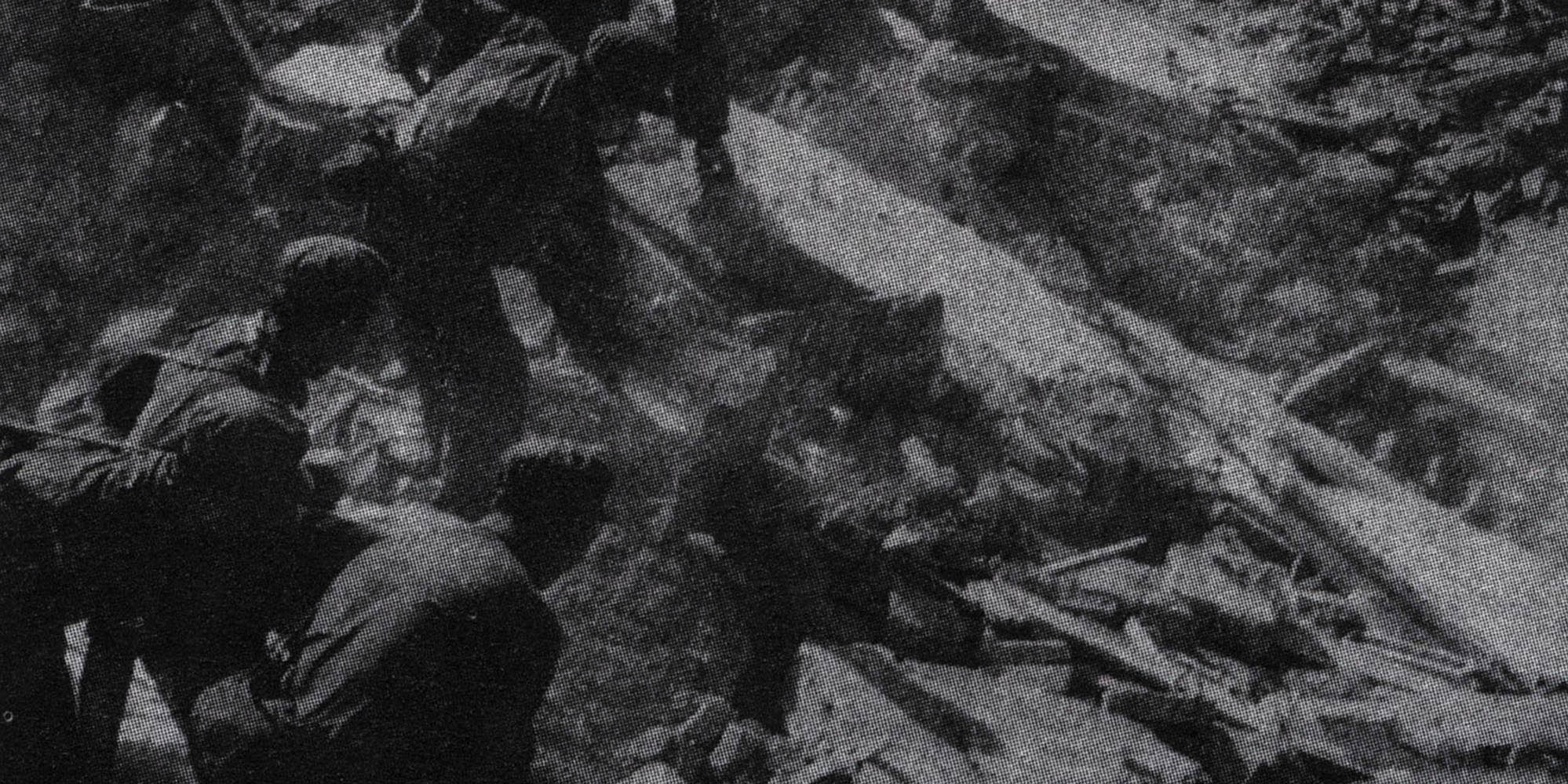
(Header image: Rescuers search for survivors in the ruins after Tangshan earthquake, July 28, 1976. VCG)