Chinese American Fields Medalist Calls for Math Collaboration in AI Age
Arguing that artificial intelligence could help mathematicians solve difficult problems, Chinese American Fields Medal winner Shing-Tung Yau said humans still have a place in pushing mathematics to new heights.
“Mathematics is not in crisis. It will only get better,” Yau told Shanghai-based news outlet The Paper on Nov. 23, saying that much of the anxiety surrounding AI stemmed from an excessive focus on problem-solving rather than the broader pursuit of mathematical discovery.
Yau, the founding president of the Asian Mathematical Union, the first pan-Asian academic organization dedicated to mathematics, called for greater collaboration among mathematicians at the union’s launch ceremony on Tuesday at the Chinese University of Hong Kong. He added that rapid advances in AI offer Asian mathematicians a chance not only to catch up with their international peers but also to overtake them.
Over the past year, AI has made a series of remarkable breakthroughs in mathematics. In May, a model from American AI company OpenAI disproved the Erdős unit distance conjecture, a problem that had remained open for 80 years.
On Nov. 20, mathematician Levent Alpöge, working for American AI company Anthropic, unveiled a proof of the Riemann hypothesis, one of mathematics’ most famous unsolved problems, developed with the help of the company’s AI system Claude. Mathematicians are now working to understand the reasoning behind the proof.
“In mathematics, it’s often only after we’ve repeatedly used a theorem over a long period of time that we know the proof is sound,” Yau explained to The Paper. He expects mathematicians to fully digest the proof of the Riemann hypothesis within five years.
“Whether the Riemann hypothesis was proved by a machine or the human brain, it’s an exciting achievement. To me, humanity’s goal is to pursue truth. As long as the truth can be discovered, there’s nothing wrong with using whatever tools we have to find it. Who gets the credit, I think, is secondary.”
Yau likened mathematical research to climbing mountains, saying AI could help mathematicians reach the first summit and open up paths to even greater heights.
“Climbing a mountain isn’t something one scholar can do alone,” he said. “Machines can speed up our collaboration by helping us bring together ideas from scientists around the world.”
In line with Yau’s emphasis on collaboration, the Asian Mathematical Union plans to recruit around 100 postdoctoral researchers annually: 50 selected by an academic committee, five each nominated by China, India, Russia, Japan, South Korea, and Iran, and 20 from other countries and regions. It also plans to regularly invite 25 senior mathematicians and 30 early career researchers from around the world to Hong Kong for research, academic exchanges, and training.
The union will focus on four areas: pure mathematics, applied mathematics, statistics, and AI.
On Oct. 11, another initiative led by Yau, the Yau Laboratory Alliance for Mathematics and Artificial Intelligence, was established at Beijing’s Tsinghua University. The alliance focuses on AI models designed specifically for mathematics, AI-assisted mathematical proofs, and interdisciplinary applications.
Editor: Marianne Gunnarsson.
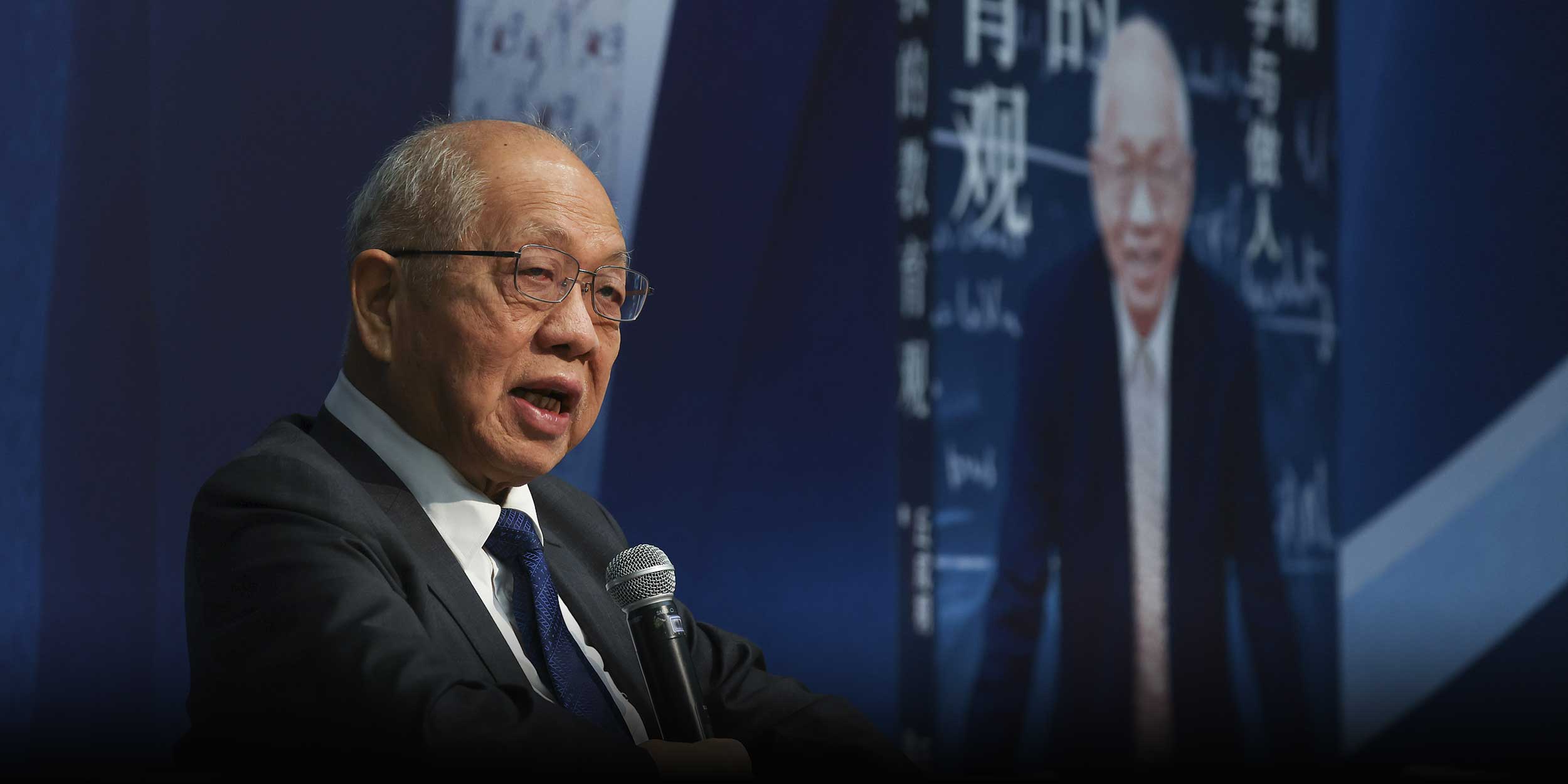
(Header image: Shing-Tung Yau speaks at a new book launch event at the National Library of China in Beijing, March 28, 2025. VCG)