Lost Ground: China’s Coffee Brands Break Starbucks and Nestlé’s Grip on Yunnan
For coffee growers in China’s southwestern Yunnan province, Starbucks and Nestlé used to be the only buyers in town. Every harvest season, their purchasing stations would have lines of loaded trucks stretching for days.
Plantation owner Zou Qingquan recalls once waiting a whole week to sell her beans to Nestlé. Back then, she says, the company revised its purchase price twice a week based on changes in the international commodity market, “so your beans were making or losing money as they sat there in the truck.”
Over the past five years, however, these two global giants have been losing their grip on the Yunnan coffee market. Rapid growth among domestic brands such as Seesaw, Manner, Luckin, and the Mixue Group, along with a shift toward specialty coffee, has opened new sales channels for farmers and pushed up prices.
According to the agricultural industry analysis platform Beedata, Nestlé and Starbucks paid an average of 48.09 yuan ($7.20) and 48.18 yuan per kilogram, respectively, for commercial-grade Yunnan green beans in the first quarter of 2026. For Luckin, it was 50.37 yuan.
But while growers’ incomes have risen, some warn that an increasingly indiscriminate buying frenzy, which in some cases is leading to the sale of unripe beans, risks disrupting established trade relationships and negatively affecting the quality and image of Yunnan coffee.
Light roast
Ma Xiaojin, who manages two coffee-growing cooperatives in Yunnan’s Menglian Dai, Lahu and Va Autonomous County, used to regularly drive the 10 hours from his farm to the Starbucks Farmer Support Center, a training and purchasing facility in central Pu’er, a city arguably best known for its eponymous tea. There, he’d join the line of trucks and wait four or five days to have his beans graded, costing him at least 2,000 yuan in truck rental costs.
Starbucks has exacting quality standards and purchases beans only from growers certified under its Coffee and Farmer Equity (CAFE) Practices program, which in January included 3,400 farms in Yunnan. The American company is also known for paying more for high-quality beans than its Swiss competitor, Nestlé.
“You can’t just show up and expect Starbucks to take your beans,” says Hao Yi, who used to work for Starbucks in coffee production. “They don’t just check each batch; they monitor your quality over several consecutive years. That’s why, in the early days, getting your beans into Starbucks was a source of pride. It also brought your subsequent harvests to the attention of specialty coffee roasters.”
In 2017, Starbucks began selling selected Yunnan beans as part of its high-end Reserve line. For growers, making the cut was no easy feat. If their products passed a preliminary check, they had to provide three large samples from each sack for testing and agree to follow-up screenings.
Specialty beans from Zou’s estate were selected in 2021, with Starbucks offering 48 yuan per kilogram. At the time, her farm was selling to the open market for more than 60 yuan per kilogram. “We earned less, but working with a big brand was good publicity for us, so it was still a net gain,” she says. The following year, many new buyers approached Zou to purchase the same beans.
Nestlé and Starbucks’ strong bargaining power stemmed not only from their steady and large purchasing orders but also from their role in establishing industry rules and standards in the region. In 1989, Nestlé introduced the province to catimor, an arabica coffee cultivar popular for its high yields and resistance to coffee leaf rust, while Starbucks has helped standardize commercial production here since the late 2000s.
Both companies also set up local agricultural support centers, dispatching agronomists to train farmers and promote good practices. Ma, whose beans were selected for the Starbucks Reserve line in 2025, remembers training sessions taking place every month or two in the early days.
“The older generation of coffee growers is very grateful to Nestlé,” says Zhang Yong, founder of Pushan Coffee, a local bean trading company. He notes that while visiting Yunnan’s coffee-growing regions last year, he found multiple farmers who were still willing to sell to the Swiss company even though its prices were lower than other brands.
However, not everyone has remained loyal to the two biggest players. On a recent trip to Pu’er, Hao talked with coffee growers and traders who said they had sold very little to Starbucks in 2025. One farmer whose beans had previously been selected for the Reserve line revealed he was now targeting other specialty coffee brands that pay more.
Ma’s two cooperatives produce 120 to 130 tons of beans a year. More than half of this output used to go to Starbucks, but over the past two years this has fallen to just over 10 tons of Reserve-grade coffee.
“It’s hard enough to buy beans in Pu’er, but it’s even more competitive in Baoshan,” Hao says. Baoshan, Yunnan’s other main coffee-growing area, is almost 10 hours by road from the Starbucks Farmer Support Center in Pu’er. With the demand for beans soaring, few are now willing to make the trip.
Working with Starbucks and Nestlé once brought huge pride and prestige, but Ma believes that the global titans’ stringent standards are increasingly seen as “too demanding,” particularly by younger farmers. It’s just easier to sell directly to smaller companies, he adds.
Taste test
Seesaw and Manner, both founded in the eastern metropolis of Shanghai, were among the first domestic coffee brands to establish a presence in Yunnan.
After launching a 10-year plan in 2014, Seesaw sent buyers to teach growers in Pu’er and Baoshan refined harvesting and processing techniques, and introduce them to specialty coffee.
Hua Runmei, a third-generation coffee grower from Pu’er, took over the family farm in 2015 after graduating from university. That year, international coffee futures — the global benchmark for pricing — were depressed, and Yunnan beans were typically sold cheap.
She agreed to transition toward growing specialty coffee in collaboration with Seesaw, which assigned a technician to guide her and assist with processing. “They tell us what they’re looking for, coffee with a clean taste and certain flavor notes, and we need to figure out how to achieve that,” Hua explains.
Her farm delivered its first 3 tons of specialty coffee beans to Seesaw in 2016. The following year, the company placed an order for 40 more.
Manner, which operates about 2,000 outlets nationwide, entered the Yunnan market in 2018, opening purchasing stations in Menglian and Baoshan. “It’s not just about a commitment to buying local. Yunnan beans are genuinely high-quality,” Wang Xu, an executive assistant to Manner CEO Jin Binbin, told the domestic media outlet Kankan News in March 2025.
The shift toward specialty coffee brought greater financial returns for growers. Hua recalls that many brands offered favorable prices and advance payments. “I think the brands that came to Yunnan in the early days were genuinely driven by a passion for locally grown coffee,” she says.
Brands generally set prices for premium beans based on production costs, allowing farms a profit margin of about 20%. They would pay up to 40% above the international futures price, sometimes more depending on the beans’ flavor profile. This not only secured beans that met their specific requirements but also encouraged growers to continue investing in cultivation and processing.
However, as domestic brands expanded, specialty coffee prices began to align with those for bulk-bought commodity coffee. “Starting around 2019 or 2020, companies changed the way they purchased beans,” Hua says. “Everyone started to want coffee that was both good and cheap.”
What emerged was a new category of bean between commodity-grade and specialty: premium commercial beans. These beans don’t have distinct flavor notes, but they do have cleaner flavor profiles and lower defect rates than standard commercial-grade beans, and typically sell for 1 to 3 yuan per kilogram more than the international futures price.
Specialty coffee brands bought relatively limited quantities of these beans. The real force reshaping supply and demand in Yunnan was companies with larger needs, such as Mixue Group and Luckin.
Mixue, a food and beverage giant based in Zhengzhou, capital of the central Henan province, acquired the budget coffee chain Lucky Cup in 2020 and expanded it as a franchise, requiring vast quantities of beans. After visiting dozens of farms, the company decided to offer freshly brewed Yunnan coffee in all of its 20,000 outlets nationwide and signed agreements with several growers for their green beans.
Chen Junxian, whose trading company Senyu Coffee was among Mixue’s first suppliers in Yunnan, recalls that local farmers and processing plants were initially lukewarm toward the Zhengzhou company, best known at the time for its ice cream and tea products.
“People didn’t really know the brand,” he explains. “They thought it was purely a milk tea company and didn’t believe it actually wanted to buy coffee beans. Now the processing plants are far more friendly.” Chen says that orders from Mixue to his business alone have nearly doubled since 2020. “We’re delivering a lot.”
The largest buyer of Yunnan beans in 2026 has been Luckin, headquartered in Xiamen, in the eastern Fujian province. Unlike other brands, which sent teams to purchasers in the region, Luckin relied for years on trading companies to handle procurement. It wasn’t until 2024 that it built its own coffee processing plant in Baoshan.
During Luckin’s Q1 2026 earnings conference call in April, co-founder and CEO Guo Jinyi announced the company had purchased more than 30,000 tons of Yunnan coffee during the 2025–26 harvest season. According to government-run news outlet Yunnan.cn, Luckin’s target is 80,000 tons a year by 2030.
For growers, the expanding market has led to enormous orders, more flexible requirements compared with Starbucks and Nestlé, and higher prices. For domestic brands, Yunnan beans mean lower transportation costs and provide an opportunity to tell the story of China-grown coffee.
Fresh take
The challenge now is keeping up with the huge demand. Industry insiders point out that even if coffee plants were grown in every suitable place in China, there would still be a supply shortage.
Chen, who started his business in 2018, says most Yunnan growers were struggling to make a profit before the market boom. Now their beans are a hot commodity, they no longer seek his help to find buyers — he needs to beg them to sell to him.
“Many aren’t comfortable with digital communication; you have to meet them in person,” says Chen, explaining that his team had to visit countless plantations, processing plants, and even farmers’ homes to secure enough beans to fill orders. This involved traipsing across sparsely populated countryside and driving 13 hours between various counties across Pu’er and Baoshan.
The thriving local economy has also attracted many Yunnan natives to return home to open coffee farms, while Pu’er tea growers have even cut down trees to make space for more coffee plants.
Some farms are also taking a chance on rare and prestigious varieties, such as Geisha, which can command a price of up to 1,500 yuan per kilogram. However, Zhang is concerned for those rookie growers who expect to sell the beans from their newly planted trees for less than 500 yuan per kilogram.
“They are investing heavily, perhaps recklessly,” he says. Geisha plants take at least three years to bear fruit and typically reach peak production around six to eight years old. No one knows what the market will look like by then, Zhang adds.
Trouble brewing?
As the buying frenzy continues, concerns about quality also grow.
Last year, Ma had to reject a whole batch of beans delivered by one of the farms he manages. “They were so bad that I couldn’t stand looking at them,” he recalls.
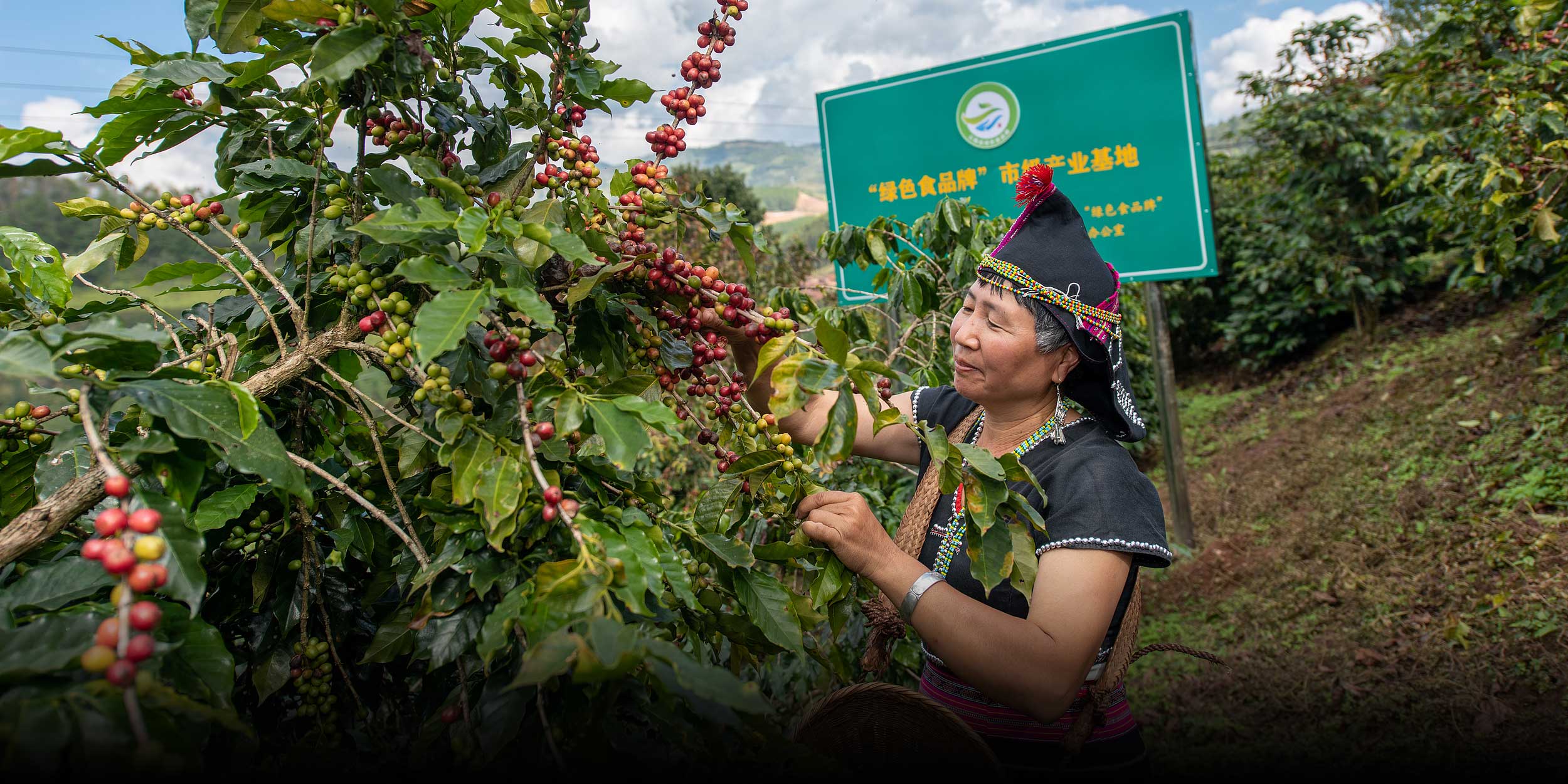
Coffee cherries ripen at different times, so pickers typically make three or four passes over the three- to four-month harvest season, selecting only fully ripened cherries to ensure quality and consistency. Now, in the haste to satisfy demand, some growers are cutting corners, making only two passes and picking unripe green cherries together with ripe red ones.
“Some people are willing to buy beans like these. I just don’t understand it,” Ma says. “If people keep harvesting so carelessly, in another two or three years, Yunnan coffee will be worthless.”
Chen sees the same problem. Once the outer fruit has been removed, it’s extremely difficult to distinguish between ripe and unripe beans during sorting, increasing the risk of defects. When his company tried to enforce quality standards at the source, growers simply told him that if he didn’t buy their cherries, someone else would. “There’s nothing we can do; we have to buy them,” Chen says.
When prices were 20 to 30 yuan per kilogram, his company would take green beans classified as Grade 1 — the highest level, applying to plump, unbroken beans measuring at least 6.5 millimeters — and sort through them again to try to reduce the defect rate.
But when ripe and unripe cherries are harvested together, quality control becomes impossible. “At prices above 60 yuan per kilogram, even a 4% loss is a huge amount of money. We can’t afford to do it anymore. We have no choice but to bow to market pressure,” Chen adds.
Even with a 5% defect rate, the market average, Chen’s company had sold its entire inventory by the end of April 2025.
Nestlé originally chose Yunnan because it provided a stable, low-cost source of beans for its instant coffee factory in the southern Guangdong province. Later, domestic coffee brands came to capitalize on both the market appeal of the homegrown coffee story and the logistical advantages.
However, as prices continue to rise, Pushan’s Zhang has observed that the market is starting to look overseas for alternative suppliers.
From January to May this year, China’s coffee bean imports from Vietnam increased 76.9% year on year by volume and 87.1% by value. Unlike Yunnan, which primarily grows arabica beans, Vietnam is a major producer of robusta, a cheaper variety with higher caffeine.
With this in mind, Zhang highlights a recent shift he’s noticed in how Chinese brands market their coffee. “Previously, many would advertise that they used 100% arabica, but as costs have risen, they’re no longer making that claim. They may well be blending in robusta,” he says.
Ultimately, the effects of the influx of domestic brands and rising prices will be felt in the consumers’ coffee cups.
(Due to privacy concerns, Hao Yi is a pseudonym.)
Reported by Li Dan.
A version of this article originally appeared in The Mirror. It has been translated and edited for brevity and clarity, and is republished here with permission.
Translator: Carrie Davies; editors: Wang Juyi and Hao Qibao.
(Header image: A farmer harvests coffee cherries at a plantation in Lancang Lahu Autonomous County, Yunnan province, Dec. 9, 2020. VCG)