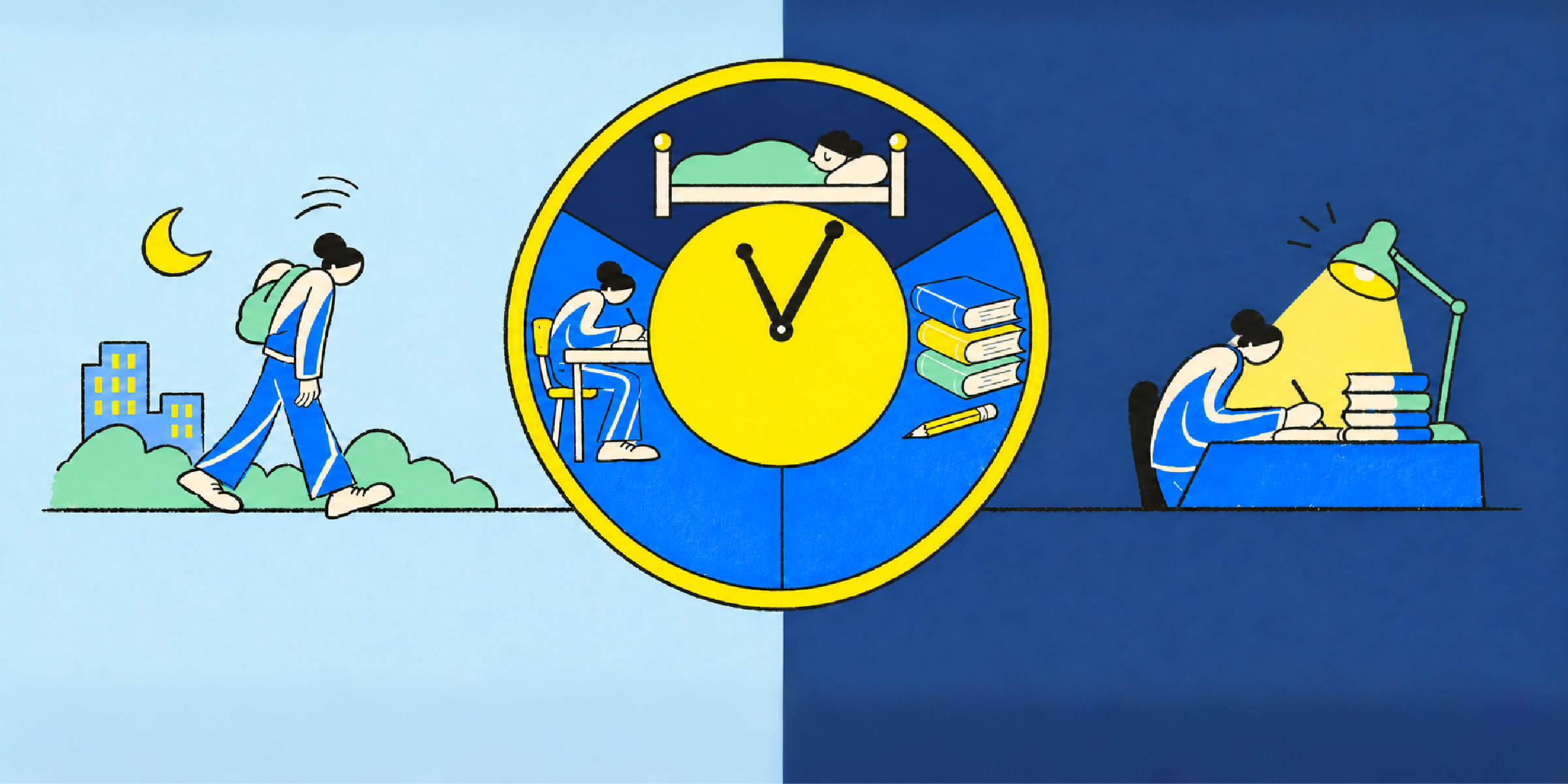
Lesson in Endurance: China’s Schools Start Later to Ease Burden on Students
Parents across China have for years raised concerns about how long children spend in school each day, with some high school students logging at least 15 hours in class.
In recent weeks, education authorities nationwide have been pushing back start times for all grades to ease the burden.
Schools in Nanjing, capital of the eastern Jiangsu province, reportedly began introducing changes in November. A parent told the Yangtze Evening Post that their child, a high school freshman, now starts studying at 7:15 a.m. and finishes after-school study sessions at 9:20 p.m., a 45-minute reduction from the previous schedule of 6:40 a.m. to 9:30 p.m.
Jiangyin, a city about two hours east by road, also announced across-the-board adjustments on Nov. 5. Classes now start at 8 a.m. at primary schools, 7:40 a.m. at middle schools, and 7:20 a.m. at high schools.
During an edition of the show “Zhengfeng Hotline” broadcast live on Jiangsu TV on Oct. 27, Jiang Yong, director of the provincial education department, said, “The issue of excessively long school hours is severe. As the education authority, we feel a profound sense of remorse.”
Paying attention
According to the 2022 China Family Panel Studies (CFPS), a nationally representative longitudinal survey of families, individuals, and communities conducted by researchers at Peking University, 46% of full-time high school students study for more than 12 hours on a typical weekday, while for nearly 25% it’s over 14 hours. Including weekdays and rest days, high school students average 68.6 hours of study time per week.
In 2024, China’s National Bureau of Statistics (NBS) published its Third National Time Use Survey, which for the first time included data on how children and adolescents spend their time.
For a 2026 article published in Youth Studies, researchers from Renmin University of China and Peking University analyzed survey data relating to students aged 6 to 17. They found that high school students spend on average 10 hours and 54 minutes engaged in education-related activities on weekdays and six hours and 29 minutes on weekends. That adds up to about 67.5 hours.
These activities cover in-class instruction, after-class study, off-campus tutoring, and commuting to and from school.
However, for some, 67.5 hours is merely a baseline. The study reveals a direct correlation between a parent’s education level and how long their child spends studying.
For those with only a middle school education or lower, their children study an average of eight hours and two minutes a day. If the parent holds a high school diploma or a university degree, that time rises by 15 or 29 minutes, respectively.
Study time also varies by location and school quality.
The CFPS shows that high school students in China’s four municipalities — Beijing, Shanghai, Tianjin, and Chongqing — as well as provincial capitals study 73.5 hours a week, nearly five hours more than the national average. Meanwhile, for students at key schools, which receive preferential funding and attract high-quality teachers, the figure rises to 75.1 hours.
Both comparisons suggest students in urban high schools and top-tier institutions endure a heavier academic burden.
But why are children spending so long in class? Xiong Bingqi, director of the 21st Century Education Research Institute, argued in an article for Southern Weekly that keeping students on campus longer makes them easier to manage, especially amid pressures to boost academic performance and meet parents’ expectations regarding supervision.
No nodding off
Children in primary education face similarly long days. The NBS’ Third National Time Use Survey shows that elementary school students spend eight hours a day on educational activities. That climbs to nine hours and 22 minutes for those in middle school.
This coincides with evidence that suggests this age group already isn’t getting enough shut-eye.
According to a 2021 Ministry of Education notice on improving young people’s sleep, primary school students should get a minimum of 10 hours a day, middle school students nine hours, and high school students eight hours. Measured against these standards, the Youth Studies research article points out that nearly 22% of 6-year-olds and 42% of 11-year-olds are getting insufficient sleep.
Although the recommended daily sleep duration is lowest for older students, about 20% of survey respondents aged 16 and 17 still weren’t getting enough sleep. Researchers explain that the relatively low proportion compared with younger age groups could be because boarding is more common at the high school level, meaning a “more fixed daily schedule.”
As more schools push back start times, some parents see a chance for change. But whether students will get more sleep depends on other factors, including homework load and the length of evening study sessions.
A later start for students will make a difference only if the time it frees up is reserved for rest.
This article, reported by Chen Liangxian and edited by Lü Yan, originally appeared in The Paper. It has been translated and edited for brevity and clarity, and is republished here with permission.
Graphic designers: Wang Yasai and Fu Xiaofan; translator: Chen Yue; editors: Wang Juyi and Hao Qibao.