What Made Jade So Valuable in Ancient China and the Americas?
Recent exhibitions at the Shanghai Museum and Beijing’s Capital Museum have introduced Chinese audiences to the civilizations of the ancient Americas. For Chinese visitors, the importance placed on jade may feel familiar. In both ancient China and Mesoamerica, finely worked jade adorned the powerful and accompanied them into the grave, a striking similarity that has long attracted scholarly interest.
How did jade come to carry such authority? One way to explore this question is to compare the jade traditions of Liangzhu and the Classic Maya lowlands, two societies from ancient China and the Americas. Liangzhu was an early regional state near present-day Hangzhou, capital of eastern China’s Zhejiang province, around 3300–2300 BC, with a walled capital, an extensive system of dams, and a pronounced social hierarchy. In the Classic Maya lowlands, spanning parts of present-day Mexico, Guatemala, and Belize, cities ruled by royal dynasties flourished around AD 300–900. Both Liangzhu and Maya cities hold UNESCO World Heritage status.
Thousands of years separated the two societies, and there is no evidence of direct contact between them. Yet both had complex social hierarchies in which powerful ritual authorities played important roles. By tracing jade from the selection of raw stone to its final resting place, we can see how control over labor, knowledge, and materials helped establish its authority in ways that were both similar and distinct.
Jade was valued in both ancient China and the Americas long before Liangzhu and the Classic Maya. The concept of jade encompasses several kinds of stone. Liangzhu’s finest ritual jades were made from nephrite, while Maya jade was principally jadeite. Both were prized for their appearance and could be polished to a lustrous finish. Craftspeople shaped jade using abrasives such as sand mixed with water. Working with different stones helped them recognize differences in hardness and toughness and determine which materials were best suited to particular objects.
In Liangzhu, material choice was closely tied to the form and status of the finished artifact. Other stones, such as serpentine, were generally used for small, less prestigious ornaments. Among the Maya, by contrast, the symbolic meanings of stones were more closely associated with their colors. Green and blue-green evoked water, cultivating maize, and renewed life. Jadeite remained highly prized, but a wider range of similarly colored stones could also be valued for their quality and craftsmanship.
Not everyone had equal access to these raw materials or the specialized skills needed to work them. This inequality helped establish jade’s association with power.
Workshops within and immediately outside Liangzhu city made prestigious ritual objects from nephrite. A short distance away, a large workshop complex specialized in small serpentine ornaments. Despite their proximity, the workshops used different materials and produced different types of objects. The fine finish of these serpentine ornaments, however, shows that their makers were skilled.
This contrast suggests that proximity and skill alone did not guarantee access to nephrite. Access appears to have depended on a workshop’s role and status within the production system.
Evidence from the Maya suggests broader access to raw jadeite, but tighter restrictions on the skills and knowledge required to produce elaborate royal artifacts. Near the jadeite sources in Guatemala’s Motagua Valley, in the country’s southeastern highlands, households of different social ranks shaped, sawed, and drilled the stone. At Cancuén, in the country’s center, much of the waste from the early stages of production was found in modest residences. Elaborately finished objects, however, were concentrated in elite buildings, alongside some tools used to polish ear ornaments.
While non-elite households carried out the early stages of jade production, finer carving, including sacred images and inscriptions that conveyed ritual and political meanings, appears to have been largely reserved for elites or specialist craftspeople working for them. Creating these details required skills and knowledge that were less widely shared. Access to raw jadeite did not necessarily mean access to the expertise needed to produce elaborate royal artifacts.
As jade artifacts took shape, their imagery became another critical means of expressing power. This is particularly evident in elite burials, where jade objects helped convey the status and ritual authority of those buried with them.
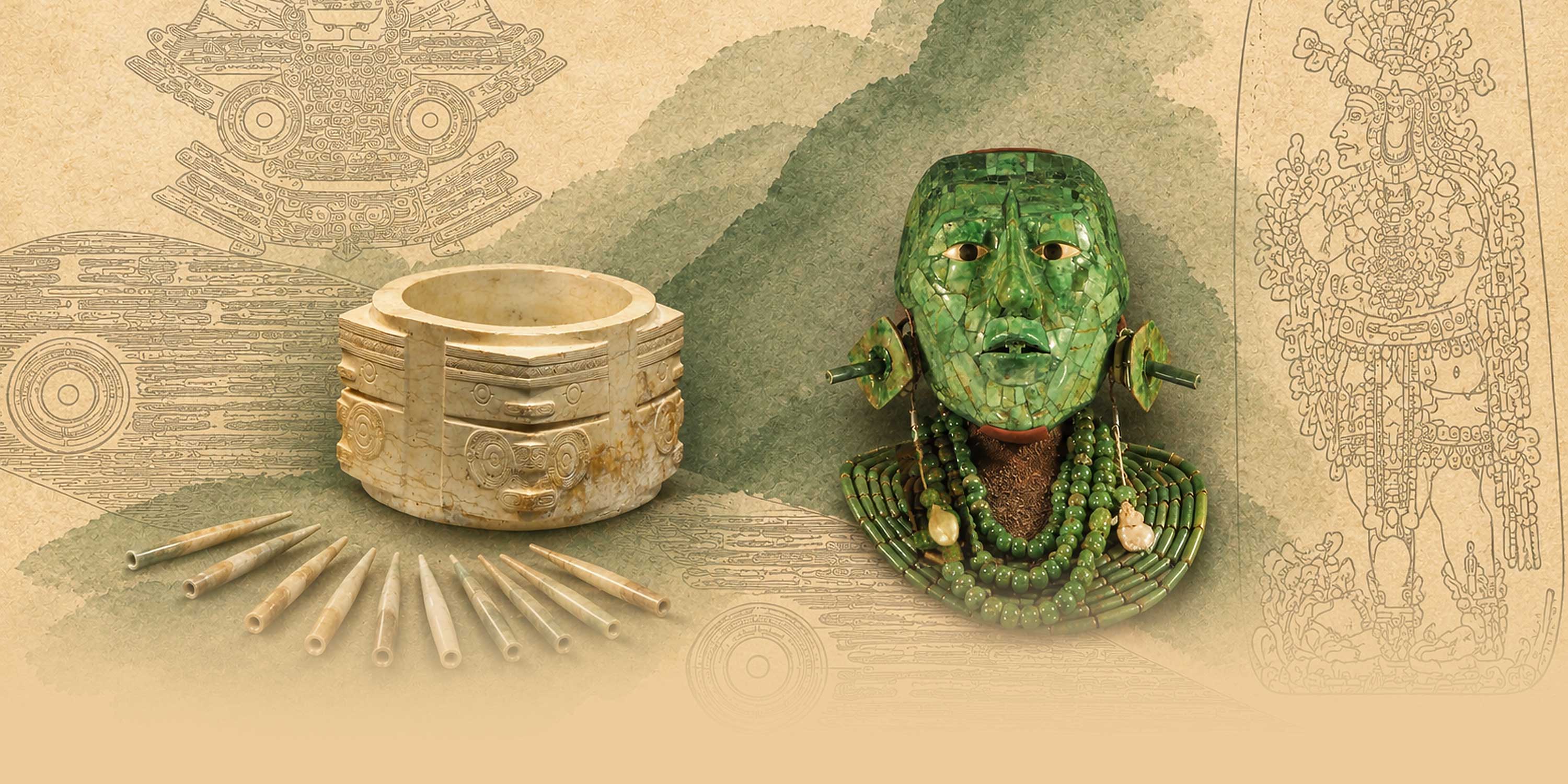
A jade cong, or ritual tube, from Fanshan, an elite cemetery within Liangzhu city, illustrates how craftsmanship and sacred imagery conveyed authority. Its surface bears an intricately carved human-and-animal-face motif known as the Sacred Insignia. The finest versions appeared on the most prestigious ritual jades, whose material and craftsmanship signaled status.
The cong also belonged to a prescribed set of burial goods. Within Liangzhu’s political center, elite burials followed established conventions that linked the types and placement of artifacts to rank and gender, leaving little scope for personal preference. Differences in the quantity and quality of objects expressed the deceased’s rank and ritual authority within this prescribed framework.
Maya rulers, by contrast, drew on shared beliefs but had greater freedom in how they arranged jade. One example comes from the tomb of Pakal the Great, ruler of the Maya city-state of Palenque, in what is now southern Mexico. His funerary mask is a mosaic of carefully fitted pieces of jade in different shades of green. Scholars interpret its youthful face as linking the ruler to the Maize God. A cube in one hand, a sphere in the other, a bead beside each foot, and a central belt figurine have been interpreted as forming a quincunx, a five-point arrangement representing the four directions and a center in Maya cosmology, with Pakal at its symbolic center.
Pakal’s jades derived meaning from their individual forms and their placement within his tomb. Shared beliefs could guide such arrangements without requiring the standardized sets found in Liangzhu elite graves. Maya sacred imagery also appeared on multicolored ceramic vessels, carved stone monuments, and buildings. Jade was one of several materials through which rulers expressed their place in the world.
The movement and final placement of jade objects also reflected their association with power in both societies.
In Liangzhu, the movement of prestigious jade objects appears to have reinforced relationships among elites. Similarities in carving between the political center and neighboring settlements suggest that these objects circulated primarily among elites, possibly through gift exchanges. Local production continued, but the most sophisticated carving techniques remained concentrated near the political center. When finished, Liangzhu jades were deliberately buried; prestigious ritual objects were typically placed in individual elite graves, while lower-ranking burials contained smaller, less elaborate ornaments.
Among the Maya, jade served purposes beyond elite ownership. Different forms of jade circulated in different ways. Some ornaments bore inscriptions linking them to particular people and events, while plain beads and axe-shaped objects known as celts circulated more freely and may have been used as payment by the Postclassic period (900–1521). Non-elite households acquired small jade beads that could express wealth and status. At Cancuén, jade-working households buried raw or partly worked jade during house construction, suggesting that even unfinished jade material held ritual value. At Copán, in western Honduras, jade and shell artifacts were buried together in a residential courtyard, showing how different materials could serve similar ritual purposes beyond royal burials.
These differences reveal how the two societies developed distinct ways of turning jade into a symbol of wealth and authority. In Liangzhu, the quality of the stone, specialized craftsmanship, sacred imagery, and rules governing its use were brought together in a tightly regulated system. Among the Maya, jade acquired authority through a wider range of materials and ritual settings, allowing for broader participation and more flexible exchange alongside restrictions imposed by elites.
Jade’s beauty may have made it desirable, but it was people who made it precious. Through craftsmanship, sacred rituals, and control over who could possess it, ancient societies transformed stone into a symbol of wealth and authority. The treasures displayed in museums today reveal a larger truth: The value of precious things lies not just in what they are, but in who gets to decide what they are worth.
Portrait artist: Wang Zhenhao.
(Header image: Visuals from Lin Xin, reedited by Sixth Tone)