China’s Sea Goddess Has a New Job: AI Weather Forecasting
As it expands its weather-warning systems across the Global South, China has handed over equipment for a customized version of MAZU — an AI-powered weather prediction tool created by the China Meteorological Administration — to Sri Lanka, one of eight countries where the platform has been deployed.
The device, described by domestic media as a rectangular black box roughly the size of a portable toolbox, was presented to Sri Lanka’s meteorological department on Nov. 1. It will form part of a system designed to warn of heavy rain, strong winds, and cyclones, and is expected to enter service by the end of the year.
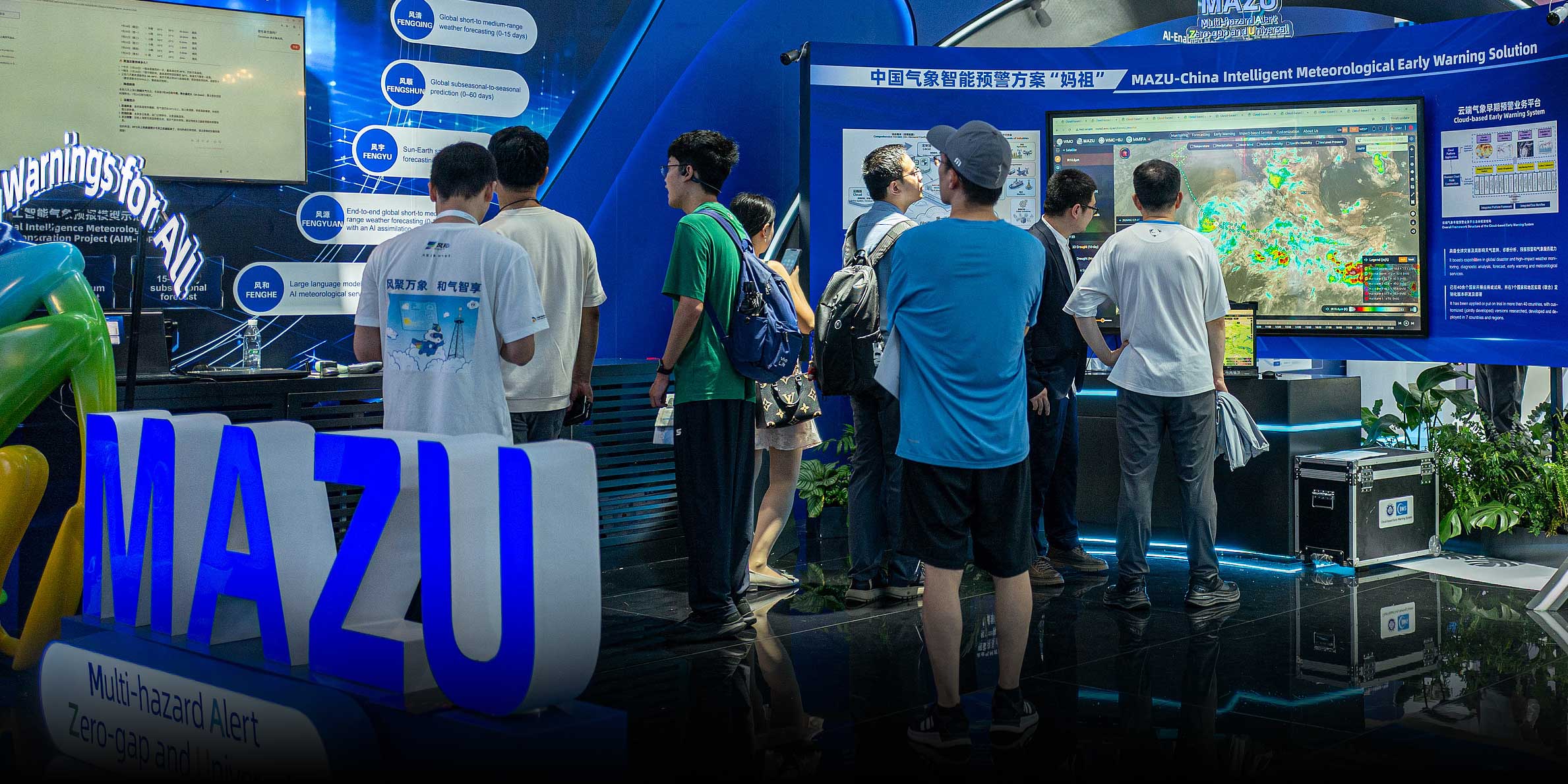
Launched in July 2025, MAZU takes its name from a Chinese sea goddess revered as a protector of sailors. It combines AI forecasting models developed by Chinese research institutions with data from the country’s weather satellites.
Conventional weather forecasting relies on supercomputers to calculate how the atmosphere will change using equations based on physical laws. AI models, by contrast, learn from years of weather data.
“Chatbots familiar to the public learn patterns in language, while AI weather models learn how the atmosphere evolves,” Niu Zeyi, an assistant researcher at the Shanghai Typhoon Institute who led the development of a forecasting model used in MAZU, told Sixth Tone. “By training on years of meteorological data, these models can predict future weather conditions based on current variables such as wind, air pressure, temperature, and humidity.”
Once trained, AI models can produce forecasts faster and more cheaply than conventional methods. One model can generate a 24-hour global forecast in 1.4 seconds, about 10,000 times faster than traditional numerical methods. For forecasts covering 15 to 60 days, AI models can reduce computing costs to one-thousandth of those of conventional methods.
But most of the savings come from running routine forecasts, Niu said. Training models, building datasets, and maintaining systems still require investment — resources many countries in the Global South lack.
MAZU’s cloud-based services are being tested by 58 countries, according to domestic media, and China plans to deploy the system in 30 countries over the next five years.
In Pakistan, the system has reportedly incorporated local radar and satellite data to develop warnings for heavy rainfall and glacial lake outburst floods. In Djibouti, the model developed by Niu’s team helps provide tailored weather warnings for the East African country’s port.
Studies show AI models can be less accurate than conventional methods when predicting record-breaking extremes, for which there is little historical data. Local weather in complex terrain also remains difficult to forecast, and it is not always clear how AI models arrive at their predictions.
The models also need to be adapted to local conditions, Niu said. “Our approach is to work with local meteorological agencies to improve datasets, conduct independent evaluations, and make local adjustments.”
Even with AI, he added, “human forecasters must still combine observations, AI predictions, and their own judgment before authorities issue warnings.”
Editor: Apurva.
(Header image: The weather warning system Mazu at the China Meteorological Administration booth during 2026 World Artificial Intelligence Conference (WAIC) in Shanghai, July 18, 2026. VCG)