China’s Traditional Colors Are Trending. But What Are We Missing?
Traditional Chinese colors have become a popular topic on Chinese social media, with posts sporting catchy headlines such as “Our Ancestors Had the Ultimate Eye for Beauty” and “Out-of-This-World Color Combinations in ‘Dream of the Red Chamber.’” Open one of these posts, and you’ll often find neatly arranged color swatches labeled with evocative traditional names such as tianqing, “celestial blue”; yuebai, “moon white”; qiuxiang, “autumn fragrance”; and yanzhi, “rouge.”
In my opinion, this enthusiasm is undoubtedly a good thing. Traditional colors deserve greater attention and should be made more accessible. Color swatches can also be useful for showcasing the colors of historical artifacts and help modern audiences connect with the past. But this kind of simplification is a double-edged sword. In making something rich and complex easier to understand, it can also reduce it to a crude, one-dimensional representation. What makes information easier to communicate can also obscure or distort its meaning.
In fact, color swatches have significant limitations when it comes to representing and explaining traditional colors. They can only scratch the surface of a much richer cultural history.
Modern color charts emerged from Western industrial and commercial systems designed to control production quality and reproduce specific colors. But this standardized, scientific approach often falls short when applied to traditional Chinese colors. Anyone who has visited an exhibition of antique clothing or textiles and tried to photograph it may have experienced this firsthand. What appears to the naked eye as a beautiful pine green might look mustard yellow on a smartphone screen. Or the various golds and yellows of an imperial dragon robe might lose their distinctiveness entirely. If even digital cameras equipped with sophisticated image-processing algorithms struggle to capture these colors, what chance does a simple color swatch have?
So why do modern industrial color charts fall short in representing traditional Chinese colors?
First, color swatches are designed to standardize colors within specific product categories, whereas traditional Chinese color names developed within particular craft traditions. As these traditions evolved, a color’s name could refer to subtly different hues in different periods.
Several factors contributed to these variations. In the age of traditional handicrafts, differences in materials and craftsmanship could produce markedly different hues. Local production conditions also gave products from different regions their own distinctive characteristics. Fashions changed over time, altering the shades associated with particular color names. Even on a single garment, colors could appear different depending on the lighting, viewing angle, or direction of the weave.
Traditional indigo dyeing offers a good example. Indigo must first be fermented in vats and chemically reduced before it can be used to dye fabric. A single dip produces a pale blue, and the color deepens after each subsequent immersion. As a result, even fabrics dyed in the same vat can emerge in countless different shades.
Second, modern industrial color standards demand precision, assigning each color a numerical value. Traditional color names, however, did not follow this quantitative model. Rather than corresponding to a single fixed value, they generally described a natural range of hues.
Take xinghuang, or “apricot yellow,” for example. The yellowish-red of a ripe apricot is not a precisely defined hue. Yet despite natural variations in its color, people can still recognize the familiar shade of a ripe apricot.
Finally, the meanings and appearances of colors have changed considerably throughout Chinese history. These changes reflected rulers’ preferences, interpretations of cultural doctrines, shifts in folk customs, the rise and decline of craft techniques, and the movement of goods through domestic and overseas trade.
Consider qing, a color term widely used in ancient China. Depending on the context, it could describe the blue of the sky, the green of plants, or even the black of someone’s hair or eyes. By the Ming (1368–1644) and Qing (1644–1911) dynasties, it still encompassed a broad range of hues. People wore qing-colored robes, but their exact shades varied. Although the “Da Ming Huidian,” or “Collected Statutes of the Ming Dynasty,” prescribed shiqing for officials’ outer robes, surviving examples range from reddish tones to bluish-green and darker, more somber shades. Meanwhile, the robe the emperor wore during rituals at the imperial tombs was yuanqing, a shade that appeared almost black.
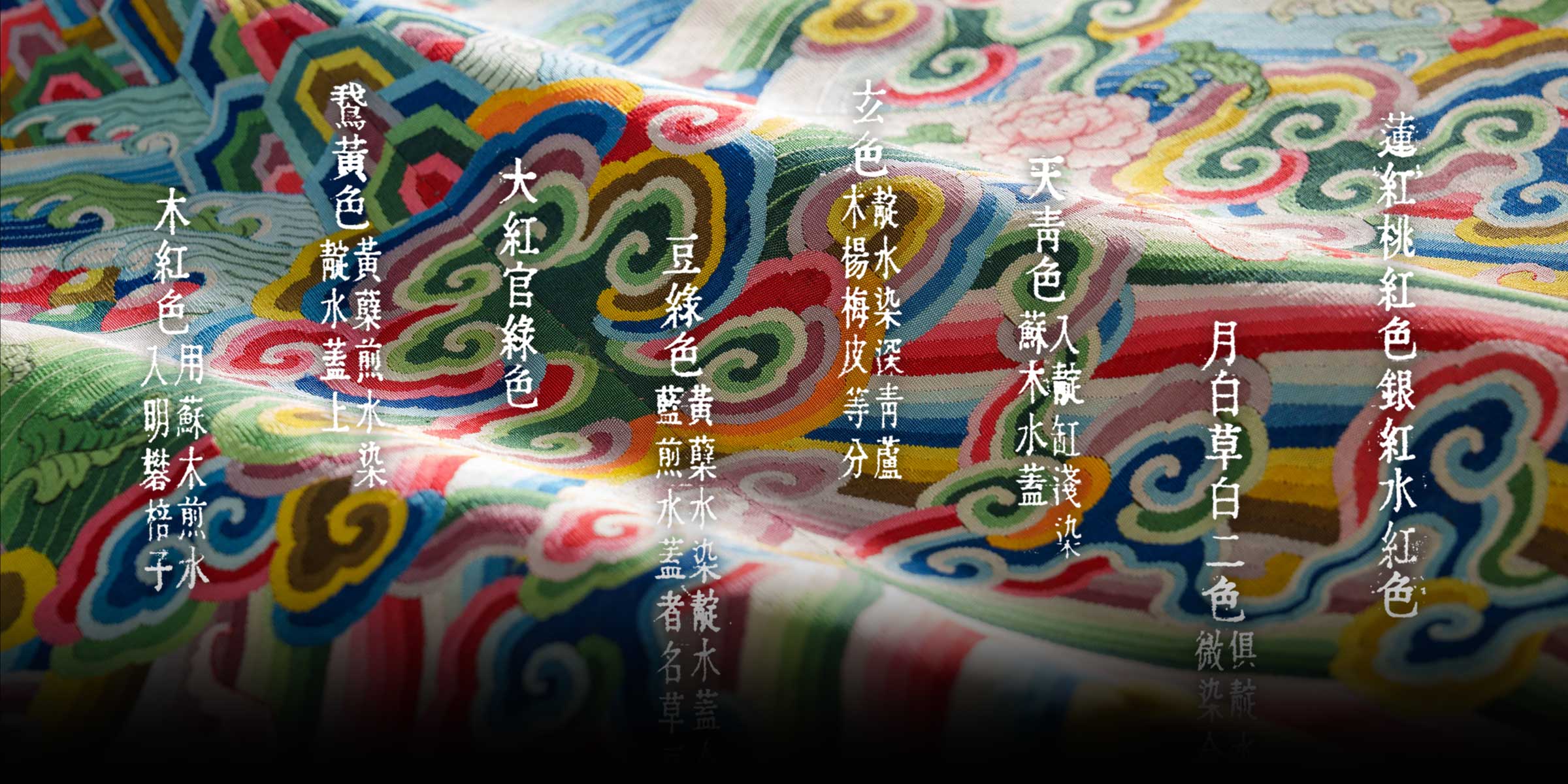
Another example is zi, or “purple.” Examining the cloud and wave motifs on Qing imperial dragon robes reveals how the color evolved over successive reigns, from dark brownish shades early in the dynasty to mauve hues in the middle period and brighter purples in the late Qing.
Furthermore, in ancient China, color was not simply something to admire or enjoy. It also symbolized divine authority and helped define ritual conventions and social hierarchies, distinguishing the central government from local authorities and the nobility from ordinary people.
Ancient China developed a five-color system associated with concepts such as the five directions and five elements. Qing, chi (vermilion), yellow, white, and black were the five primary colors, while green, red, bi (jade), purple, and liuhuang (“flowing yellow”) were the five auxiliary colors. Successive rulers used these distinctions between primary and auxiliary colors to reinforce social hierarchies.
During the Qing dynasty, for example, the emperor’s ceremonial attire followed a four-color system from the middle of the dynasty onward. He wore tianqing, “celestial blue,” when performing sacrifices to Heaven; minghuang, “bright yellow,” for sacrifices to Earth; dahong, “deep red,” for sacrifices to the Sun; and yuebai, “moon white,” for sacrifices to the Moon.
The Qing imperial court also expanded the use of yellow in imperial dress, a practice dating back to the Sui (581–618) and Tang (618–907) dynasties. Strict rules determined who could wear particular shades. Minghuang, “bright yellow,” was reserved for the emperor, empress dowager, empress, and imperial noble consort. Xinghuang, “apricot yellow,” was restricted to the crown prince and crown princess, while jinhuang, “golden yellow,” was worn by princes, noble consorts, and consorts. Xiangse, “fragrant yellow,” was designated for imperial concubines and various ranks of princesses and princely consorts.
Clearly, color swatches alone cannot convey such rich cultural meanings and historical details. But the problem goes beyond how we reconstruct traditional colors. It also concerns how we understand history itself.
Modern industrial products are generally designed for mass consumption, often favoring simplicity and practicality. By contrast, many of the objects that have survived from ancient China belonged to emperors, empresses, and other powerful figures. The differences between their world and ours, in social context, cultural values, and everyday life, mean that interpreting these objects through a modern lens can easily lead to superficial conclusions or misunderstandings.
This brings us back to today’s enthusiasm for traditional colors on social media. China’s color traditions never formed a fixed, unchanging system, and preserving a tradition involves more than simply reproducing the past. It is a process of critically engaging with what came before, deciding what to discard, what to preserve, and what to adapt or develop further.
But meaningful preservation must begin with an understanding of the historical traditions themselves. That means looking beyond individual colors to examine the contexts in which they emerged, how their meanings and uses changed over time, and the cultural, social, and material relationships that shaped them.
Translator: David Ball; portrait artist: Wang Zhenhao.
(Header image: Visuals from the Palace Museum, reedited by Fu Xiaofan/Sixth Tone)