Digging Into China’s Overlooked World War I History
When most Chinese people think of World War I, they think of it as a “European war.” This is not simply an oversight. It is the result of a century of forgetting.
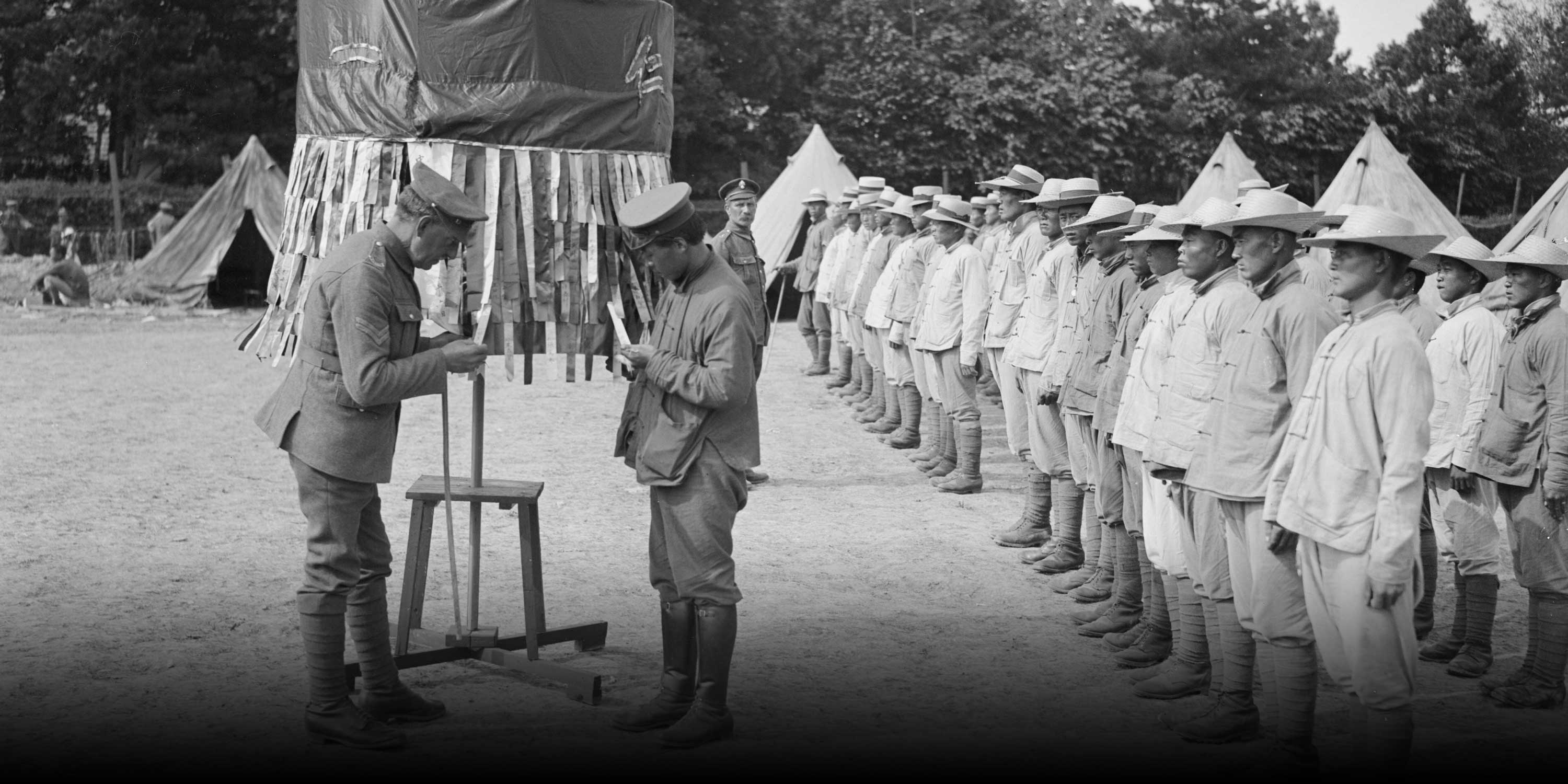
Few people are aware that between 1916 and 1918, Britain and France recruited around 140,000 Chinese laborers from Shandong, Hebei, Guangdong, Hong Kong, and other regions to work on the Western Front. They dug trenches, built defenses, and transported ammunition. After the fighting ended, they stayed on to help with reconstruction, clearing battlefields and filling in shell craters. Some did not return home until 1922.
Sending laborers overseas was not simply a matter of supplying manpower. It was also part of a carefully considered political strategy. Politicians such as Liang Shiyi — an influential adviser to then-President Yuan Shikai — believed that Germany and Austria-Hungary were unlikely to defeat Britain and France, and advocated a “laborers-as-soldiers” strategy that would allow China to participate indirectly in the war and break its diplomatic isolation. Meanwhile, figures associated with the New Culture Movement, an early 20th-century intellectual and cultural reform movement, saw sending laborers overseas as an opportunity to develop China’s working class. They included Li Shizeng, a French-educated anarchist and organizer of the Diligent Work-Frugal Study Movement, and Cai Yuanpei, a leading educator and president of Peking University.
Yet China’s participation in the Allied war effort did not bring the diplomatic gains its leaders had hoped for. At the 1919 Paris Peace Conference, the victorious powers agreed to transfer Germany’s former rights in Shandong province to Japan rather than return them to China, a decision that helped spark the May Fourth Movement, a wave of student-led protests that became a turning point in modern Chinese history.
The contributions of the Chinese laborers themselves also received little recognition. When they returned home in the 1920s, they found a country gripped by political upheaval and were often met with indifference or even suspicion.
The result was a double erasure. The West forgot their contributions, while China forgot their sacrifices.
In July 2019, a delegation from Belgium’s In Flanders Fields Museum visited Shanghai University. The two institutions agreed to jointly investigate, excavate, study, and exhibit the remains of Chinese labor camps on the Western Front during World War I. By then, scholars from the United Kingdom, France, Belgium, Germany, Canada, and other countries, led by Professor Nicholas J. Saunders of the University of Bristol, had spent nearly a decade systematically surveying the physical remains and landscapes of the Western Front. Yet the Chinese labor camps remained a missing piece of the puzzle. Although frequently mentioned in historical records, they had never been systematically investigated or excavated by archaeologists.
In May 2023, Shanghai University officially launched the Chinese Labour Corps (CLC) Camp Project, in collaboration with the In Flanders Fields Museum, Ghent University, and Howest University of Applied Sciences. A non-invasive geophysical survey was completed in April 2024, and excavation began in February 2025. The project concluded in March 2026.
Before we began digging, information about the Chinese labor camps could be found in historical documents, but it was fragmented. Official military archives paid little attention to these noncombatants from China, while local records offered a more vivid picture. One example is the diary of Belgian priest Achiel Van Walleghem. In August 1917, he recorded the presence of two Chinese labor camps in the village of Reningelst, near the Belgian town of Ypres, a major battleground during World War I. In January 1918, he noted that some shop owners had begun learning Chinese to attract the laborers. And on the night of April 13, 1918, when one of the camps came under German artillery fire, he recorded 10 deaths and more than 30 injuries. In fact, the threat of shelling had already prompted strikes and protests among Chinese laborers in late 1917. British military records provided another crucial detail: the 75th Company of the Chinese Labour Corps was stationed there from August 1917 to April 1918. Gu Xingqing, an interpreter for the Chinese laborers, also described the night of the bombardment in his memoirs.
Historical records also reveal differences in how the British and French treated Chinese laborers. Those recruited by the French worked alongside locals under relatively loose supervision, making the remains of their camps difficult to identify. By contrast, British-recruited laborers — organized into the Chinese Labour Corps — were subject to military-style discipline and housed in enclosed camps surrounded by barbed wire. The camps followed a military organizational structure. Initially, each battalion consisted of 1,031 men, with 10 to 12 sharing a tent. Each camp had just one iron gate, which was locked at night. To leave, the men had to obtain permission and travel in groups, and they were forbidden from venturing more than 3 miles away.
Documents even record how the laborers died and were commemorated. The leading causes of death were tuberculosis and the 1918 influenza pandemic, rather than artillery fire. However, the death tolls vary considerably: British records put the figure at around 2,000, French records at approximately 1,500, while Chinese figures suggest that at least 20,000 did not come back to China. Chinese laborers recruited by the British were buried in military cemeteries. Their headstones followed the same style as those of British soldiers, but bore inscriptions in both languages, including the laborers’ names and places of origin in Chinese, alongside English epitaphs such as “Though Dead, He Still Liveth” and “A Noble Duty Bravely Done.”
After the war, returning French and Belgian residents sometimes blamed the surviving Chinese laborers for social unrest. Yet the laborers were still bound by their contracts and remained to clear the battlefields. Some stayed in France to work in mines until 1929, while others married and settled there permanently.
In June 1921, the British military issued a total of 93,357 commemorative medals at its Chinese labor base in Shandong’s port city of Qingdao. Some were presented in person, while others were mailed to the laborers’ homes. Even today, these medals can occasionally be found in remote villages across Shandong and Hebei.
If historical records tell us so much, why was archaeological excavation necessary? Because documents can tell us where the camps were and what happened there, but they cannot fully reveal what the camps looked like. Their layouts were never systematically recorded, and the sites had long since been cleared and leveled after the war. This is where archaeology comes in.
The non-invasive geophysical surveys of the site we commenced in spring 2024 used high-resolution electromagnetic induction and magnetic survey techniques. The data revealed numerous anomalies at depths of 1 to 1.5 meters, including fragments of artillery shells of various calibers. This was consistent with local farmers’ accounts of still unearthing shrapnel when plowing their fields.
The two intersecting trenches excavated in February 2025 covered 512 square meters. We uncovered two ash pits with traces of burning at their bases, eight shell craters ranging from 1 to 5 meters in diameter, foundation stones from barracks, tent pole bases, and clusters of communication cables. For the first time, we were able to reconstruct the layout of a camp whose physical arrangement had never been documented, identifying its barracks, tent area, and main road.
We also unearthed more than 520 artifacts that offered glimpses of everyday life: belt buckles, Royal Engineers and Royal Artillery cap badges, surgical forceps from a field hospital, piles of bullet and shell casings, and nearly intact British army-issued rum jars and lemonade bottles. If historical documents help us understand the Chinese labor camps, archaeology brings us closer to the people who lived in them.
The significance of the project extends beyond the discoveries themselves. For a long time, World War I archaeology was mainly the preserve of metal detectorists, while professional archaeologists generally avoided the subject. This began to change with archaeological investigations conducted ahead of construction of Belgium’s A19 highway in 2002, which helped establish the field as a serious area of academic research.
Our excavation of the Chinese labor camp was the first of its kind to be led by a Chinese academic institution.
The project also opened up new avenues for Chinese archaeological research in two fields. The first is conflict archaeology, which looks beyond weapons and battlefields to examine entire societies caught up in war. The second is industrial archaeology, which can shift attention away from industrial achievements alone and toward the people and human efforts behind them. At its heart, this approach is about focusing on people rather than objects.
The Chinese laborers were not merely supporting characters in World War I. They found themselves caught up in a conflict involving Eastern and Western societies, working and dying amid misunderstanding and hostility. Yet even in the face of constant danger, they found ways to express themselves, creating trench art engraved with dragon motifs and landscape scenes.
Even the idyllic scenery of Flanders today was partly shaped by Chinese laborers, who filled in many of the trenches and craters left by the war. The experiences of these 140,000 ordinary Chinese men lie at the intersection of 20th-century Chinese and world history, reflecting the interactions and tensions between different societies.
“In Flanders fields the poppies blow / Between the crosses, row on row,” wrote John McCrae in his poem “In Flanders Fields.” Today, the poppies still bloom every year. But among those fields and crosses, Chinese laborers once lived and worked. Archaeology cannot bring them back to life, but it can give the soil a voice and remind the world that they were here.
Translator: David Ball; portrait artist: Wang Zhenhao.
(Header image: A British soldier and a Chinese laborer examine written identification ribbons during a roll call at a Chinese Labour Corps camp in Samer, France, May 26, 1918. From the collection of the Imperial War Museums)