She Is Chinese Opera’s Greatest Star. And Its Most Divisive.
For Chinese opera fans, 2026 will surely be remembered for one thing: Mao Weitao’s triumphant return to the stage.
Few outside China may have heard of her, but the 63-year-old is a titanic figure in her chosen discipline, Yue opera, and part of that rare group of artists who transcend their field to achieve crossover fame.
Over her nearly 50-year career, Mao has fearlessly reinvented the traditional art form, dragging it back into China’s cultural mainstream through a series of daring — and often provocative — creative choices.
From shaving her head to play Kong Yiji, the poor male scholar and eponym of Lu Xun’s classic short story, to producing “The New Dragon Gate Inn,” hailed as China’s first immersive opera show, she has continually pushed the boundaries of what a Yue opera can be.
The innovations have helped her achieve unprecedented commercial and critical success. But they have also made her a polarizing figure: even today, she jokes that she feels like she should wear “a bulletproof vest” whenever she premieres a new work.
Mao’s journey began at 17 with her first bow in Yue opera — one of around 300 regional varieties of traditional Chinese opera, originating in the city of Shaoxing in eastern China’s Zhejiang province.
Yue opera is known for being the only Chinese opera style in which female performers play every role — including male characters — and Mao quickly stood out for her rare ability as a kunsheng: an actress able to infuse male roles with beauty and elegance.
Within five years, she became the first ever Yue opera performer to receive the Plum Blossom Prize, China’s highest honor for theatrical performance. She has since won the award twice more — the only Yue opera actress in history to receive the so-called Plum Blossom Grand Prize, given to those who win the honor three times.
Yet she has also sparked plenty of outrage. Her raw, stripped-back portrayal of Kong Yiji in 1998 — which saw the 36-year-old Mao appear onstage with a buzzcut and dressed in rags — violated every norm of Yue opera, which traditionally seeks to delight audiences with lavish costumes and graceful performances.
A heated debate over the merits of tradition versus modernization followed, as critics accused Mao of sacrificing Yue opera’s soul for the sake of her creative vision. But ticket sales were excellent — and Mao continued to forge her own path.
After stepping back from performing in the mid-2010s, she co-launched her own production company — Baiyue Cultural Creative — with partners including the Chinese tech giant Alibaba and a Zhejiang Yue opera troupe. More experimentation followed.
In 2023, Baiyue debuted “The New Dragon Gate Inn” — an immersive Yue opera based on a hit 1992 Chinese martial arts movie. The first Chinese opera show of its kind, it followed a format similar to immersive stage shows like “Sleep No More,” letting the audience move freely through a recreation of the inn as the actors performed around them.
When the show became a massive commercial success — turning lead performers Chen Lijun and Li Yunxiao into stars — it felt like Mao was passing the baton to the next generation. Mao, however, had other ideas.
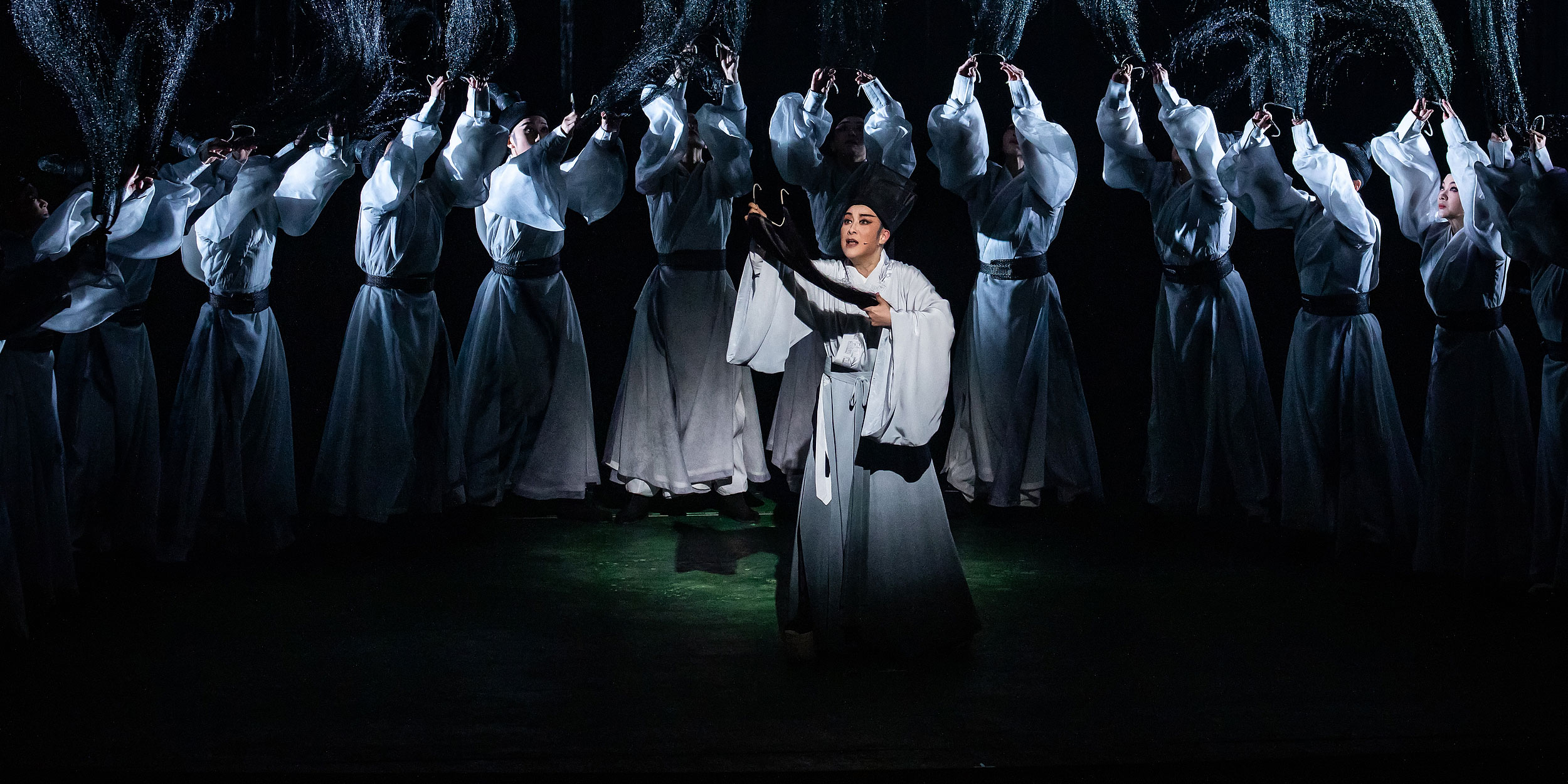
Earlier this year, she unexpectedly returned to the stage for the first time in nearly a decade in the new show “Su Dongpo” — an opera based on the life of one of China’s most beloved poets.
With Mao in the title role of Su, it is one of her most avant-garde productions yet. The show ditches Yue opera’s traditional linear narrative structure, instead leaping from one episode in Su’s life to another in a style Mao likens to Christopher Nolan’s movie “Inception.”
Critics have complained that “Su Dongpo” looks more like a Broadway musical than a Yue opera. But Mao has grown used to such comments: after decades in the spotlight, she knows she’ll never please what she describes as “traditionalist” opera fans.
The opera’s ending even reads like Mao’s preemptive answer to the controversy she knows the show will provoke. “Who’s afraid?” she asks, echoing a line from Su’s celebrated poem “Calming the Waves.”
In this interview, Mao discusses the new show, its reception, and the broader struggle to revive Chinese opera without losing its essence. The interview has been edited for brevity and clarity.
Sixth Tone: Su Dongpo ranks among China’s greatest cultural icons. What inspired you to create a show based on his life?
Mao: Su Dongpo’s life was full of dramatic turns. He once rode high in his prime, then suddenly hit rock bottom and was driven from place to place in exile. Yet he always remained at ease with himself — he had a natural gift for dealing with hardship. As I see it, he kept his feet in the mud while flowers bloomed in his heart.
At my age, with so many years of stage and life experience, I need a role with exactly this kind of depth, dramatic expressiveness, and tension. Ten years ago, I probably couldn’t have played him. Now, the timing feels just right. My looks may not be what they were, and my voice is no longer as clean as it was — but that heavier, thicker texture happens to suit the role.
Honestly, I think I’m quite like Su Dongpo — “an incorrigible optimist.” When I run into difficulties, I get a good night’s sleep, have a good meal, and my troubles pass. A while ago, when we performed in (the eastern city of) Nanjing, I bumped into a good friend, the writer Bi Feiyu. He asked me, “If Su Dongpo were a woman, what do you think she’d be like?” I answered with one word: “Me.”
Sixth Tone: Your emotional resonance with Su is clear onstage. But is it true that the creation of this show was also a difficult process?
Mao: It was. At the lowest point — when we were rehearsing the passage built around his most famous work, “Charm of a Maiden Singer: Memories of the Past at Red Cliff,” I found I simply could not go on. I had no idea how the music should be presented, how the vocals should sound, or how it should be performed.
But this impasse ended up handing me the key to a breakthrough. I thought of the rankou technique — a tradition of using stylized false beards to highlight a character’s personality and emotional state — and decided to turn to that ancient craft for help.
Yue opera doesn’t use the rankou, so I traveled to (the northern province of) Shanxi to study beard technique under Li Yuexian, the celebrated female performer of male roles in Jin opera. What I picked up was only the basics of the art — but it mattered enormously. I had found the key that unlocked the door to Su Dongpo. I knew how to play him.
Sixth Tone: That section is particularly powerful. It’s rare to see the rankou used that way — not hanging quietly, but torn off and wielded in a fierce dance. It became more than a marker of gender and age, instead signifying Su Dongpo’s creative, social standing – and something else that resists being put into words.
Mao: I was indeed trying to transform the rankou technique into a “second face” for building the character — a vehicle for Su Dongpo’s complex emotions and the shifts in his attitude towards life. This kind of artistic grafting across opera genres is also an exploration of what might be possible when Yue opera kunsheng portray middle-aged and elderly men.
That said, although the rankou solved one of my biggest creative problems, the production was still extremely difficult to rehearse — we halted rehearsals three times before it finally premiered. That process itself was very “Su Dongpo.” The hardships I went through in rehearsals helped build the character. The closer I drew to Su’s spiritual world, the more it nourished me. Every performance I give is a process of self-growth. Playing Su Dongpo has made me grow once again.
Sixth Tone: You have said more than once that playing Su Dongpo was a healing process.
Mao: Yes — and not only was I healed; I think the audience was, too. I have been thinking a lot about one question recently: China has so many celebrated literati; why is Su Dongpo so especially beloved?
We revere the unyielding passion of Qu Yuan — who drowned himself in the Miluo River after the fall of the capital of Chu, the ancient kingdom where he served as a loyal minister — and admire Tao Yuanming’s return to a pastoral life. But we cannot live the way they did: those paths are impossible to replicate in contemporary society.
Su Dongpo’s attitude toward life, by contrast, offers practical wisdom that remains useful for anyone living today. His life went through peaks and troughs, yet he never sank. He forged a path forward through adversity and kept his composure even amid the storms. And he loved life: he loved cooking, he loved making friends.
These qualities may be exactly what comforts people today. The fast pace of life, emotional exhaustion, uncertainty — everyone suffers some degree of anxiety. And Su Dongpo’s answer is neither escape nor resistance, but acceptance.
From this perspective, I believe this play can be embraced not only by Chinese audiences today, but by international audiences as well. How can Yue opera go global? I have thought about that question for many years, and I have done a great deal of experimenting. In my view, this production can go global, because Su’s spiritual state has the power to resonate with audiences of different countries and cultures.
Foreign viewers may not understand the conventions of Yue opera, may not be familiar with Song dynasty history, may never even have heard of Su Dongpo — but they can understand how a person faces the vicissitudes of fate and maintains dignity and gentleness in adversity.
Sixth Tone: Speaking of going global, the lighting, movement, stage design, and even some of the music all feel very modern. Were international audiences on your mind while you were rehearsing?
Mao: Not at all. Our first consideration was still the domestic audience. Today’s audiences have seen so much. The traditional “one table and two chairs” staging is fine as far as it goes, but it may no longer satisfy people’s aesthetic needs when it comes to how stories are told and opera is experienced. What we have been exploring all along is how a comprehensive stage aesthetic can connect with contemporary audiences and deliver the emotional value that modern people are looking for.
Sixth Tone: You have always been a “reformer” of Yue opera. In your mind, is there anything about Yue opera that must absolutely never change?
Mao: Sure. First, the dialect of Yue opera must not change. Its language and phonology are Yue opera’s most distinctive artistic markers and a living embodiment of eastern China’s Jiangnan culture. Pronunciation gives rise to melody, and melody gives rise to vocal style; the soft, lilting local accents carry Yue opera’s original spirit and warmth. To abandon the dialect would be to lose the soul of the genre.
Second, performance style centered on all-female Yue opera troupes must not change. Since the first women’s training school was founded in 1923 and all-female Yueju opera went on to become mainstream, this uniquely captivating aesthetic has shaped the genre’s grace and vitality, and set Yue opera apart from every other form of Chinese opera. We must keep passing down and developing this distinctive artistic character.
Third, the aesthetic centered on xieyi — suggestive, imagistic expression — must not change. Xieyi is not only the aesthetic hallmark of Yue opera; it is the aesthetic hallmark of all traditional Chinese art. This beauty of suggestion runs through every detail of vocal design, performance, and stage setting, and is core to traditional Chinese art. We should always hold fast to this essence of Eastern aesthetics, and find a new national style that belongs to the present moment
(Header image: Mao Weitao (center) stars in the premiere of the Yue opera “Su Dongpo” in Hangzhou, Zhejiang province, Dec. 29, 2025. VCG)