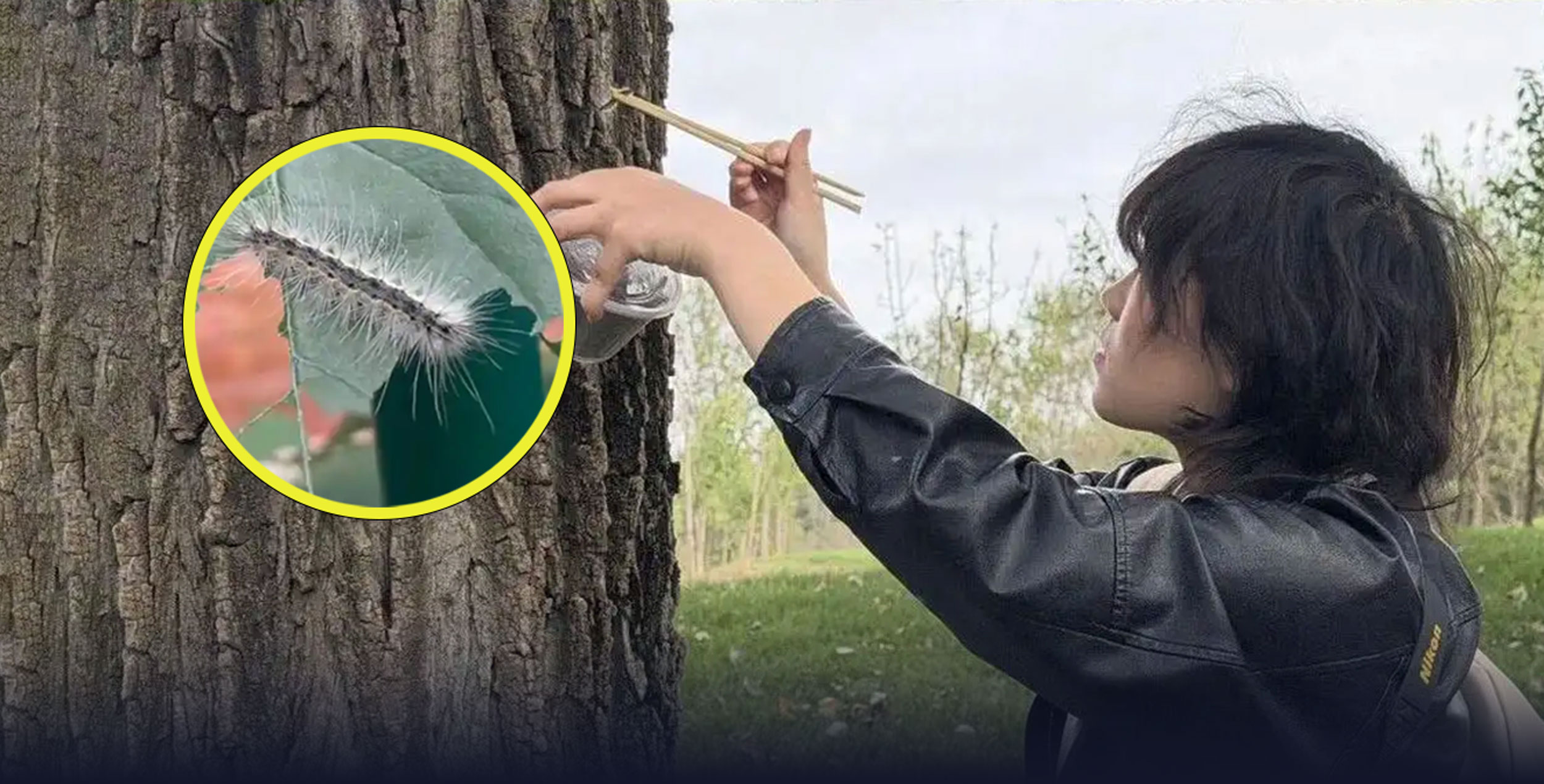
Bug Bounty: Beijing Park Recruits Visitors Against Invasive Moth
Beijing Wildlife Park has turned its fight against a surge of invasive caterpillars into a public contest, offering up to 10 park tickets to visitors who collect the heaviest haul each day. From Sept. 28 to 30, participants caught an estimated 120,000 larvae weighing a combined 18.5 kilograms.
The safari-style zoo on the capital’s southern outskirts announced the event with a call for “warriors” to battle a leaf-eating pest it dubbed the “forest food monster.” Initially scheduled for two days, the contest was extended through Oct. 7 after drawing strong interest and now runs throughout the weeklong National Day holiday.
Participants first register and receive a brief lesson on identifying the pest before staff hand out disposable gloves, food containers, and chopsticks. They search the park for larvae and submit their catches by 2:50 p.m., when staff weigh them and determine the day’s rankings. The captured caterpillars are destroyed rather than fed to the park’s animals.
Prizes are awarded each day based on the total weight collected. The first-place entry receives 10 park tickets, with five for second place and two for third. Everyone who participates receives a commemorative pin, while those finishing fourth through 10th also receive a themed headband.
Competition was stiff from the opening day. A visitor surnamed Liang collected about 4,000 caterpillars weighing 596.3 grams, filling six containers but finishing second. The winning entry came from a five-person team that brought in 1,069.5 grams, while third place went to a catch weighing 391.4 grams.
“The winners were a team of five and caught nearly twice as many as I did,” Liang, a pianist who has visited the park for a decade, told Beijing Daily. “I couldn’t keep up.”
Liang said there was no particular trick to catching the caterpillars, though she found more in less crowded parts of the park and in the shade beneath taller trees. “I brought my own plastic bottles and tweezers, which I found more convenient,” she said.
The winner on the second day, Zhang Hanfang, 18, collected 1.3 kilograms with a six-person team. A taxidermist who runs a studio specializing in insect, reptile, and bird specimens, he made the two-hour drive from neighboring Hebei province with a friend’s family the day after seeing the park’s announcement. The group shares an interest in natural science.
“There’s no secret,” Zhang told Sixth Tone. “Just keep your eyes on the trees and keep at it. It was intense and thrilling. The contest also satisfied our October itch to go bug hunting.”
A video about the contest posted on the lifestyle app Xiaohongshu, known in English as RedNote, received more than 31,000 likes and 1,400 comments. One commenter described the initiative as “crowdsourced debugging,” while a related hashtag on Weibo attracted nearly 3 million views.
In recent weeks, residents across Beijing have reported seeing fall webworm caterpillars — the larvae of an invasive moth native to North America — on sidewalks, balconies, and even people’s shoulders.
The city is experiencing the peak larval period of the pest’s third generation this year, with mature larvae descending from trees in search of sheltered places to pupate and survive the winter.
Yang Zhongqi, chief scientist at the Chinese Academy of Forestry, said the species is a major invasive pest that threatens more than 300 plant species, including forest and fruit trees, flowers, and crops.
“During severe infestations, the caterpillars can strip a tree of every leaf, damaging urban greenery and hindering the tree’s growth,” Yang said. “But they do not kill the tree.”
Beijing had released nearly 700 million parasitic wasps this year before beginning the release of another 400 million on Sept. 28. Harmless to people and pets, the wasps lay their eggs inside fall webworm pupae, preventing adult moths from emerging.
Yang Sihan, head of monitoring and forecasting at the Beijing Gardening and Greening Resources Protection Center, attributed this year’s surge to a cyclical pattern of severe outbreaks, warmer winters, and frequent summer rain that disrupted spraying.
At sites monitored over five consecutive years, the survival rate of overwintering pupae rose from 65.3% in 2023 to 84.2% this year, Yang Sihan said. Heavy rain also left fewer clear days for spraying and washed away pesticides after they were applied. A single female moth can lay 300 to 600 eggs and sometimes as many as 2,000.
Editor: Apurva.
(Header image: A participant tries to catch a caterpillar at Beijing Wildlife Park, September 2026. From @北京野生动物园 on Xiaohongshu)