Weaving History: China’s ‘Wig Capital’ Fights to Keep Its Crown
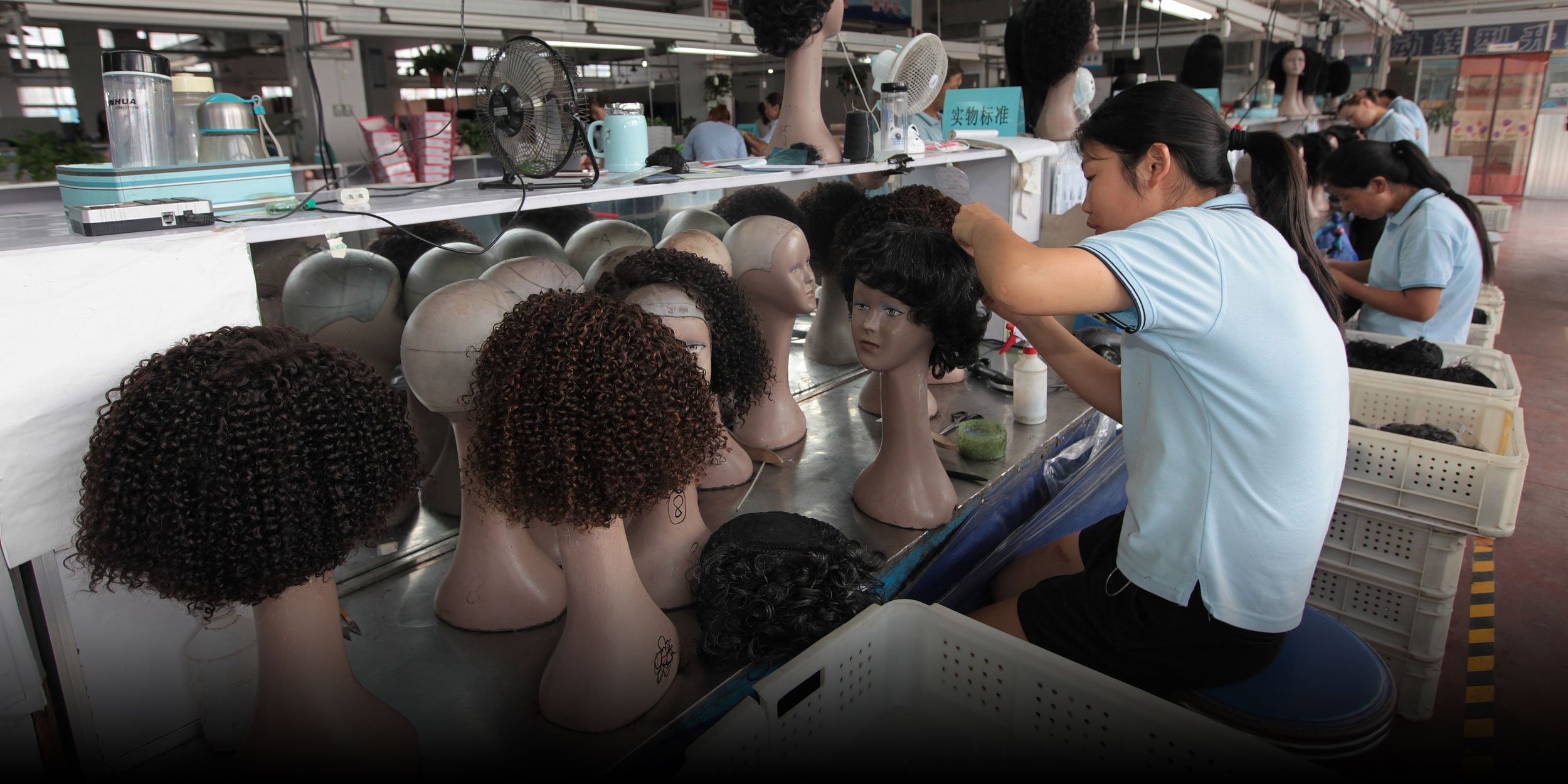
The hair business in Xuchang, in China’s central Henan province, has been growing since the 16th century. Starting from opera props, the city is now the “Wig Capital of the World.”
Roughly 60% of wigs on the global market come from Xuchang. According to the local commerce bureau, the industry’s total import-export value hit 11.56 billion yuan ($1.72 billion) in the first half of 2026, up by nearly 11% year on year.
The core of this pillar industry, Jian’an District, is home to 311 foreign trade enterprises shipping hair products — and business is booming. Yet life behind the sales figures isn’t so rosy.
Although cross-border e-commerce platforms have helped companies reach new markets, including North America and Europe, businesses here say the commissions they charge are making it difficult to turn a profit.
The industry is also facing a potential serious labor crisis, with high-than-average salaries failing to attract more talent, especially younger workers.
Long and short of it
According to local historical archives, people in Xuchang began collecting human hair as early as the Ming dynasty (1368–1644), using it to make theatrical props and fake beards.
It wasn’t until 1900, when Bai Xihe from the city’s Quandian Village collaborated with a German merchant to establish a hair trading depot, that a wider industry began to emerge. Soon, villagers were fanning out nationwide to find supplies, with the raw materials pooled in Jian’an.
By the 1930s, Xuchang had dozens of workshops making processed hair, or dangfa, which was shipped through ports in Qingdao in the eastern Shandong province and Wuhan, capital of the central Hubei province, to overseas markets including Japan and the Philippines.
Dangfa is a semi-finished product made from human hair that has been washed, straightened, sorted, and tied into bundles. It’s a key upstream raw material for wigs.
Many rural families opened small home-based operations, forming the embryo of a cottage industry. The men would travel around the nation collecting hair, while the women stayed home to sort and knot wigs strand by strand, an essential craft that takes at least six months to master.
“An industrial ecosystem doesn’t come together overnight,” says Tian Liangjun, vice president of the Xuchang Hair Products Association, established in 2004. “Our industry has more than a century of accumulated history. The raw materials, the talent, the technology, the market intelligence are all here — and so are the supporting accessories, equipment, printing, and packaging.”
By the time China began to open its economy in the late 1970s and early ’80s, Xuchang possessed the raw materials and manufacturing capacity, but companies from South Korea had control of the network channels to overseas markets. They purchased hair and semi-finished goods from Xuchang and sold finished products to beauty supply stores in the United States. Chinese enterprises were consigned to contract processing, with limited profits and little market leverage.
“In the past, more than 80% of the U.S. hair-product market was controlled by South Korean companies. They had us by the throat,” Tian says. “We depended on them, so when South Korean agents came to Xuchang to inspect the goods, they acted like they were above us. Some of us even had to bring them bowls of water to wash their hands at the end of their inspection.”
However, things changed in 1990, when entrepreneur Zheng Youquan founded the Xuchang Hair Products General Factory, which saw local businesses advance to producing finished wigs.
Zheng was born in 1954 in the city’s Xiaogong Village and learned wig-making as a child before entering the hair processing trade in the ’80s.
When he opened his own factory, he faced a major challenge: the three-head sewing machine, a core piece of equipment, wasn’t made in China and no foreign manufacturers would sell him one. So he enlisted the help of a retired factory worker from Qingdao who could draw the machine’s inner workings from memory, which a team of local engineers then used to build it.
Using this technology, Zheng’s plant produced Xuchang’s first wigs for foreign buyers, branded Qicai Xiufa, meaning “colorful tresses.” Three years later, he established Rebecca Hair, a Sino-U.S. joint venture with Sina International Corp., and entered the North American market. In 2003, Rebecca became the first hair-product enterprise listed on the Shanghai Stock Exchange.
Tian believes Zheng helped catapult the local industry to a new level, transforming the city from a trading hub for raw materials into a major production base for finished goods.
Cutting out the middleman
The emergence of cross-border e-commerce in the mid-2010s was another game changer. Global platforms such as AliExpress and Amazon enabled Xuchang manufacturers to bypass the middleman and deal directly with overseas consumers, as well as create their own brands.
UNice, which specializes in hair products for Black and Latino women, began trading on multiple platforms in 2014 and set up its own sales website about four years later. “We decided to create our own brand and registered trademarks in China, the European Union, and the United States,” says Wang Qi, who works for the brand. “With third-party platforms, you need to play by their rules, and there are all sorts of uncertainties. Building our own site reduced our dependence on platforms and put operations in our own hands. More importantly, we have full control over product quality.”
Some Xuchang companies have also opened warehouses overseas to gain a better understanding of the destination market and to cut costs with cheaper bulk freight.
“In 2025, the cumulative additional tariffs the U.S. imposed on Chinese hair products reached 145% at one point, and the tariff costs on small parcels below the $800 tax-free threshold rose sharply,” recalls Bo Luwen, who runs a wig business in Jian’an. “Surrounding factories shut down because they couldn’t ship anything.” His company had a stockpile in U.S. warehouses, so it was shielded from the market shock.
He adds that warehouses do more than provide cover in emergencies; they also improve the customer experience. A consignment shipped from China to North America can bob on the ocean for weeks before reaching the buyer, whereas goods sent from within the continent can arrive the next day.
OQ Hair, an online brand offering 100% human hair products, released a glueless wig in 2023 that promises to cut application time from 30 minutes to a few seconds. Thanks in part to a short promotional video that garnered 3 million views, the company recorded sales of more than 10 million yuan within six months.
“The rise of cross-border e-commerce completely broke the South Korean monopoly over distribution channels,” Tian says. “We went from contract manufacturing to making our own brands — from passive to active. This was when our industry truly came into its own.”
Split ends
Yet the hard work is far from over. Although cross-border e-commerce platforms led to a breakthrough in distribution, “they bred new problems, too, including relatively high commissions and ever-shifting rules,” Tian explains. “Sellers also can’t autonomously decide what to sell or how to price it.”
The commissions charged by Amazon, AliExpress, and Temu run from 5% to 20%, he says. “This is squeezing our companies’ already-thin margins. It’s hard for sellers on those platforms to make money.”
Another concern is the worsening talent shortage. Many steps in industrial wig-making still require manual labor, and anecdotal evidence suggests that fewer people are willing to work in Xuchang’s factories, especially younger generations. Some businesses are even offering to pay front-line employees 8,000 yuan a month, well above average, yet still struggle to fill vacancies.
A hand-sewn wig takes a skilled worker about a week to complete, and machines cannot fully replace hand-knotting. As older craftspeople are aging out, some skill-intensive tasks are now being outsourced overseas.
Against this backdrop, many companies see only one way forward: abandon the low-end price war in favor of premium, branded products. Leading enterprises are also investing in research and development, hoping to move toward fully automated production.
On the retail side, there’s also Xuchang Hair Expo City, a specialized wig trading and commercial market near the city’s railway station and long-distance bus terminal.
“Xuchang may be the wig capital, but for years, visitors couldn’t find a single place to actually buy one here,” says Tian, who has run the market since it was founded in 2022. ‘There were plenty of manufacturers, but none of them served walk-in customers. The industry had no storefront you could see and touch.”
Inside, shelves are stacked with everything from synthetic wigs selling for a few dozen yuan to hand-knotted wig caps made from 100% real human hair priced at more than 10,000 yuan.
“We want buyers worldwide to know that when it comes to buying a wig, Xuchang is all they need,” Tian says. The market’s annual sales volume, including via e-commerce channels, is now about 200 million yuan, with most customers coming from other regions of China. However, he adds that the number of foreign buyers is increasing.
Whatever happens, Tian believes that genuine quality is the ultimate trump card. “If your goods aren’t good, no one will want them, even if you beg.”
(Due to privacy reasons, Wang Qi and Bo Luwen are pseudonyms.)
Reported by Cheng Ting, Kang Jiaxin, Yang Yuan, and Fang Yuejia.
A version of this article originally appeared in The Paper. It has been translated and edited for brevity and clarity, and is republished here with permission.
Translator: Eunice Ouyang; editors: Wang Juyi and Hao Qibao.
(Header image: Workers style wigs at a factory in Xuchang, Henan province, 2019. VCG)