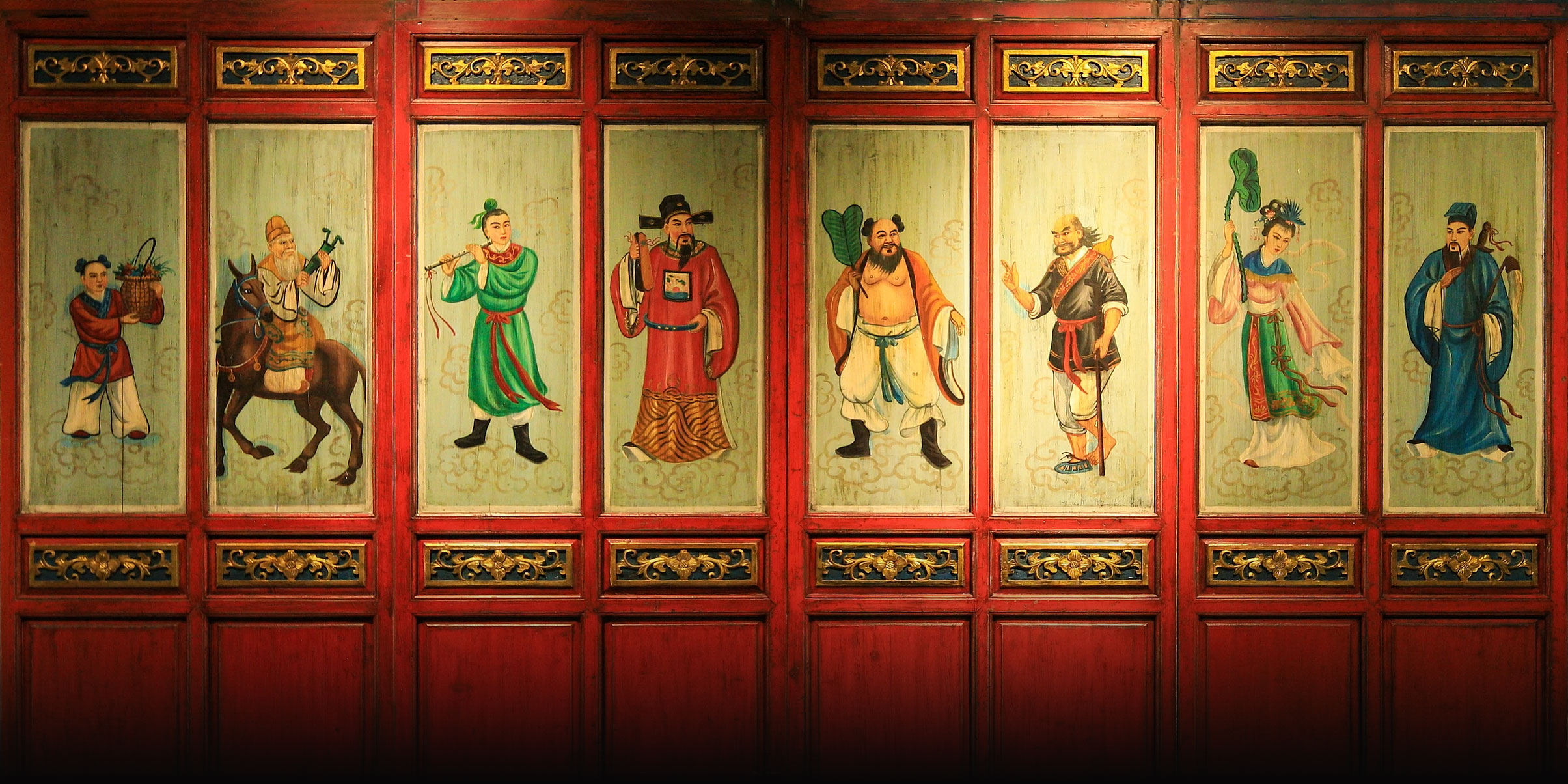
The Enduring Appeal of China’s Eight Immortals
This summer, “All Wishes Come True!” took in more than 1.8 billion yuan ($268 million) at the Chinese box office, becoming the latest in a string of hit animated films inspired by traditional Chinese myths and legends. The movie reimagines the Eight Immortals, a group of legendary figures in Chinese mythology and Taoism, as ordinary mortals who pose as immortals and venture into the celestial realm of Penglai. There, the mismatched group finds itself caught up in a conflict involving powerful gods, including the warrior deity Erlang Shen.
Despite the film’s widespread acclaim, some Taoist friends of mine were far from impressed. They believe it trivializes important figures in Taoist tradition, completely reimagining their stories while simply borrowing the names of Chinese immortals as a gimmick. But how fixed are the stories of the Eight Immortals in the first place?
Firstly, what makes the Eight Immortals — one of the best-known groups of immortals in Chinese culture — so special? And how exactly are they understood within Taoism?
Let’s start with why there are eight. In traditional Chinese culture, the number eight has long been associated with completeness and balance. The “Zhou Yi” (or “Book of Changes”), for example, describes the eight trigrams; traditional cosmology divides space into eight directions; and ancient people worshipped eight agricultural deities collectively associated with the harvest.
Then there are the “immortals” themselves. The Chinese word xian, or “immortal,” has long been associated with hermits who withdraw into the mountains in pursuit of spiritual cultivation. In Taoism, immortals are distinct from shen, or deities, in that ordinary humans can attain immortality through cultivation. Immortals thus occupy a space between the human and sacred worlds, embodying the Tao in the human realm.
Before the Eight Immortals became established as a group, several individual members had already appeared in historical writings and paintings from the Tang (618–907) and Song (960–1279) dynasties, each associated with their own supernatural feats.
Zhongli Quan and Lü Dongbin practiced neidan, a Taoist tradition of spiritual cultivation sometimes called “internal alchemy,” and frequently interacted with the influential Taoist priest Chen Tuan. Zhang Guolao once demonstrated various miraculous Taoist arts before Emperor Xuanzong of the Tang dynasty. Han Xiangzi could make flowers bloom instantly. Lan Caihe was a beggar who wore a shoe on one foot while leaving the other bare, often singing and dancing while intoxicated and carrying a large clapper.
Once they had formed into a group, however, the Eight Immortals did not simply retreat into the mountains or ascend to heaven. Instead, they remained closely connected to the human world. The most representative figure in this respect is Lü Dongbin, who chooses to remain among mortals and save them. He assumes various guises, including those of a fisherman, an ink and paper peddler, a sick beggar, and even a pregnant nun. Stories and images of Lü spread across China, with saving and enlightening ordinary people becoming a central theme in legends surrounding him.
The Yuan dynasty (1279–1368) mural “The Eight Immortals Crossing the Sea” at Yongle Palace in Ruicheng, in northern China’s Shanxi province, shows that the Eight Immortals had by then become an established subject in Taoist art. But closer inspection reveals that the only female member of today’s group, He Xiangu, is missing. In her place is Xu Shenweng, a Taoist figure associated with the Northern Song period (960–1127) who once ranked among the Eight Immortals. In other words, the Eight Immortals were originally an all-male group.
So, when did He Xiangu become one of the Eight Immortals? One early appearance of her as part of the group comes in the Yuan dynasty drama “Chen Jiqing Mistakenly Boards a Bamboo Leaf Boat” by Fan Kang. By the time Wu Yuantai wrote the mythological novel “Journey to the East” during the Ming dynasty (1368–1644), she had become a permanent member of the group.
This change came amid the flourishing of women’s literary and religious activity during the mid-to-late Ming. Like male scholars, educated women participated in religious and intellectual life and produced literary works of their own. In “Journey to the East,” He Xiangu’s defining supernatural ability is her power to foresee good and bad fortune. Born into a family that ran an herbal medicine shop, she possesses medical knowledge and uses encounters with people seeking treatment as opportunities to encourage them to do good.
With the addition of He Xiangu, the lineup familiar today became fixed and increasingly popular. The Eight Immortals eventually became influential enough to attract the attention of European missionaries studying Chinese religion and folklore. French Jesuit Henri Doré (1859–1931), for example, compiled stories about them in “Researches into Chinese Superstitions,” his multivolume study of Chinese popular religion, folklore, and customs.
The Chinese Jesuit priest Pierre Hoang (1830–1909), also known as Huang Bolu, meanwhile, described the Eight Immortals as representing a cross-section of society: the old and young, men and women, the rich and poor, the noble and lowly. In another interpretation, Zhang Guolao represents old age; Lan Caihe and Han Xiangzi, youth; Zhongli Quan, the military; Lü Dongbin, the scholar; Cao Guojiu, the nobility; Li Tieguai, the sick; and He Xiangu, women.
The Eight Immortals thus came to encompass a broad range of social identities and experiences. They had, collectively, seen many sides of the human world, allowing people from different backgrounds to recognize something of themselves in the group. Their differences also created a kind of balance, recalling a passage in Chapter 2 of the “Tao Te Ching,” which states: “Thus existence and non-existence produce each other; the difficult and the easy bring about each other; the long and the short impart form to each other; the high and the low comply [or change places] with each other; sounds and voices harmonize with each other; priority and sequence alternate with each other.”
From the mid-to-late Ming dynasty onward, the Eight Immortals also became a popular decorative motif on ceramics produced in both imperial and private kilns. They often appeared more subtly on everyday objects, including furniture, utensils, clothing, and architectural decorations. Rather than depicting the immortals themselves, artisans represented them through eight objects associated with the group: Li Tieguai’s gourd, Zhongli Quan’s fan, Zhang Guolao’s fish drum, Lan Caihe’s flower basket, Cao Guojiu’s jade tablet, Han Xiangzi’s flute, He Xiangu’s lotus, and Lü Dongbin’s sword. Craftsmen combined these symbols with scrollwork, bats, clouds, and waves to create decorative compositions that also conveyed wishes for longevity, good fortune, and wealth.
Stories about the Eight Immortals were similarly adaptable. Among commoners, plays such as “The Eight Immortals Crossing the Sea” and “The Eight Immortals Assembly Celebrate Longevity” were widely performed. By the Qianlong and Jiaqing reigns (1736–1820) of the Qing dynasty (1644–1911), such stories were increasingly associated with birthday celebrations, with gatherings of the Eight Immortals symbolizing longevity, joy, and good fortune.
Among intellectuals, meanwhile, the Eight Immortals served as a source of creative inspiration. One example is “The Record of Handan,” the last of the “Four Dreams of Linchuan” by the great Ming playwright Tang Xianzu. Rather than focusing on reunion, the play uses Lü Dongbin to explore the illusory nature of worldly ambition.
In the play, Lü meets a poor scholar obsessed with achieving fame and gives him a porcelain pillow. After putting on a pot of rice to boil, the scholar falls asleep and dreams that he marries, places first in the imperial examinations, and spends decades navigating political machinations before becoming a powerful and honored official, only to eventually die from overindulgence. Waking to find his pot of rice still cooking, the scholar realizes his entire lifetime of ambition was merely a brief dream. Lü then begins the process of enlightening him, introducing him to the other immortals, who appear one by one to admonish him until he finally awakens to the emptiness of his desires.
All this shows just how adaptable the stories of the Eight Immortals have always been. Taoist traditions and popular folklore have continually shaped and reshaped one another, producing new versions of the group for different audiences and eras.
In that sense, what is happening to the Eight Immortals today is nothing new.
Translator: David Ball.
(Header image: An Eight Immortals room screen at a museum in Suzhou, Jiangsu province. VCG)