A Dying Tradition? The Haunting Beauty of China’s ‘Day of the Dead’
By 8 p.m. on Aug. 26, the great banyan tree at the center of Boshi Village is already surrounded by offerings. Bowls filled with fresh fruit, roasted meat, and other snacks are stacked rows deep among the tree’s gnarled roots. The air hangs thick with candle and incense smoke.
Locals have laid out the smorgasbord of treats as part of the Shigu festival, a series of rituals predominantly held in southern China each year that is often likened to Mexico’s Day of the Dead.
While it’s far from well-known overseas, Shigu has long been one of China’s most important and vibrant festivals. Like the Day of the Dead, it’s a centuries-old tradition to honor the deceased and draws on a rich mix of religious and folk practices.
But Shigu is also a distinctly local celebration that embodies many unique aspects of Chinese culture — and especially the culture of Chaoshan, the southern coastal region where Boshi Village is located.
Shigu — which literally translates as “feeding the lonely ghosts” — sees communities come together to care for the spirits of the departed: making offerings, chanting Buddhist scripture, and even communicating with the deceased.
It’s unclear when the festival first emerged, but references date back to at least the Southern Song dynasty (1127–1279). For a long time, the Shigu festivities in Chaoshan drew bigger crowds than any other event apart from Chinese New Year.
To grasp Shigu’s significance, it’s necessary to understand how it fits into China’s traditional cosmology. According to Confucian and Taoist practices, families have a responsibility to care for the spirits of their departed loved ones, leaving offerings of food, paper money, and even alcohol to ensure they are comfortable in the afterlife.
But many people die with no children to care for their souls, while seafarers and soldiers often perish far from home and their bodies are never returned to their hometowns. If neglected, these spirits become “lonely ghosts” that wander the Earth, spreading woe and harassing the living.
The Shigu festival is designed to prevent this. Taking place in the seventh lunar month of the traditional Chinese calendar — when Yanwang, the king of hell, is said to open the gates of the underworld — communities lay out offerings for these lonely souls, giving the hungry ghosts temporary relief.
In this, Shigu differs from the Day of the Dead, which is more about families honoring their ancestors. China’s Qingming Festival in early April is perhaps a closer equivalent in that sense, though its traditions of tomb-sweeping and quiet family ceremonies are quite different.
Over the centuries, the Shigu festival has become more elaborate. Offerings are now often accompanied by communal rituals that blend Buddhist and local folk traditions. (In many places, the festival is also called “Pudu,” a name that derives from the Buddhist concept of “universal salvation” — or delivering all souls from suffering.)
In Chaoshan, many groups organize “spirit-writing” ceremonies — a practice akin to using a Ouija board to communicate with ghosts, except characters are written in sand. Others organize processions between local temples and offering grounds, led by officials chanting Buddhist scripture.
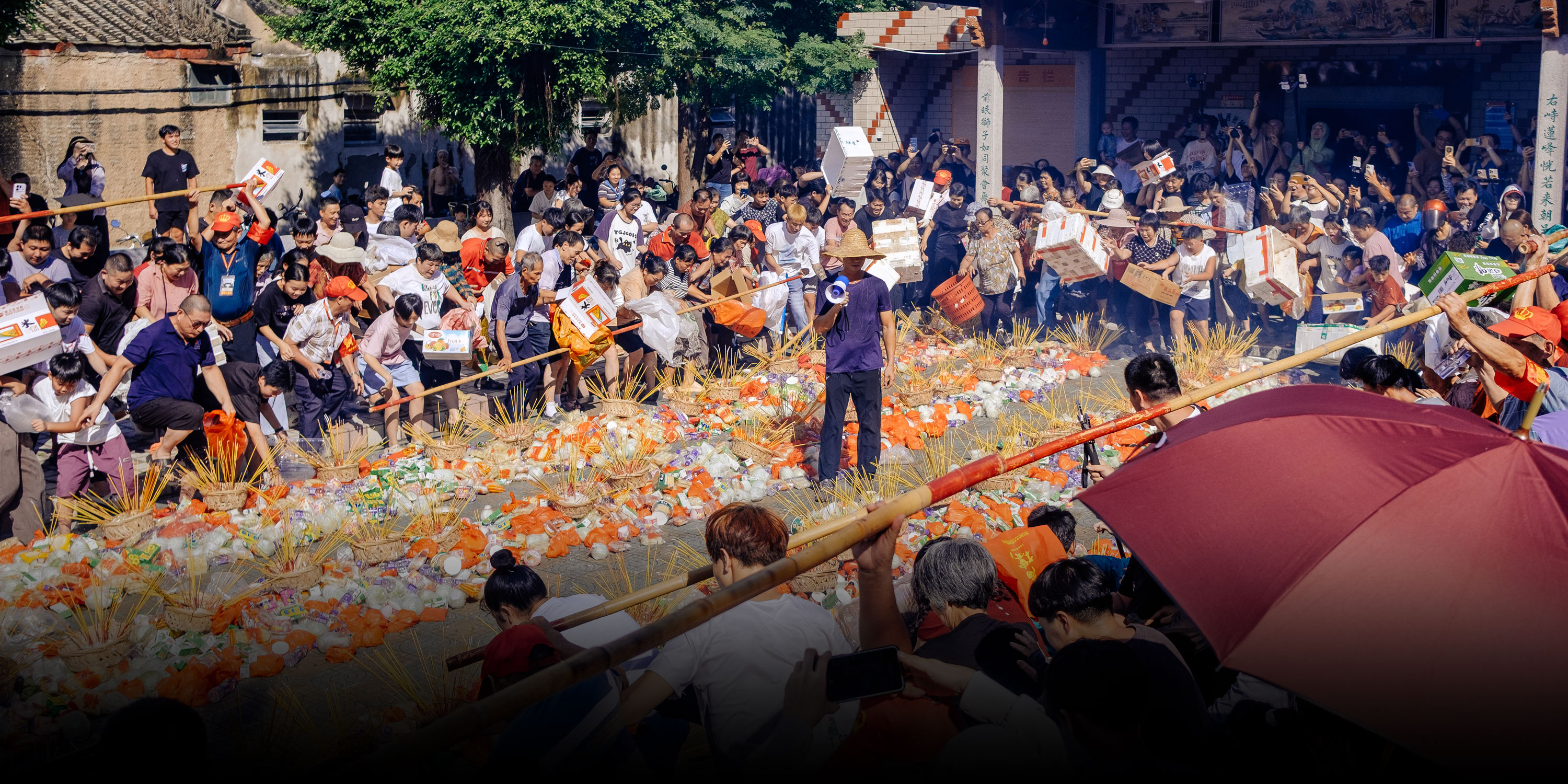
Local charities, meanwhile, donate everything from medicine to coffins to people in need in mass “merit-making ceremonies.” Most famously, the impoverished are allowed to grab the food laid out for the spirits during a ritual known as the “scramble for the offerings” — though these days the contests tend to be infiltrated by a fair number of tourists.
Today, Shigu is still marked across the Chinese-speaking world, but the celebrations are particularly central to life in Chaoshan — a reflection of the region’s turbulent history.
Chaoshan has long had a large population of hungry ghosts. For centuries, wars and uprisings across the region left countless people without a proper burial. More recently, millions set sail from Chaoshan to seek work overseas, forming large diasporas across Southeast Asia and even further afield.
To care for all these wandering souls, towns and villages across Chaoshan still mark Shigu at the end of every summer. Though the 15th day of the seventh lunar month, known as the Zhongyuan Festival, is widely regarded as the height of the Shigu festival, communities hold their ceremonies on different days throughout the month. No one is sure how and when the dates were selected.
In Nansha, a village near the city of Shantou, the Zhongyuan Festival celebrations are in full swing when Sixth Tone visits in late August. Shopkeepers unable to join the collective village ceremony set up tables outside their businesses to lay out offerings. Other villagers gather at the local temple and ancestral hall to organize the main events.
Elderly residents take charge. Some use loudspeakers to blare out appeals in Chaoshan dialect, calling on villagers to donate money and rice for the Pudu. Others fold triangular paper offerings or prepare baskets of “guye fish rice,” a staple offering used in local rituals.
Inside the temple, a group of women performs a ceremony to honor the wandering spirits — known affectionately as guye, or lonely elders. Donated flour, rice, cooking oil, and fruit are piled in front of the temple for needy villagers to collect.
At the ancestral hall, neat stacks of rice cakes, bread, snacks, and baskets of “guye fish rice” are arranged in a courtyard in front of the main entrance. Lin Qiwei, a local village elder, begins a ceremony to make the offerings at 3 p.m., kneeling and chanting a sacrificial text.
“Orphaned souls with no one to claim you, come here and eat,” Lin calls. “Once you have eaten your fill, return each to your place; do not disturb the living; do not frighten the children.”
After the ceremony comes the much-anticipated “scramble for the offerings,” where locals compete to grab the delicacies. Local beliefs hold that consuming food blessed by the spirits brings good fortune. The ritual also serves as a form of charity, to help villagers who have fallen on hard times.
But the “scramble for the offerings” has become controversial in recent years. As the ritual’s fame has grown — with influencers posting videos of the spectacle on Chinese social media — it has begun to attract large groups of outsiders, who often crowd out those who are truly in need.
Yet, despite its viral popularity, the reality is that today’s Shigu festival is a shadow of its former self. In the early 20th century, practically every household in Chaoshan took part in the festivities and incense burned all month long, according to folk-custom researcher Lin Xuejin.
After 1949, the festivals were suspended for decades, as traditional practices and beliefs were discouraged as “feudal superstitions.” They slowly revived after “reform and opening-up” began in the late 1970s, but mass internal migration and breakneck economic development have also taken their toll.
Today, while villages across Chaoshan still hold Shigu, the monthlong community-wide celebrations have dwindled to one-off collective events on selected days, run almost entirely by older residents. Young people are noticeably scarce in Nansha — except for the gaggle of influencers and creators filming and livestreaming the events.
The Chinese internet’s sudden embrace of Shigu can feel jarring. As Lin chants his appeal to the lonely ghosts before an audience mostly made up of retirees, several drones whir overhead, waiting to capture the excitement of the coming “scramble for the offerings.”
But locals hope the trend can help revive the festival. Several villagers say the influx of content creators has encouraged younger generations to value their local culture more — and pushed older residents to keep organizing the ceremonies despite falling attendance.
Fu Xingcong, a Ph.D. candidate at Beijing’s Minzu University of China studying Shigu practices in Chaoshan, tells Sixth Tone that these external forces have strengthened local cultural identity and given the declining tradition a much-needed boost.
Back in Boshi Village, locals are doing their best to preserve the festival in their own way. Chen, a woman in her 40s, drives up from the nearby city of Chaozhou to pay her respects shortly after 8 p.m.
Watched by her teenage daughter, she carefully inserts incense sticks into her specially prepared bowls of braised goose, cured pork, and soft white rice cakes, arranges them on the ground, and then kowtows while murmuring her wishes.
Chen, who gave only her surname, says she returns to her ancestral village for the Shigu festival every summer. Though she moved to the city many years ago, she still feels it’s important to maintain this link to her old home and pass it on to the next generation.
“This was something I absorbed from childhood,” Chen tells Sixth Tone. “Once you grow up and get married, it becomes your responsibility to perform these rituals.”
Cunxin Charity Hall, Downtown Shantou
This article is co-authored by Wu Huiyuan.
(Header image: At the “scramble for the offerings” in Shantou’s Nansha Village, Guangdong province, August 2026. All photos by Wu Huiyuan/Sixth Tone)