How a Rotten Apple Brought China’s Internet Into a Mushroom Lab
What are the odds that two compatible spores from a wood-rotting fungus would land on the same apple, enter through its stem, germinate, meet, and eventually produce a mushroom inside the fruit?
“About the same as winning the lottery,” said Mu Liheng, a researcher at the Yunnan Wild Mushroom Protection and Development Association, in Kunming, capital of southwestern China’s Yunnan province.
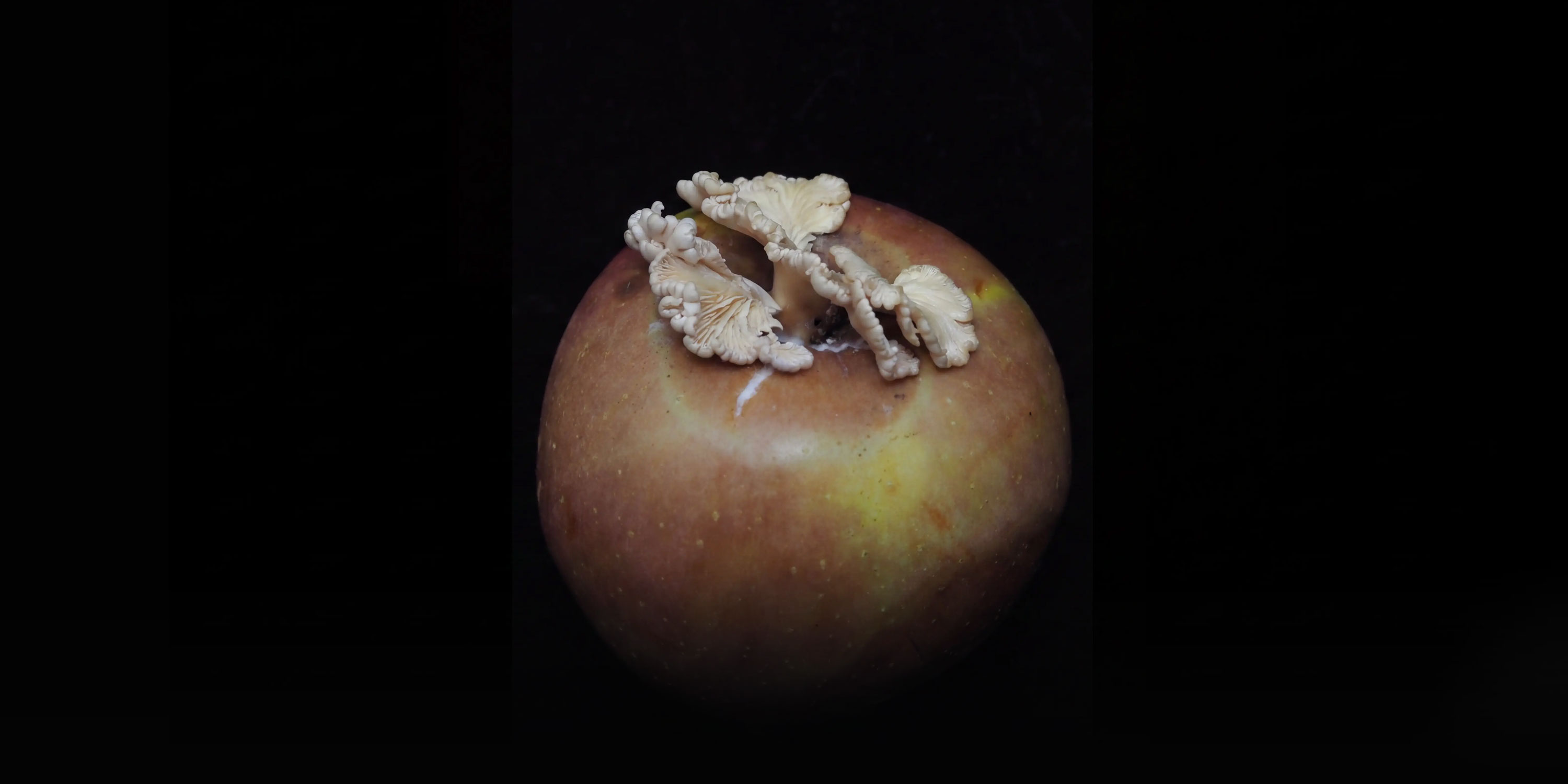
In July 2024, Mu’s colleague Xu Rongju came across a photograph on the lifestyle app Xiaohongshu, also known as RedNote, that appeared to show exactly that: a white, fan-shaped mushroom was growing from the stem of an apple beside a woman’s kitchen sink.
Suspecting the mushroom might be worth studying, he contacted the user, a woman surnamed Deng living in the eastern Zhejiang province, and asked her to send it to him. Two days later, the rotten fruit arrived at the team’s laboratory in Kunming.
Xu’s posts about the team’s subsequent experiments helped turn the discovery into an online sensation, prompting people across China to send in mushrooms found growing on grapes, mangoes, garlic, and even used coffee capsules.
Over the next two years, the researchers drew on some of those specimens, along with strains from an existing breeding program, to develop what they called eight numbered “generations” of split-gill mushrooms.
Two varieties have emerged as particularly promising, and one could eventually reach the shelves of a major supermarket chain.
Rotten luck
The day after the apple arrived, Xu commented beneath Deng’s photograph. “This strain is very strong and has research value,” he wrote, promising to report back when the team made progress.
In one Xiaohongshu update, Xu placed photographs taken a day apart side by side. A dense white network of fungal threads, known as mycelium, had spread farther across the rotten apple. Other images showed the fungus growing rapidly in a Petri dish and thick individual threads under a microscope.
DNA sequencing identified the strain as Schizophyllum commune, commonly known as the split-gill mushroom. The team planned to isolate and purify the culture before moving on to cultivation trials.
Split-gill mushrooms normally grow on dead wood, making the inside of an apple an unusual place to find one. On Deng’s apple, no mycelium appeared in sections that remained intact. It grew most densely in tissue that had already decayed, suggesting the fungus was feeding mainly on the rotten portions.
The apple culture joined more than 1,000 split-gill strains at the team’s laboratory. The team selected about 400 for further crossbreeding.
Edible split-gill mushrooms, known in China as bai shen, can have a dry texture and mildly bitter taste. Mu, who joined the work in 2023, was looking for strains with better flavor and texture, as well as lower spore production, which could reduce respiratory risks for growers.
Some strains in the collection had previously been sent into space through a collaboration with China’s human spaceflight program, including aboard the Shenzhou-12 spacecraft in 2021. After returning to Earth, they were screened for potentially useful mutations, and promising strains were used in further breeding. The apple strain itself was not sent into space.
As Xu’s updates spread online, users gave the apple mushroom a name: “Guo Jun Wang,” or the “King of Fruit Mushrooms.” In Chinese, the name sounds like “Prince Guo,” a character in the hit Qing dynasty (1644–1911) palace drama “Empresses in the Palace.” The pun helped propel the mushroom to the top of the trending rankings on microblogging site Weibo.
Xu used the nickname in a Xiaohongshu update: “You Give Me a Rotten Apple, I’ll Give You Back the King of Fruit Mushrooms.”
“Thank you, Xiaohongshu. I really didn’t expect to find research material here,” he wrote. “Once the experiment is complete, I’ll include everyone in the acknowledgments.”
People asked what the mushroom tasted like, whether it might have an apple flavor, whether it could be grown commercially, and when they might be able to eat it.
A month after mailing the rotten apple to Kunming, Deng received mushrooms cultivated from its strain. She chopped them up, mixed them with eggs, steamed the dish, and documented the entire process online.
By then, more than a dozen people a day were tagging Xu in photographs of mushrooms they wanted him to identify. Over the following year, the researchers received specimens found growing on more than 40 different fruits, foods, and everyday objects, including persimmons, pomelos, cantaloupes, garlic, and used coffee capsules.
One of the earliest contributors was Huang Cheng, a 37-year-old medical equipment business owner in central China’s Hubei province. Days after seeing the apple mushroom online, he removed a used capsule from his coffee machine and noticed several small, white, fan-shaped mushrooms growing from it.
“Normally, I might have just taken a picture and thrown it away,” Huang said.
Instead, he remembered that Deng’s apple had been sent to a laboratory. He photographed the capsule, posted it online, tagged Xu, and asked whether it might also be useful for research.
The post drew thousands of likes. Other users began directing Xu to Huang’s photographs, and within two days, the capsules had arrived at the lab. The team later received similar coffee-capsule specimens from Shanghai and Kunming.
“We were able to see different mushrooms from all over the country, growing on different fruits and all kinds of unusual things,” Xu said. “This really went from a small laboratory to a much bigger laboratory.”
Fruit loop
In the lab, the team isolated a strain from Huang’s coffee-capsule mushroom and crossed it with one of the space-bred strains in the collection.
Their offspring was crisp, heat-resistant, and faintly apple-scented. The team classified it as the fourth generation of the “Guo Jun Wang” series and named it “Xiang Fei,” or “Fragrant Concubine,” after a legendary Qing dynasty consort said to have carried a natural fragrance.
Many of the “Guo Jun Wang” generations, including the Xiang Fei, were not descended from Deng’s apple strain. As the project expanded, researchers used the name for promising varieties they developed, drawing on samples sent in by people online as well as strains already held by the association.
Producing those varieties meant repeatedly crossing and testing hundreds of strains. Mu often worked until midnight, preparing thousands of Petri dishes and checking newly cultivated samples.
“It was too much,” he said. “We didn’t really keep count at the time. There was no set amount of time we spent on it.”
For Xu, the experiments came on top of his doctoral research. “I just thought that if we could grow it and give the internet users an answer, that would actually be something meaningful,” he said.
The first generation of Guo Jun Wang mushrooms “tasted bad and bitter,” Xu recalled. By the second half of 2025, the team had selected more than 10 promising varieties and invited dozens of mushroom enthusiasts to cook and taste them.
“Some have an average texture but look beautiful. Some grow particularly fast. Some have high levels of polysaccharides,” Xu said, referring to the complex carbohydrates that can give mushrooms immune-boosting benefits. “The one that grew on grapes has a very good, crispy texture.”
After more than a year of breeding and selection, another variety stood out in February 2026. Provisionally designated the eighth-generation Guo Jun Wang, it had an unusual growth form and produced very few spores.
The two traits were unrelated, Mu said. The low spore production resulted from a gene segment involved in spore formation failing to be expressed, while a different gene controlled the mushroom’s unusual shape.
In July, Deng received both the eighth-generation and Xiang Fei mushrooms from the laboratory, two years after sending her rotten apple to Kunming.
Small batches of the mushrooms have also been sold through Xu’s Xiaohongshu account for 19.9 yuan ($2.80) per 100 grams. Mu said split-gill varieties identified in China are edible, and that large-scale production would require routine safety checks, including tests for heavy metals and pesticide residues.
However, the number of buyers remains limited because public awareness of split-gill mushrooms in China is still relatively low, Xu said. “If someone has eaten bai shen before, they might have tried them once and thought they don’t taste very good, so won’t eat them again.”
The team has been in contact with e-commerce giant Alibaba’s supermarket chain Freshippo about potentially selling Xiang Fei, which the researchers say tastes better and stores more easily than conventional varieties.
But commercial production remains beyond their current capacity. The team lacks the funding and manpower to grow the mushrooms at scale, while questions remain over who would cultivate them, how they would be transported, and how consistent quality could be maintained. For now, the researchers grow small batches by hand; outsourcing production, they say, could make quality harder to control.
They are also studying why crossbreeding produces such pronounced differences in the split-gill mushroom’s shape, work they hope could eventually help guide the breeding of other fungi.
“We’re happy that after all the attention in 2024, the story didn’t simply disappear,” Mu said. “There have been new developments over the past two years, and at least we’ve gotten two results that we wanted.”
In the hunt for a suitable name for the eighth-generation mushroom, the researchers have turned to the internet again.
One Xiaohongshu user suggested “Popcorn,” because its unusual shape resembles popped kernels. Another proposed “Ba Xian Wang,” or “Eighth Prince” — another Qing dynasty prince and a brother of Prince Guo.
Editor: Apurva.
(Header image: Split-gill mushrooms growing from the apple after it arrived at the laboratory, July 2024. Courtesy of Xu)