China Gives Schools More Flexibility as Enrollment Shrinks
Amid falling primary school enrollment, multiple regions in China are combining primary and secondary school levels, encouraging primary school teachers to transfer to higher grades, and creating schools with flexible enrollment.
Starting this September, several newly built schools designed to allow more flexible enrollment in Yiwu, in the eastern Zhejiang province, as well as the eastern coastal city of Xiamen, have opened and welcomed their first classes of students.
The change comes amid decreasing numbers of new students enrolling in primary school. In 2025, 14.6 million students were reported to have enrolled in primary schools nationwide, down nearly 10% from the year before and 22% from the enrollment peak in 2023. The number of junior high school students is also expected to peak this year, according to the Ministry of Education.
Previously, primary schools have generally acted as independent institutions with relatively fixed sizes and facilities. But as student numbers decline, some regions are launching schools that adjust capacity according to fluctuating enrollment, known as “tidal,” or chaoxi, schools.
Two of the first such schools opened this fall in Yiwu. Of them, the New Silk Road School’s Choucheng campus accepts students from primary school through junior high school, and features facilities that can be “dynamically allocated to different grades,” according to the local government. The other, Suxi Middle School — which hosts both junior and senior high school students — has implemented a flexible enrollment policy that accommodates classes of different sizes depending on the year.
Huli Innovation Experimental School in the eastern coastal city of Xiamen also expanded from a nine-year to a 12-year school this year, cutting its primary and junior high classes to make room for 30 senior high school classes.
Another school in Xiamen, Lianhua Middle School’s Longshan campus, originally intended to be a primary school, was converted into a 36-class junior high school this fall.
In March, authorities in Hangzhou, the capital of Zhejiang province, announced plans to build the city’s first tidal school, with construction set to be completed in 2028. Over the next three years, four more such schools are planned for the city’s Xiaoshan District, with a total investment of over 1.5 billion yuan ($223 million). In addition to space for 8,100 junior and senior high school students, local education authorities estimate that the model could save 18.7 hectares of land and nearly 900 million yuan in public funds.
Since June, several regions, including the eastern Fujian, Anhui, and Jiangxi provinces, have also released announcements recruiting junior high school teachers from primary and senior high schools. A teacher transfer training program was also recently launched in Shanghai, helping teachers make the move from kindergartens to primary schools and from primary schools to junior high schools.
On social media, users claiming to be primary school teachers said they had been asked to transfer to other grades. Data shows that the number of full-time primary school teachers in China fell by 131,900 in 2025.
The topic has received more than 14 million views on microblogging platform Weibo, with many users expressing concerns about the quality of teaching, arguing that teachers accustomed to teaching primary school may struggle to adapt to the curriculum and student needs at the junior or senior high school level.
Some teachers who have transferred to other educational levels face issues such as lower pay and inadequate training, Chen Chunyong, a researcher at the National Academy of Educational Sciences, wrote in an online commentary.
Chen called for national and provincial authorities to establish certification standards for teachers transferring between educational levels, including clear requirements for academic qualifications, assessments, and training.
Xiong Bingqi, deputy director of the 21st Century Education Research Institute in Beijing, also said the new reforms may undermine the country’s recent promotion of small-class teaching.
“Many regions still use traditional class size to calculate teacher staffing allocations, leading to the conclusion that there is a ‘surplus of primary school teachers and they need to be transferred to other levels to reduce excess,’’ he said. “This kind of traditional logic hampers the implementation of small-class reforms and affects the long-term distribution of teaching resources.”
Editor: Marianne Gunnarsson.
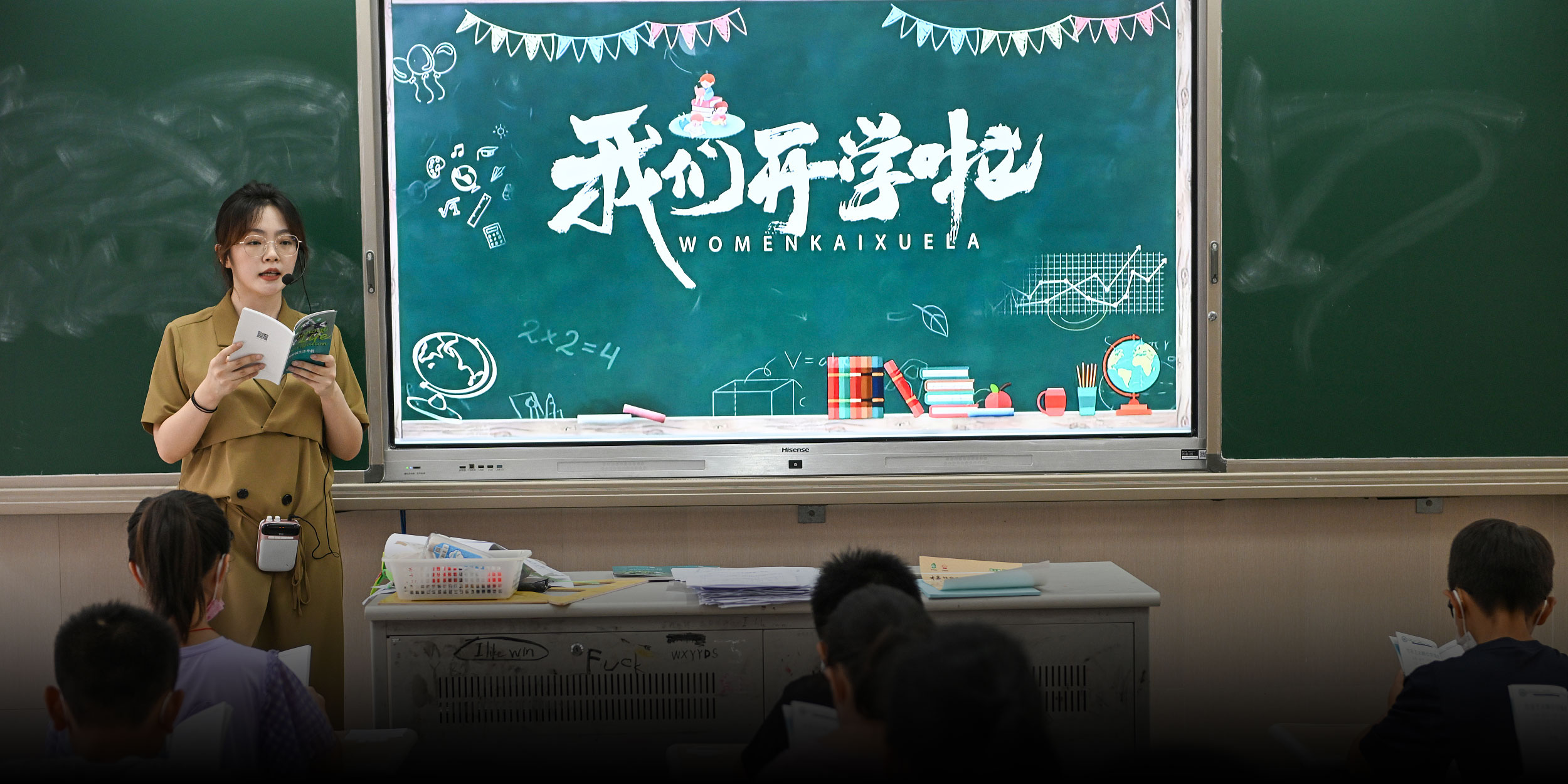
(Header image: Students on their first day of school in Kunshan, Jiangsu province, Aug. 30, 2022. VCG)