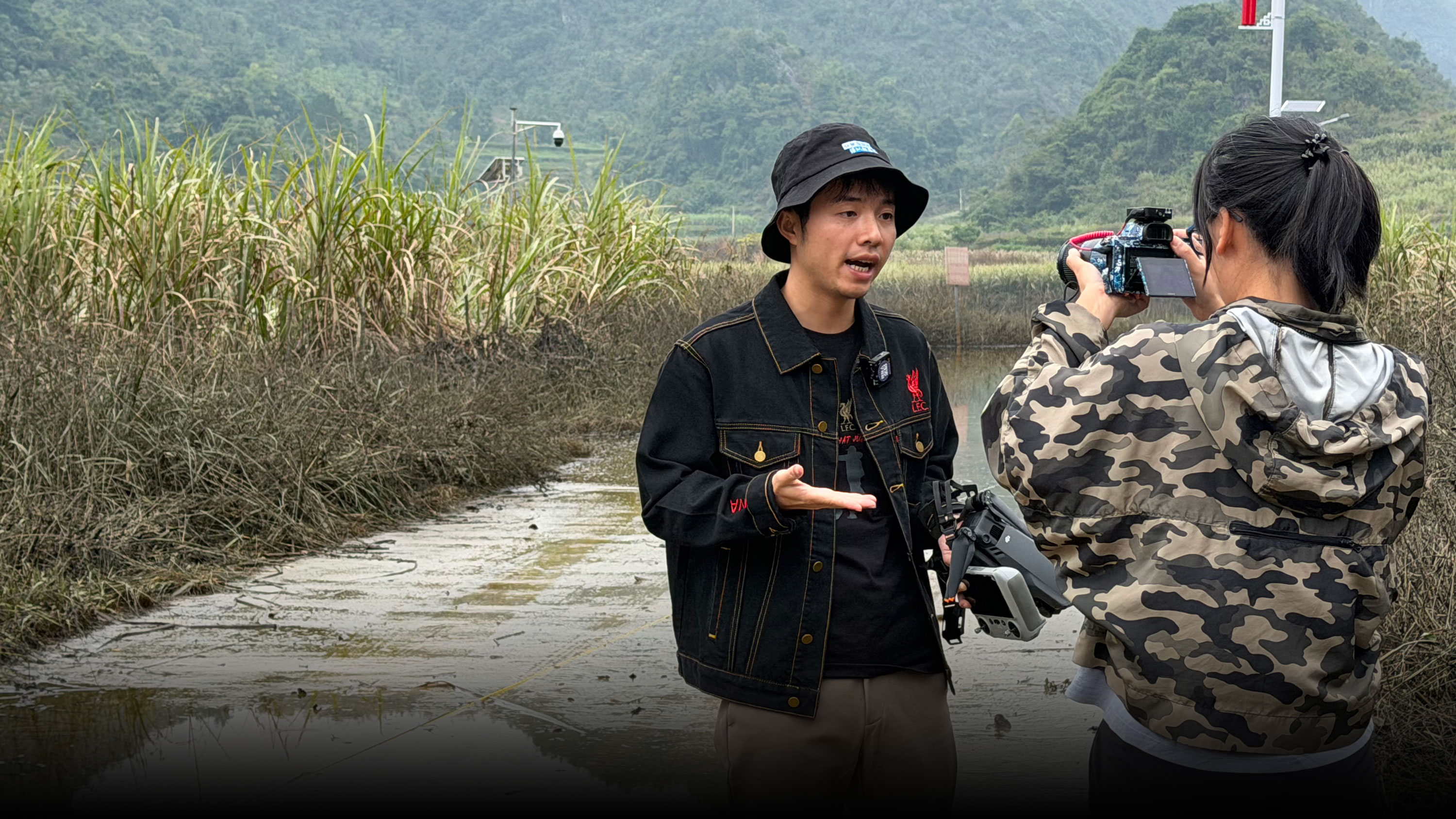
Two Filmmakers, 1,100 Villages, and a Race to Record Rural China
SHAANXI, Northwest China — “You have gone off route. Recalculating.” For the fourth time that day, Zhao Yushun and his wife, Yuan Zhenzhen, ignored the GPS. By then, jujube trees, signs advertising local specialties, and a view of distant mountains had already pulled them off course.
Now it was a farmer sorting pears beneath a black sunshade by the roadside in Dali County, northwestern China’s Shaanxi province.
“What kind of pear is this? I’ve never seen it before,” Zhao asks after they pull over. “How’s the harvest this year? Have people here been growing pears longer, or jujubes?”
“Jujubes,” the farmer says with a wry smile. His family has grown them since he was a child, but over the past decade more and more people have started planting them, and the returns are no longer what they once were. “Things are worth more when they’re scarce.”
As he speaks, Yuan raises her camera and starts recording, keeping it around waist height to make it less conspicuous.
The farmer soon moves beyond pears, telling Zhao about his years as a migrant worker in the southern tech hub of Shenzhen and his eventual return home to care for his children and aging parents. With jujube profits falling, he has also begun growing pears, hoping for a better return.
Thirty minutes later, Zhao and Yuan are back on the road. The encounter becomes the closing scene of the fifth episode of their “Yellow River” series.
Since 2021, Zhao and Yuan have traveled through more than 1,100 villages and towns, turning roadside conversations and unplanned stops into short documentaries about rural China. Their account, Yuzhenjishi, or “Encountering Reality,” has more than 530,000 followers on Bilibili, one of China’s largest video platforms.
Many of the people Zhao and Yuan film are farmers in their 60s or older who grew up working the land, spent years as migrant workers in cities, then returned home after being aged out of many urban jobs. They now farm through falling crop prices, increasing mechanization, extreme weather, and the departure of younger generations.
Since July, Zhao and Yuan have been traveling along the Yellow River, one of China’s longest and most historically important waterways, filming a six-episode series on the farms and pastures along its banks. Sixth Tone joined them for three days as they traveled through Henan, Shanxi, and Shaanxi provinces.
Down to earth
For Zhao and Yuan, leaving rural China had once seemed the obvious measure of success. Both grew up largely in the care of older relatives while their parents worked in cities, part of a rural generation known in China as “left-behind children.”
When Zhao did well in school growing up in a village in central China’s Hunan province, villagers would tell him: “Your hands aren’t meant to hold a hoe. They’re meant to hold a pen. You have to get out and go to the big city.”
He studied journalism; Yuan, who grew up in a small town in the southern Guangdong province, studied Chinese literature. Both made it to university, but neither found the stable urban life that education had seemed to promise.
As graduates of second-tier universities, they moved between media jobs in Beijing, Shenzhen, Guangzhou, and other cities, rarely earning enough to feel settled.
“We moved so many times,” Zhao said. “Every time we moved, we wondered whether we should hire a medium-sized truck, only to find that our stuff filled barely half of a small one. After we left, there wouldn’t be any trace of us in the city.”
By 2021, Zhao and Yuan were both 27 and living in a rented apartment in Beijing. Zhao spent about three hours a day commuting by bus and subway. He came to recognize the passengers who got on and off at particular stops without ever knowing who they were.
The routine made him feel like “a cog in the machine.” Yuan described herself as “someone stuck in a corner.”
One night in 2021, they decided to start their own video account. They named it Yuzhenjishi, combining one character from each of their names with the slogan: “Let the overlooked be seen.”
Their first post was an edit of news footage about a herd of elephants that had wandered north from their habitat in the southwestern Yunnan province. At the end, they added a caption: “A herd of elephants drifting north, just like us leaving home to make a living.”
The couple soon moved to Guangzhou, the capital of Guangdong province, where they continued working in media while filming in their spare time. At first, they focused largely on small cities around the province. But after making a video about left-behind children in a mountainous area, they found themselves increasingly drawn to villages and towns.
Within a year, Yuan proposed a more drastic move: quitting their jobs and making videos full time. After spending much of their childhoods trying to study their way out of rural China, Zhao and Yuan began returning to it with cameras.
For Zhao, the change brought a sense of connection he had rarely felt while covering new skyscrapers and suburban redevelopment in cities. The rural stories were “things I genuinely care about,” he said. “I finally felt grounded.”
As they began filming rural communities, viewers increasingly responded with stories of their own. Some left comments 400 or 500 words long.
One viewer from Hunan described growing up in a mountainous area where families had little land to farm and few ways to save money. “We all ended up taking the same path: leaving home to find work,” the viewer wrote. “It was all just to make a living.”
An agricultural university student wrote that after drought destroyed an experimental crop, they began searching for coverage of similar losses and were struck by how little they found. “Farmers and real rural communities barely have a voice of their own,” the student wrote.
The responses became important enough that Zhao and Yuan later printed a selection in a leaflet accompanying their first book, an anthology adapted from the written narratives of their videos. They came to see their videos as only half the story; viewers supplied the other half.
“We’re like a little public square,” Zhao said. “I pick up a loudspeaker and shout, ‘If anyone has something they want to say, come over.’ And then people really do come and tell their stories.”
On record
In practice, Zhao’s “loudspeaker” is usually just a question.
In a cornfield, he picked up an ear the harvester had missed and called to a farmer gleaning nearby: “Do you still want this?” Soon, the man was telling him about a nearby reservoir he had helped repair years earlier.
On the banks of the Yellow River, Zhao approached two men overseeing repairs to an embankment. “We’re from the south and have never seen this kind of embankment,” he said. “Could you explain it to us?”
Few turn him away. And once they begin talking, Yuan watches for the moment to start filming.
After filming a group of peach farmers packing nectarines for delivery to a foreign trade company, Zhao and Yuan were offered some fruit. When they asked how much they owed, one farmer waved them off.
“No need to pay,” he said. “Just put this in your video.”
Zhao remembered another farmer telling him much the same thing: “Little brother, there’s no money in farming these days. Look how hard life is for us farmers. Film this and put it on people’s phones. I’ll give you a like.”
“Farmers actually really want to talk,” Zhao said after returning to the car. “They just don’t have a channel to do so. So we bring the microphone to their doorstep.”
Zhao and Yuan describe these farmers as “standing at the crossroads of an era,” perhaps the last generation shaped primarily by traditional small-scale farming.
Their conversations often return to money and work, from falling crop prices and thin margins to years of physical labor and pensions that leave many older rural residents with little to live on.
Zhao argues that rural life is often viewed from outside in one of two ways. “People tend to imagine the countryside either as an idyllic retreat or as a place of poverty and hardship,” he said. “But both are ways of looking in from the outside.”
“We’re part of this world ourselves,” Zhao said. “What we do is document it from within and then communicate it outward.”
One of their most watched videos underscored the point more directly. Released in 2022 under the title “China’s 760 Million Farmers Don’t Need Praise,” it has nearly 5 million views.
“Since primary school, textbooks have taught us to praise farmers and applaud their hard work, but they never taught us to truly understand them,” the video said. “For farmers, mountains and rivers are not poetic, and rural life is no pastoral idyll. Farming is about survival.”
They have also tried posting on YouTube, with limited success. Zhao believes many of their stories require too much background knowledge for overseas audiences.
“After all, we are not Li Ziqi,” he said, referring to the hugely popular Chinese creator known internationally for idealized videos of rural life. “We are not making a pastoral fantasy.”
Still rolling
This spring, Zhao and Yuan hoped to film elderly porters who haul oranges out of the mountainous Three Gorges region along the Yangtze River.
But by the time they went looking for them, drones had taken over most of the work. Only a handful of porters still do it today, mainly on plots with too few orange trees to meet the minimum charge for drone transport.
“And of course, that’s a good thing. It’s a sign of progress that people no longer have to do such grueling work,” Zhao said. “But what that generation of porters went through, the lives they lived, and the labor they endured, was never recorded.”
They have encountered the same problem while trying to document people who built reservoirs, canals, and other water projects more than half a century ago.
Yuan’s grandmother had helped build an irrigation canal when she was young. Before she died, Zhao and Yuan took her back to see it. “Canal, reservoir — I’ve come to see you with my walking stick,” she said.
Children were playing nearby. Yuan’s grandmother tried to strike up a conversation with a gray-haired man in his 60s. “Did you help build the canal?” she asked. “It was such hard work back then.”
“How could I have?” he replied. “Anyone who worked on it would be at least 80 or 90 by now.”
Yuan’s grandmother smiled and said nothing more.
Many of the projects were built more than 60 years ago, and Zhao said it is increasingly hard to find surviving workers who can still tell their stories.
During the Yellow River trip, they met a man who had worked on one such project. Later, Zhao repeated a line the man had uttered in his local accent: “Once it was finished, it had nothing more to do with us.”
“If we don’t film these stories now, in another 10 years, there’ll be no one left who remembers them,” Yuan said.
The couple says they plan to spend 10 years documenting rural China. They are not worried about running out of stories, because many of the questions they pursue — about farming, migration, aging, and the changes reshaping villages — have no simple answer.
For Zhao, putting those questions on camera is a necessary first step. “First it has to be seen,” he said. “Once it is seen, people can start paying attention.”
Keeping that space open also costs money. After quitting their jobs in 2022, Zhao and Yuan burned through their savings and accumulated more than 250,000 yuan ($37,000) in debt.
They bought their camera, drone, and car on installments and took on outside commercial projects to support their documentary work. Even now, they sometimes sleep in the car while filming and get a hotel only when they need to do laundry.
It was not until 2025, the year they married, that they felt for the first time that they had actually made some money. After paying down debts and heading out to film again, much of it was soon gone.
“We were constantly moving money around just to keep things afloat,” Yuan said. “At the beginning of the year, we landed some other commercial deals, and it barely made us feel alive again. It’s like dying and coming back to life, then dying and coming back again.”
The two have nevertheless settled into a division of labor that requires little discussion. Zhao does most of the interviewing, appears on camera and narrates; Yuan films and edits. On the road, they often know without speaking when Zhao should deliver a piece to camera, when Yuan needs another shot, or when they should stop and try again.
But they differ over what they expect the work to achieve.
For years, Yuan wrote the same sentence on every résumé she sent to prospective employers: “Images have the power to change the world.” Zhao often repeated it too.
She is less certain now.
“I’m just going through a bit of a period of uncertainty,” Yuan said. “Change is difficult. Video may not necessarily change the world, but it can record the world.”
“I want to change things; he wants to record them,” she added. “I’m the more radical one.”
For Zhao, the record itself is reason enough to continue. “These are precious historical records,” he said. “A hundred years from now, someone may look through our videos to understand what this generation of farmers was thinking.”
Along the Yellow River, Zhao and Yuan collected water in plastic bottles at different points on their journey. At the river’s estuary in the eastern Shandong province, they opened the bottles one by one and poured the water back in.
Editor: Apurva.
(Header image: Zhao Yushun (left) and Yuan Zhenzhen film a flooded field in Baise, Guangxi Zhuang Autonomous Region, October 2025. Courtesy of Zhao)