Behind China’s Unlikely Box-Office Hit, Indie Filmmakers Struggle to Be Seen
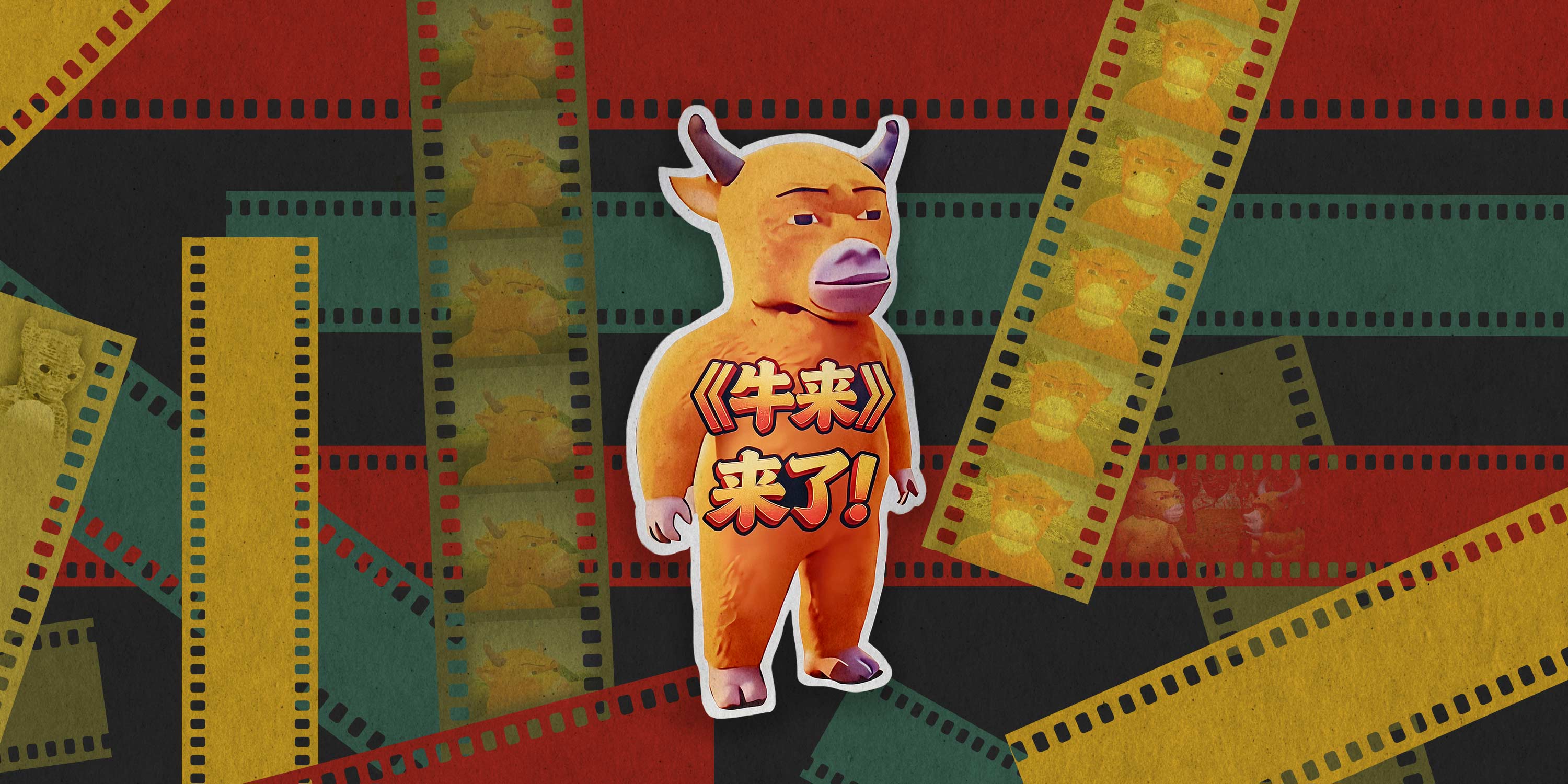
Watching “Niu Lai” was an experience like no other. The theater was surprisingly busy for a late Sunday-night screening, with a crowd eager to watch China’s most notorious cartoon calf and his mother. For the first half hour, I was surrounded by laughter, fueled by the characters’ crude 3D modeling, wooden movements and facial expressions, and baffling, sometimes uncanny dialogue that was already trending on social media. Yet as the story took a sadder, more unsettling turn, the room grew quieter, and I began to wonder: Perhaps the creators, a mother-and-son duo with no industry experience, really did have something serious to say.
After grossing just 5,500 yuan ($815) in its first week, the animated film, reportedly made by 34-year-old amateur filmmaker Xin Yumeng using secondhand equipment, experienced an extraordinary box-office turnaround, taking in 50 million yuan ($7.44 million) by Aug. 26. It has since been dubbed China’s answer to “The Room,” Tommy Wiseau’s 2003 drama that began as a box-office bomb before achieving cult status for its notoriously crude production.
On review sites and social media, many viewers have wondered how such a production managed to secure screens alongside blockbusters like Christopher Nolan’s “The Odyssey” and Wen Muye’s “Once Upon a Time in the Middle East.” But the question can also be framed another way: What does it take for a domestically made, independent, low-budget film to actually reach Chinese audiences?
Producing a film in China involves a multilayered procedure. First, a filmmaker must own or work with a licensed production company to file the project with the National Film Administration (NFA), generally through its provincial bureaus. Once production is complete, the finished film undergoes a content review as well as a technical review covering elements such as visuals, audio, and subtitles. Films that pass the process receive a public screening permit from the NFA.
Such a procedure requires expertise and effort in paperwork, yet 764 films were produced in China in 2025 alone, although that was down from a pre-pandemic high of 1,037 in 2019. “Even doctoral students of the Beijing Film Academy may make a film with a public screening permit as their thesis project,” Kong Degang, a lecturer who studies theater arts at Nanjing Normal University, said. “The real question is: Do you distribute your film in theaters, or sell it to television or streaming services?”
Indeed, most films approved by regulators either never make it to theaters or disappear from them within days. To secure theatrical screenings, filmmakers generally need to work with distribution companies and share revenue. Distributors’ decisions are driven by a film’s commercial prospects, often judged by factors such as star power, high-end visual effects, or sophisticated marketing campaigns, advantages that independent productions rarely possess. Teams with strong connections to theater chains also have a better chance of securing screens. “China has an unforgiving film market. Without sufficient industry resources, a high box office is unlikely,” Kong said. On one day in August, more than a dozen films screening in China grossed less than 10,000 yuan ($1,487).
This dynamic creates a Matthew effect, in which films that perform strongly from the outset receive more screenings and therefore have a better chance of further success. That forces filmmakers to maximize their initial impact through costly promotional campaigns or exhausting roadshows. Luka Yuanyuan Yang, director of the 2024 documentary “Chinatown Cha-Cha,” told me that while commercial productions can spend as much on distribution and marketing as they do on production, independent filmmakers rarely have that luxury. Instead, her team held advance screenings city by city, and she once rushed to host events in two cities on the same day.
“You are racing against time,” Yang said. “You must seize the 10 days before and after your premiere. If you lose those 10 days, you lose everything.”
Global funding cuts, the pandemic’s impact, and competition for audiences from short-form videos have further squeezed independent filmmakers at every stage of production and distribution. Ma Guyuan, an independent director and playwright who left Beijing for a break in southwestern China’s Yunnan province, said tighter oversight of film companies’ finances since the late 2010s has contributed to a more cautious investment climate. Even with support from film festivals, which can provide funding to selected projects, she has often had to subsidize her work with personal savings. Young filmmakers from less affluent backgrounds frequently finance their projects by taking jobs in advertising or online television. Some have left the industry altogether.
“Life is short,” Ma said. “It makes a huge difference whether you spend 10 years in a declining industry or a rising one.”
In 2016, the government-backed Nationwide Alliance of Arthouse Cinemas was established to partner with theaters across China and help distribute low-budget and arthouse films, including Yang’s “Chinatown Cha-Cha.” Participating theaters reserve a minimum of three screenings a day for films distributed through the alliance. But this safety net has its limits, particularly as many theaters struggle financially. In 2025, the alliance cut ties with 516 of its more than 2,000 partner theaters for failing to meet their screening commitments.
Asked whether “Niu Lai”’s success could be replicated, my interviewees were skeptical. “We have seen a Yang Yu,” Ma said, referring to the pharmacy student-turned-animator whose 2025 “Ne Zha 2” became China’s highest-grossing film. “But there are 9,999 other Yang Yus who are never seen by the public.”
For Kong, a more open and vibrant film culture is essential if a wider range of work is to thrive. Yet rising ticket prices and increasingly fragmented leisure time encourage both audiences and the industry to play it safe, favoring directors, actors, and franchises with proven track records.
Nevertheless, “Niu Lai”’s unexpected surge has jolted a market hungry for something different. “Commercial productions have kept people stuck in habitual ways of thinking about what a film should be,” said Yang, who expressed “respect” for “Niu Lai”’s “handcrafted” approach.
Perhaps that is the significance of “Niu Lai.” Its success does not offer a formula that other independent filmmakers can simply reproduce. But its unlikely journey from a 5,500-yuan opening week to packed screenings is a reminder that audiences can still make room for films that fall far outside the industry’s conventional ideas of what is commercially viable, or even what a film is supposed to look like.
(Header image: Visuals from VCG, reedited by Sixth Tone)