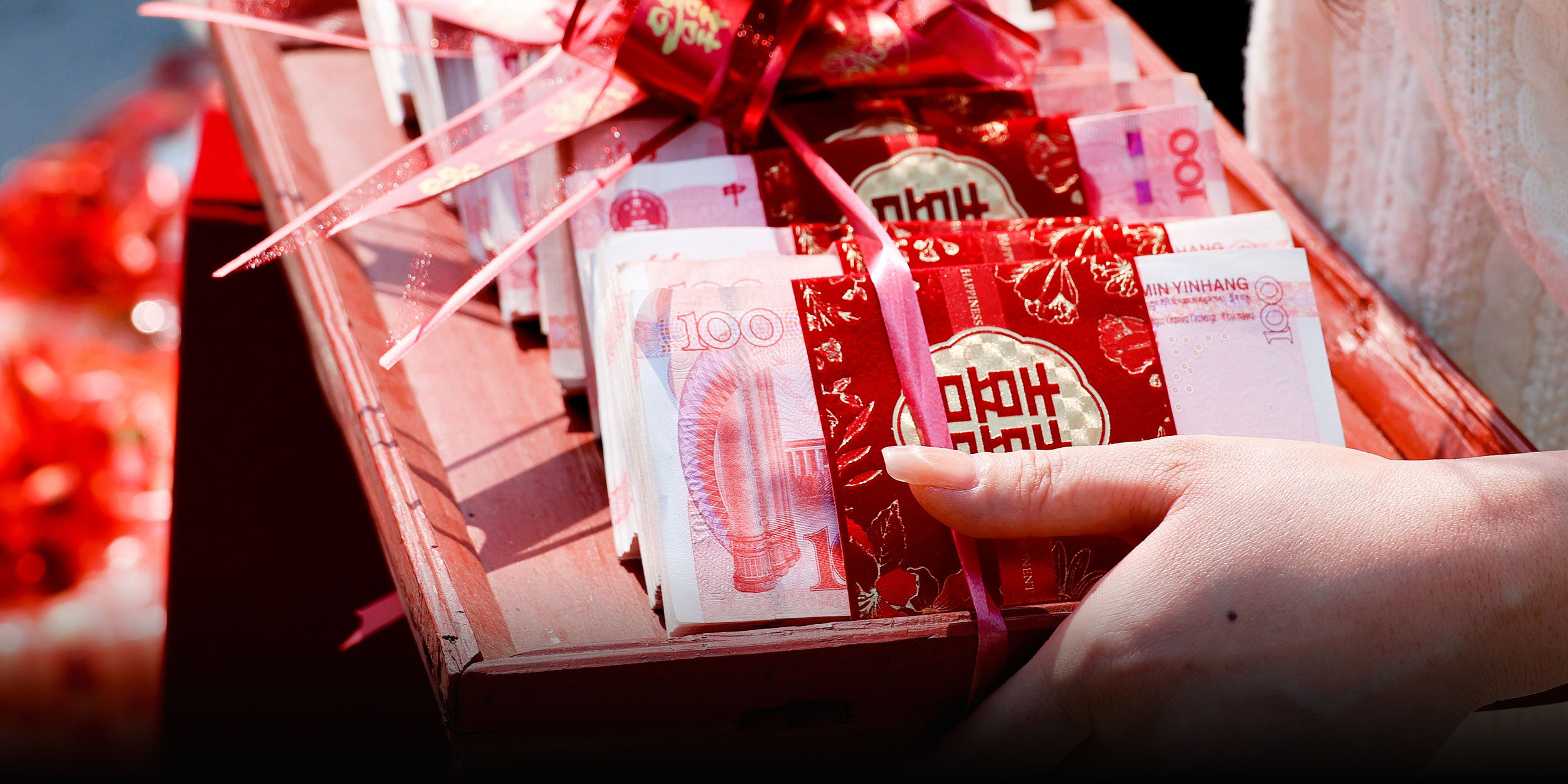
Chinese County Takes Aim at Soaring Bride Prices
A rural Chinese county is working to end the practice of grooms and their families spending exorbitant amounts to ask for their brides’ hands in marriage — a custom known as “bride price.”
Authorities in Shicheng County in the eastern Jiangxi province have worked to drastically reduce bride prices in its community over the last four years. The share of families who pay under 50,000 yuan ($7,400) rose from 16% in 2022 to over 27% in 2025, according to a national rural customs meeting to review the county’s progress on Aug. 26 in the nearby city of Ganzhou, state news agency Xinhua reported Thursday.
Bride price, or cai li, first emerged as a custom during the Western Zhou dynasty (1046–771 BC). At the time, suitors asked their potential bride’s family for consent to marry her by presenting them with gifts such as deer hides and silk. Gifts also compensated the family for the labor deficit incurred when their daughter left the home and symbolized the man’s ability to provide for his future family. It therefore followed that the more generous the gift, the more desirable the man.
But the custom has evolved to reflect social status and power, with brides’ families asking for increasingly vast sums. In part because of a nationwide gender imbalance, average rural bride prices surged from 10,000 to 20,000 yuan in the early 2000s to roughly 140,000 yuan in 2021, according to research conducted by Wuhan University, in the central Hubei province. Today, some pay up to 2 million yuan.
For years, the central government has attempted to rein in the practice. This year’s national annual rural policy document, released in February, also called for continued crackdowns on high bride prices and the promotion of “simple” and “civilized” wedding traditions.
In line with the new policy, government departments in Shicheng County are working together to use pilot programs and public matchmaking services to decrease or eliminate family spending on bride prices.
At the national meeting in Ganzhou, officials discussed new data that revealed a shift: almost a third of the 361 couples who married in Shicheng County in the first half of this year reportedly paid no bride price — in contrast to years past, when bride price was expected.
In some Shicheng County villages, the rejection of high bride prices has been enshrined in local rules and customs, reportedly cutting total wedding costs to about one-fifth of what they used to be. “Red and white” councils, or hongbai lishihui — named for the colors that represent weddings and funerals — have been established to “step in” to correct excessive spending on bride prices.
Changxi village in the county has also promoted lower costs for weddings in general, ensuring that wedding banquets are kept under 680 yuan per table.
The villagers have also developed a consensus that bride prices should be kept at either 3,600 or 6,900 yuan — considered lucky in Chinese culture as “six,” or liu, is a homophone of “smooth,” and “nine,” or jiu, is a homophone of “a long time,” symbolizing a long marriage.
Shicheng also offers rewards to couples and their parents who do not spend vast sums on bride prices. Such families can apply for a card granting them access to discounts on wedding banquets, discounted business loans, free entrance to local attractions, and free pregnancy checks. Over 1,000 cards are said to have been issued this year.
“The card is not just about money; it’s an honor,” Lai Hua, deputy director of Shicheng Civil Affairs Bureau, told domestic media. “We want people who support the new customs to feel recognized, rewarded, and proud.”
Editor: Marianne Gunnarsson.
(Header image: Wrapped bundles of cash given as bride prices in Sinan County, Guizhou province, Feb. 22, 2026. VCG)