Hundreds Still Missing After Deadly China-Nepal Border Mudslide
On Monday, Zhao Jianing rode his motorcycle through the Gyirong border checkpoint under clear skies, inching past export trucks and lines of BYD vehicles as traffic backed up along the China-Nepal border. He recalled seeing at least a dozen uniformed workers at their posts.
Two days later, a massive surge of water, mud, and debris descended from the Nepali side of the Himalayas and tore through the border area at around 11 a.m. Wednesday. Funneled through a steep valley toward southwestern China’s Xizang Autonomous Region, the torrent swept away police posts and buried the Gyirong checkpoint.
Surveillance footage from outside the checkpoint showed muddy floodwaters surging above the border gates and engulfing the area within seconds as people fled. Aerial footage from state broadcaster CCTV later showed the border zone blanketed in mud, with no buildings visible.
By Thursday, three people had been confirmed dead and 558 remained missing in Gyirong County on the Chinese side, while two people had been rescued. Across the affected area, at least 273 people were dead and 1,384 remained missing.
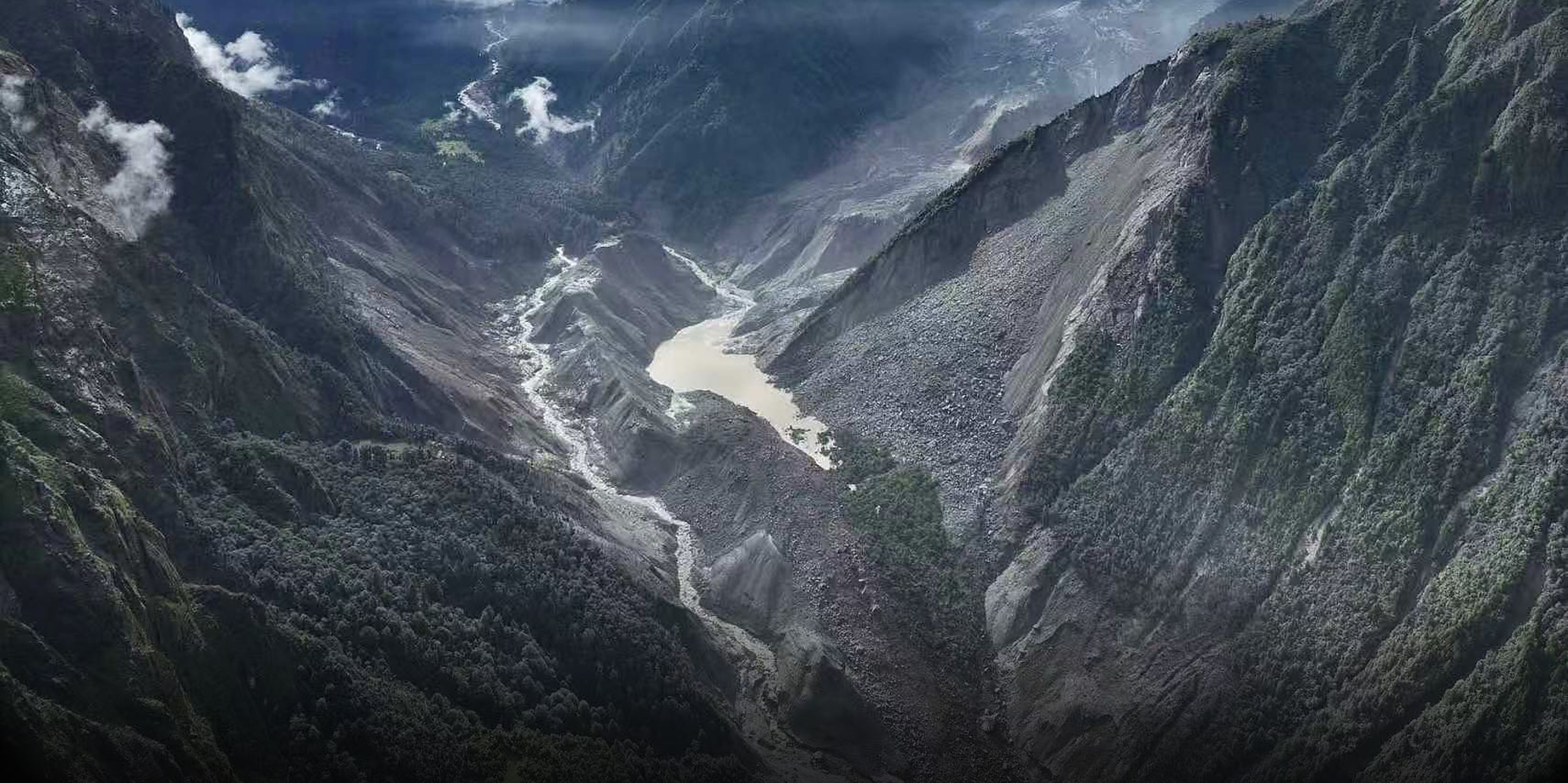
China’s Ministry of Water Resources told CCTV that a landslide dam had formed upstream, creating a lake containing an estimated 2 million cubic meters of water. The lake was already overflowing, and another 3 million cubic meters were expected to channel into it over the next three days, raising the risk that the dam could fail.
The threat further complicated rescue efforts already hampered by damaged roads and communications infrastructure.
Xizang activated its highest-level emergency response, deploying military transport aircraft, more than 800 firefighters, and armed police officers to the area. Central authorities also allocated 220 million yuan ($30.7 million) for disaster relief, recovery, and reconstruction.
Chinese Premier Li Qiang arrived in the mudslide-hit area of Gyirong Township on Thursday to oversee rescue and relief efforts, state news agency Xinhua reported. He visited on behalf of President Xi Jinping and met rescue workers and people displaced by the disaster.
Wang Qian, an official with the Shigatse military sub-command, told CCTV that the edge of the mudslide was about 2.5 kilometers from the Gyirong checkpoint, where mud was nearly 1.5 meters deep.
Gyirong is Xizang’s largest land port and a major gateway for trade and travel between China and Nepal. As of June 23, the checkpoint had recorded more than 100,000 entries and exits this year, up 12.85% from the same period in 2025.
Crossing into Nepal two days earlier, Zhao, a 26-year-old motorcyclist from Inner Mongolia Autonomous Region, remembered the checkpoint as busy but ordinary, with clear skies, lines of export vehicles, and workers directing traffic.
One of those workers, a uniformed man Zhao estimated to be in his 30s, had briefly argued with him over his speed.
After seeing footage of police posts being swept away, Zhao said he kept thinking about the encounter. “I never imagined that just one or two days later, everything would be gone,” Zhao told Sixth Tone. “It happened so fast. I think he probably had no chance to escape. I feel really guilty and upset.”
The road on the Nepalese side beyond the checkpoint was extremely difficult to navigate, he said. In some places, the mud was “as deep as half the length of an arm,” he said, forcing him to use both feet to keep the motorcycle moving. His shoes even came off.
“The cliff was on the right and the muddy road was on the left. I could barely ride. I thought I was going to die there,” he said.
No official investigation has established the cause of Wednesday’s disaster, but several experts said preliminary evidence points to a possible high-altitude ice-rock avalanche originating from a tributary of the Donglin Tsangpo River in Nepal.
Fan Xuanmei, director of the State Key Laboratory of Geohazard Prevention and Geoenvironment Protection at Chengdu University of Technology, told Southern Weekly that a high-altitude mass of ice and rock may have destabilized and collapsed before rapidly descending into the valley.
As it moved downstream, the mass could have mixed with water and scraped loose material from the valley floor, Fan said, expanding into a much larger flood and mudslide. Such a mechanism would differ from a conventional glacial-lake outburst flood.
The terrain may have amplified the destruction. Yi Shaoliang, an expert at the International Centre for Integrated Mountain Development based in Nepal, said the enormous volume of water may have struck hard rock formations on the opposite side of the Lhende River, generating powerful turbulence and redirecting the flow toward buildings at the Chinese checkpoint, according to Southern Weekly.
The border corridor has faced destructive flooding before. In July 2025, a flood destroyed the Friendship Bridge linking China’s Gyirong Port with Rasuwa Fort in Nepal. Research across the Himalayan region has linked warming to expanding glacial lakes and greater instability in high mountain environments, though experts cautioned that Wednesday’s disaster may have followed a different mechanism.
Kang Shichang, director of the Institute of Mountain Hazards and Environment under the Chinese Academy of Sciences in Chengdu, told domestic media that if an upstream ice-rock avalanche were detected quickly enough, downstream communities could theoretically receive about 20 minutes of warning.
In the remote Himalayan valleys around Gyirong, however, limited monitoring and the speed of such events can leave little time between detection and disaster.
Additional reporting: Jiang Xinyi; editor: Apurva.
(Header image: A landslide-dammed lake near Gyirong Port in Gyirong County, Xizang, Aug. 27, 2026. VCG)