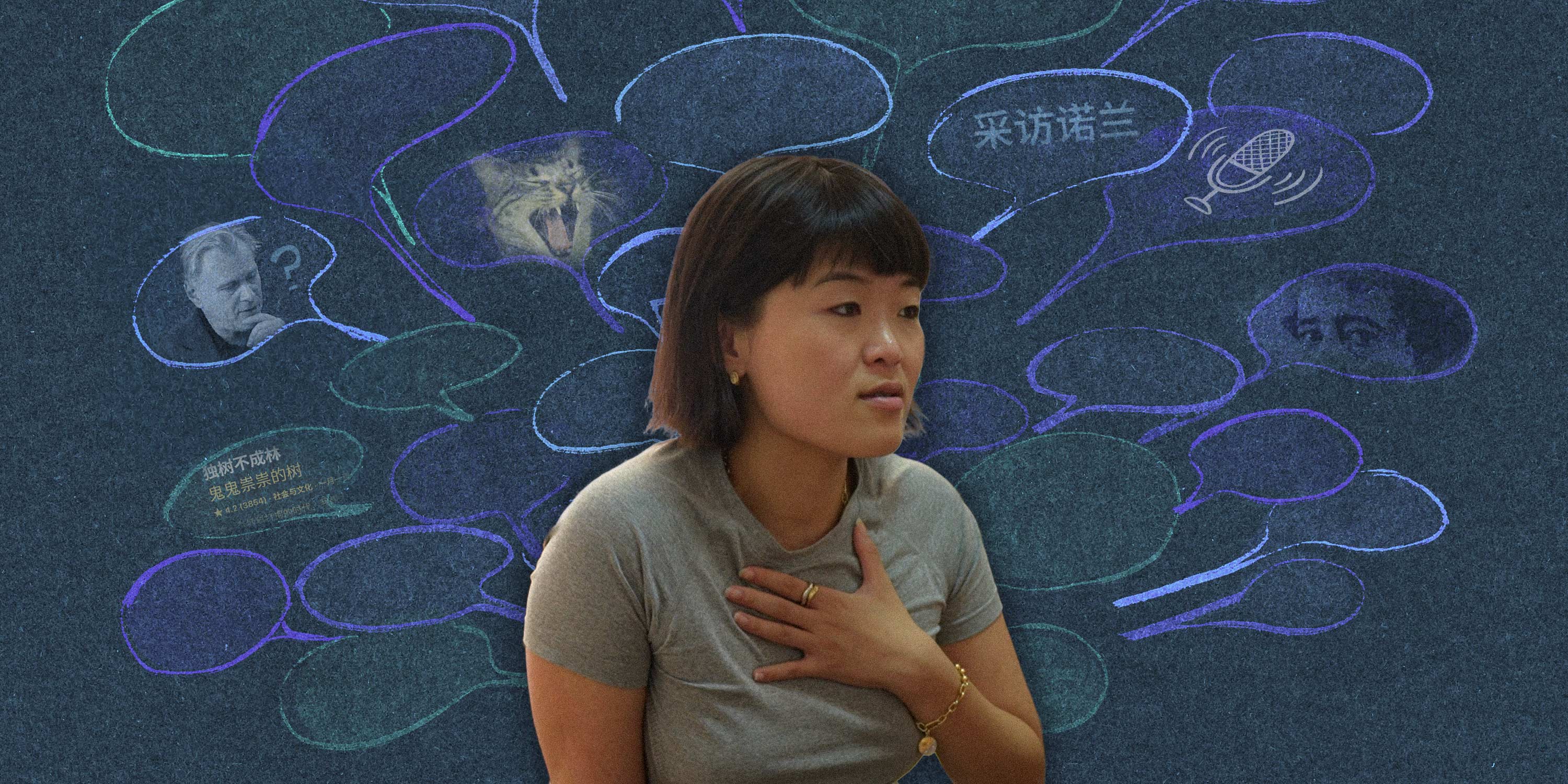
Eye of the Storm: Viral Podcaster Breaks Silence Over Plagiarism Scandal
“Every time fishermen head out to sea, they have to face the uncertainty of the ocean. When a storm hits — you can only head back to port.”
Zhuge Yiyang, an essayist and podcaster better known online as Zhong Shu, stares lost in thought from the pier at Jiaoshan Fishing Port Town, part of Wenling City in the eastern Zhejiang province.
Facing her own storm, she’s returned home.
In early August, the 29-year-old rode a wave of global fame after a viral interview with British-American filmmaker Christopher Nolan about his latest blockbuster, “The Odyssey.” Yet things quickly came crashing down when she was accused of plagiarism, sparking widespread criticism.
In the wake of the controversy, almost all of Zhuge’s public appearances in China were canceled. Yet on Aug. 18, she agreed to meet with reporters from Jiefang Daily in her hometown, taking in the alleyways, docks, and fish markets she frequented as a child.
In her own words
Zhuge has released three episodes of her hit podcast “Monologues of a Committed Observer” since the plagiarism accusations emerged, discussing Shakespeare and Plutarch. The show has more than 970,000 subscribers on the Chinese podcast platform Xiaoyuzhou.
While she acknowledges that she draws on media reports and international podcasts, she firmly denies copying any content.
“When I talk about the Canadian election, for example, I’ll read reports from the American and Canadian media, and compile that information into an episode. I’m not a journalist,” says Zhuge, who is currently studying toward a Ph.D. in political philosophy at Boston College in the United States. “A lot of my information I get from listening to overseas podcasts.”
Yet the claims against her have drawn intense public scrutiny. On Aug. 19, business news outlet Caixin removed from its website a recent column Zhuge wrote on universities dealing with student use of artificial intelligence. This came after several online users remarked on the column’s similarity to a piece published in The Atlantic magazine in May. (Editor’s note: Sixth Tone can verify that the first two paragraphs published on Caixin closely match The Atlantic’s first two, as well as parts of its third.)
Until now, Zhuge has refused to respond publicly to the plagiarism accusations, preferring instead not to get involved in the “maelstrom of online harassment.”
“I don’t know how to respond. … There’s no point in trying to clarify things at a moment like this,” she says. “People have claimed that I stay up every night deleting comments. I haven’t deleted a single comment. I do want to find out who is really behind all this, who is pulling the strings, but there’s simply nothing I can do.”
For her most recent podcasts, Zhuge says she wrote the script on a plane, without referring to any materials. But when the episodes were released, people began claiming that specific passages had been plagiarized.
“Some people have set up a website that lays out what they claim are examples of ‘article spinning,’ word by word. I’ve looked at it. The English and Chinese don’t match; not a single example is a word-for-word translation,” she says. “There are some passages from sources that I haven’t even read, and they don’t correspond to the material they are being compared with.”
(Sixth Tone has listened to several episodes highlighted on the website and noted multiple instances where Zhuge’s scripts closely match content from overseas podcasts. In not all instances does she credit her source.)
“Once this started circulating online, my comment section began getting hundreds of comments every hour, many of them mentioning this website,” Zhuge adds. “This is the storm I’m going through.”
So is that why most of her upcoming public appearances have been canceled?
“That has nothing to do with any of the conjecture,” she insists. “I canceled (the events) a long time ago, but the organizers only announced it recently. These events had already been called off before this wave of controversy.
“Some of my elderly relatives aren’t in good health, and with the controversy surrounding me online, I’ve also been feeling emotionally drained. So I wanted to come back and spend more time with them.”
Humble beginnings
Zhuge is no stranger to criticism. In the past, she’s been branded arrogant and condescending, particularly for repeatedly calling Wenling “uncultured” on her podcast.
However, she insists the term isn’t derogatory, but rather an objective fact. With a strong tradition in commerce, the people of Wenling are more interested in pursuing wealth than reading or academic pursuits, she says. As a result, being “uncultured” is inevitable.
“When I was growing up, there was only one Xinhua Bookstore (a state-owned chain), and almost everything it sold was study materials,” Zhuge recalls.
She says speaking bluntly is also common among Wenling people. Her grandmother, for example, alternates between telling her she is “as fat as a pig” and “as skinny as a refugee.” She believes this way of speaking has influenced her own manner of expression, making her come across at times as blunt or even offensive.
“People in big cities wouldn’t talk like this, but no one here thinks there’s anything wrong with it — it’s simply the truth.”
After finishing elementary school, Zhuge left Wenling for a boarding school in Hangzhou, the capital of Zhejiang. She later completed high school and university in the U.S., when she eventually began her career as a translator, writer, and podcaster.
She often refers to herself as a “small-town girl,” yet critics argue that Zhuge uses her background as a “shield” to justify her arrogance, saying that her “manufactured persona” hardly fits with someone who attended the elite Groton School in Massachusetts, U.S.
“I don’t think coming from a small city is something to be ashamed of,” Zhuge says, “nor do I think it means you’ve overcome some kind of hardship or that you have to prove something to people from big cities.”
However, her origins did have an impact when she arrived at Groton at age 15. The few Chinese students at the school were from first-tier cities like Beijing and Shanghai. Through them, Zhuge says she was exposed to an “elite discourse” she had never encountered before.
“I’ve never deliberately constructed any persona, but I know that there’s been a change — not intentional; my circumstances were simply different back then,” she says.
Zhuge was living in the U.S. when she first rose to prominence on Zhihu, China’s Quora-like platform, writing on political theory. Later, she began posting on the lifestyle platform Xiaohongshu, or RedNote, about the meals she cooked for her husband and the books they were reading, as well as podcasting about her academic research.
“Then I went through a divorce, racked up a large amount of legal fees, and spent a period living a fairly miserable life,” she says. “At this point, the narrative online changed, and I became this ‘strong, independent woman.’ But I still cook, I still enjoy cleaning, I still post about sports. I’m still very happy — the only difference is that I no longer have a husband.”
But after her interview with Nolan went viral, Zhuge says she no longer felt as comfortable posting about her daily life, as it could be easily misinterpreted.
“For example, my father has a softshell turtle, and we often visit the nearby stream to catch fish and shrimp to feed it. I’d posted about that before, only now people were saying I was trying to construct a persona,” she says. “There seems to be a stereotype about intellectuals — people think it’s OK for me to hold events in big cities, but I shouldn’t go back to my hometown. But that’s my life.”
What lies ahead
Standing by the Jiaoshan pier, Zhuge begins reminiscing about her childhood. She would often visit the harbor with her parents on weekends, sometimes sailing out on a small fishing boat.
Today, the dock is dominated by larger, more advanced vessels. Yet the fishermen must still brave the same rough sea, never knowing whether they will return with a lucrative haul or be forced back to shore by high winds.
For Zhuge, this is the fundamental element of coastal life: You never know what will come — you can only eat what there is to eat.
“That’s what life by the sea is like. When the winds and waves come, you can’t go out to sea, and you never know when a storm will hit,” she says. “When I was going through my divorce, that’s how I comforted myself: this is just the stormy sea of life.”
The legal proceedings in 2024 consumed a great deal of time, money, and energy, affecting her Ph.D. studies. It was around this time that she began podcasting more frequently.
“I wanted to speak out on a public platform, and a podcast is a place where you can talk for 40 minutes and still be well listened to,” Zhuge says, adding that she has no interest in fame or wealth — she simply eats what there is to eat. “If I wanted to make money, I definitely wouldn’t be podcasting.”
However, the popularity of “Monologues of a Committed Observer” has helped her foster connections with Chinese media outlets and publishers, eventually leading to her being asked to translate works by the philosophers Hannah Arendt, Jean-Jacques Rousseau, and Plutarch. The income has alleviated some of the financial burden from her divorce.
In the face of the online storm, she is now considering whether to halt the podcast entirely. “I’m seriously considering giving it up,” Zhuge says. “Maybe tomorrow I’ll decide I’m done, and quit. I don’t have a team, so I don’t have to force myself to keep going. That’s my advantage here.”
Reported by Yu Liang, Zhu Lingjun, and Zhou Liya.
A version of this article originally appeared in Jiefang Daily. It has been translated and edited for brevity and clarity, and is republished here with permission.
Editors: Wang Juyi and Hao Qibao.
(Header image: Visuals from Zhou Liya and VCG, reedited by Sixth Tone)