After ‘Sleep No More,’ What’s Next for Chinese Immersive Theater?
After 2,670 performances, the immersive theatrical production “Sleep No More,” co-produced by Shanghai Media Group and pioneering British theater company Punchdrunk, will conclude its 10-year run at the McKinnon Hotel in Shanghai on Aug. 30.
When it opened in Shanghai a decade ago, the production wowed local theatergoers with its novelty and impact. Audience members donned white masks and entered a dimly lit building where they could move freely between rooms: following Macbeth, searching for the witches, or wandering the corridors piecing together clues. No one could see the complete story, but “missing out” was part of the experience.
A decade on, immersive theater has blossomed across China, appearing in theaters, scenic areas, museums, shopping malls, and former factories. There are even purpose-built theatrical theme parks. “Unique Henan,” for example, in the suburbs of Zhengzhou, capital of the central Henan province, features 21 performance spaces and nearly 1,000 actors performing almost 700 minutes of material each day. Visitors can spend an entire day exploring the park and still see only a fraction of what it offers. Meanwhile, “Unique Dream of Red Mansions” in Langfang, in the northern Hebei province, takes the classic Chinese novel “Dream of the Red Chamber” as its theme, with four large theaters, eight smaller ones, and 108 interconnected immersive spaces. Its daily performances total more than 800 minutes.
Was all this brought about by “Sleep No More”? Yes and no.
In traditional theater, the theatrical world is confined to the other side of the stage, while the audience sits in darkness and watches a carefully framed reality. This model came under scrutiny in the 20th century. Avant-garde theater pioneers, including Antonin Artaud, Jerzy Grotowski, Peter Brook, and Richard Schechner, reexamined the body, space, presence, and the relationship between audiences and performers. Schechner, in particular, developed the concept of “environmental theater,” emphasizing that a theatrical event encompasses not only performers and text but also the audience, sensory stimuli, architecture, and other elements of the performance space. Modern theater has since continued to seek ways to move audiences beyond fixed seats and into cities, rivers, markets, and historical settings, making space part of the work itself.
Such practices are nothing new in Chinese theater. From 1932 to 1937, playwright Xiong Foxi went to Ding County in Hebei as part of a movement to popularize theater in rural China. His productions integrated stage scenery with the real sky and surrounding forest, while audiences crossed the fourth wall to participate directly in the performance.
Since the early 2000s, director Wang Chaoge’s pioneering “Impression” and “Encore” series have reshaped the spatial aesthetics of China’s cultural tourism performances through large-scale live productions. They took theater beyond the proscenium arch and into outdoor landscapes, familiarizing audiences with expansive, panoramic, and interactive performances. “Encore Pingyao,” which premiered in 2013 in Pingyao, in the northern Shanxi province, went further by dispensing with the traditional stage entirely. Audiences walked through streets, courtyards, and indoor spaces alongside the actors.
“Sleep No More” was therefore by no means the starting point for immersive theater in China. Long before its arrival, Chinese audiences were already familiar with shared spaces, physical participation, and collective rituals. Nevertheless, it marked an important watershed. It gave Chinese theater practitioners an internationally influential model: a mature, replicable, sustainable, and long-running production. By combining free movement, multiple narratives, repeat viewings, and word-of-mouth recommendations, it demonstrated that audiences were willing to pay for highly personalized live experiences.
Before “Sleep No More,” even China’s grandest immersive productions were generally guided by their creators, with audiences moving through history as a group. It gave individuals greater agency, allowing each person to follow different characters and leave with an incomplete but unique story. These approaches represent two important strands in Chinese immersive theater: one emphasizes group movement, local history, and collective memory, while the other focuses on individual choice, free exploration, and fragmented narratives. Both, however, make the performance environment part of the show, place audiences and performers in the same space and time, and allow them to experience together a theatrical event unfolding “here and now.”
Over the past decade, many Chinese productions have emerged between these two approaches. Theater has moved beyond the traditional stage into public squares and parks, forests and lakesides, warehouses and factories, and historical sites. Its forms range from parades in theme parks and rituals at village temple fairs to farmers singing together in fields or an individual quietly grieving in a museum before onlookers.
Chinese immersive theater has not simply imitated “Sleep No More.” Instead, it has converged with China’s established traditions of live performance, experiential theater, and cultural tourism, gradually forming a distinctly local style. At destinations such as “Unique Henan” and “Unique Dream of Red Mansions,” theater has expanded from a single work into an entire cultural attraction. Productions of different scales and formats coexist, while architecture, landscapes, dining, and travel all become part of the experience.
This form of theater draws on China’s rich resources of local history, classic literature, and cultural heritage, while also being closely linked to urban renewal, scenic-area development, and destination tourism. Compared with Western immersive productions, which tend to emphasize individual exploration and unfamiliar experiences, Chinese productions more often combine historical resources, collective viewing, and large-scale spaces.
Yet the proliferation of such productions has also exposed problems. A bigger space does not necessarily mean deeper immersion. Enormous scale can accommodate more narratives, but it can also allow architectural spectacle to overshadow the drama. Likewise, local culture can provide rich material, but it can also be compressed into a handful of easily recognizable symbols.
Now that “immersive” has become a ubiquitous cultural label, perhaps we theater practitioners need to reconsider a fundamental question: Why do we need immersion?
Immersion is not the purpose of theater, but a way of establishing a relationship between the audience and the work. It shortens not only the physical distance between audiences and performers but also the psychological distance between audiences and characters, environments, history, and real-life situations. Audiences should enter a theatrical space for the novelty of “being there” as well as to better understand the characters’ environment, the pressures they face, and why they make particular choices at a particular time and place. Physical presence is only the starting point. Meaningful immersion moves from presence to understanding, and then to empathy, identification, or reflection.
As the boundaries of spatial spectacle continue to expand, the future value of immersive theater in China should not be measured by architectural scale or technological sophistication. Instead, it should be judged by whether it can transform space into narrative and the audience’s presence into understanding.
At its best, immersive theater is not about temporarily transporting audiences to another world but about ensuring that the characters, history, and culture they encounter remain with them after they leave, creating connections with their own lives. In this sense, even as “Sleep No More” ends its Shanghai run, its influence on contemporary Chinese theater will continue.
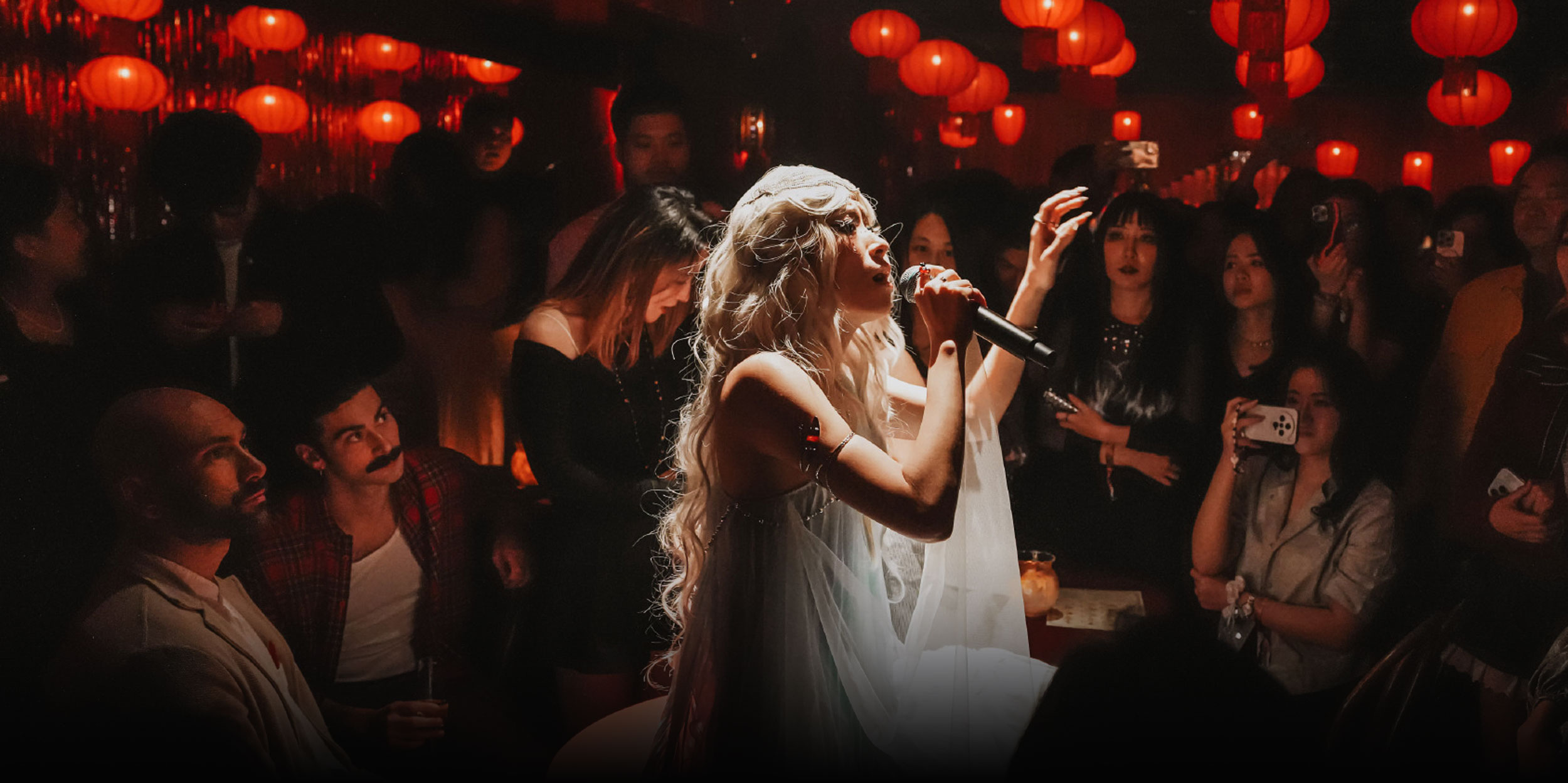
(Header image: A promotional image for “Sleep No More.”From @SleepNoMore上海 on Shanghai)