Tracing the Route of ‘Cathay’
Eighty years ago, Roy Farrell and Sydney de Kantzow — two ex-air force pilots who had supported China’s War of Resistance Against Japanese Aggression during World War II — purchased a Douglas DC-3 twin-engine propeller airplane. After establishing an import-export company in Shanghai, they soon relocated to Hong Kong and officially registered their new venture: Cathay Pacific Airways.
Today, Cathay Pacific is ranked as a 5-star airline and flies to 60 countries worldwide. Less recognized is the origin of “Cathay” as a common term. Chosen by the founders as a nod to their China connection alongside “Pacific” to capture their ambition for their enterprise to one day cross the world’s largest ocean, the word itself tells a story of communication and misunderstanding between ancient China and the West.
Indeed, for centuries, the name “Cathay” haunted the European imagination. It conjured visions of a distant, mythical realm of silk and spices beyond China — even as European merchants and missionaries quietly traded with the immense state. The great irony is that for nearly 300 years, Europe operated under the profound delusion that these two magnificent empires were separate neighbors, and perhaps even rivals.
This mismatch in geographical understanding can be traced back to a difference in terminology, itself a byproduct of accounts from travelers who visited different parts of the region amid shifting names for the north and south. According to the Oxford English Dictionary (OED), “Cathay” can be traced back to “Khitan,” the name of the nomadic people who established the Liao dynasty in the north from the 10th to the early 12th century. The Khitan name was then absorbed by the powerful Kara-Khanid Khanate to the west along the Silk Road, which subtly altered its pronunciation. As the word flowed westward into Persian (as Katā), then post-classical Latin (Cataia or Cathaia), and in Marco Polo’s accounts as Catai, “Cathay” came into being.
And yet, a linguistic rift began to appear as Europeans who landed on China’s southern coast found themselves dealing with a country named “China,” an older word derived from Sanskrit. On 16th-century maps, “China” was thus often depicted as a mere coastal strip known to Portuguese sailors, while “Cathay” loomed as a vast, mysterious inland empire to the north.
This was no mere academic error; it had monumental, real-world consequences. In fact, this geographical schism served as the very engine of the Age of Discovery. When Christopher Columbus and John Cabot set sail for the New World — with a heavily annotated copy of Marco Polo’s book of travels — they were convinced they were heading toward Cathay. Driven by the desperate hope of finding this elusive northern empire, Humphrey Gilbert penned his 1576 treatise, “A Discourse of a Discoverie for a New Passage to Cataia.”
Yet, the human drive to uncover the truth is a powerful instinct. The reconciliation of “Cathay” and “China” belongs not to kings or cartographers, but to the walkers — specifically, the missionaries who refused to accept that the map was complete. When Matteo Ricci arrived in China in the late 16th century, he noticed that the “Cathay” described by Polo perfectly matched the empire of the Ming dynasty (1368–1644). To settle any lingering doubts, the Portuguese Jesuit missionary Bento de Góis then embarked on a grueling overland expedition from India. Crossing the unforgiving Pamir Mountains and the Gobi Desert, he searched for the legendary kingdom of Cathay. Though he died waiting for permission to enter Beijing, his ultimate sacrifice proved that the Silk Road led directly to the seat of the Ming’s rule, not the separate land of “Cathay.”
By the early 17th century, Western travelers like Ricci, de Góis, and Martín de Rada had conclusively established that the China reached by sea could be accessed by following Marco Polo’s land route across Central Asia. When their letters finally reached Europe, the phantom of “Cathay” vanished from the maps, leaving behind only the tangible reality of China.
One might expect the word “Cathay” to have perished alongside that geographical revelation. Instead, it transformed. As the OED notes, from the beginning of the 17th century, “Cathay” was gradually superseded by “China,” and by the century’s end, the process was complete. Stripped of its geographical necessity, the word was reborn as an archaic, highly connotative strand of poetic use. In the early 18th century, poet James Thomson wrote of caravans bending “to the golden coast of rich Cathay/With news of human-kind.” By 1823, Lord Byron was similarly invoking “far Cathay” alongside Ceylon and Inde in “Don Juan.” In 1859, Harper’s Magazine placed Cathay alongside Atlantis and El Dorado as a land now “peopled with beings of flesh and blood.” By 1871, Joaquin Miller mused, “Where the winds come in from the far Cathay/With odor of spices and balm and bay.” Through these verses, the word had become a timeless vessel for exotic mystery and richness.
Perhaps most fascinating is the OED’s entry for the phrase “cycle of Cathay,” defined as “a period of time which is long-lasting but during which little changes.” Popularized by Lord Tennyson’s poem “Locksley Hall” (“Better fifty years of Europe than a cycle of Cathay”), the phrase reflects a complex, heavily Eurocentric Western gaze assuming cultural superiority. This cultural bias was further cemented in an 1886 issue of the North American Review, which claimed that “the world has made more progress in that time [...] than in many cycles of Cathay.”
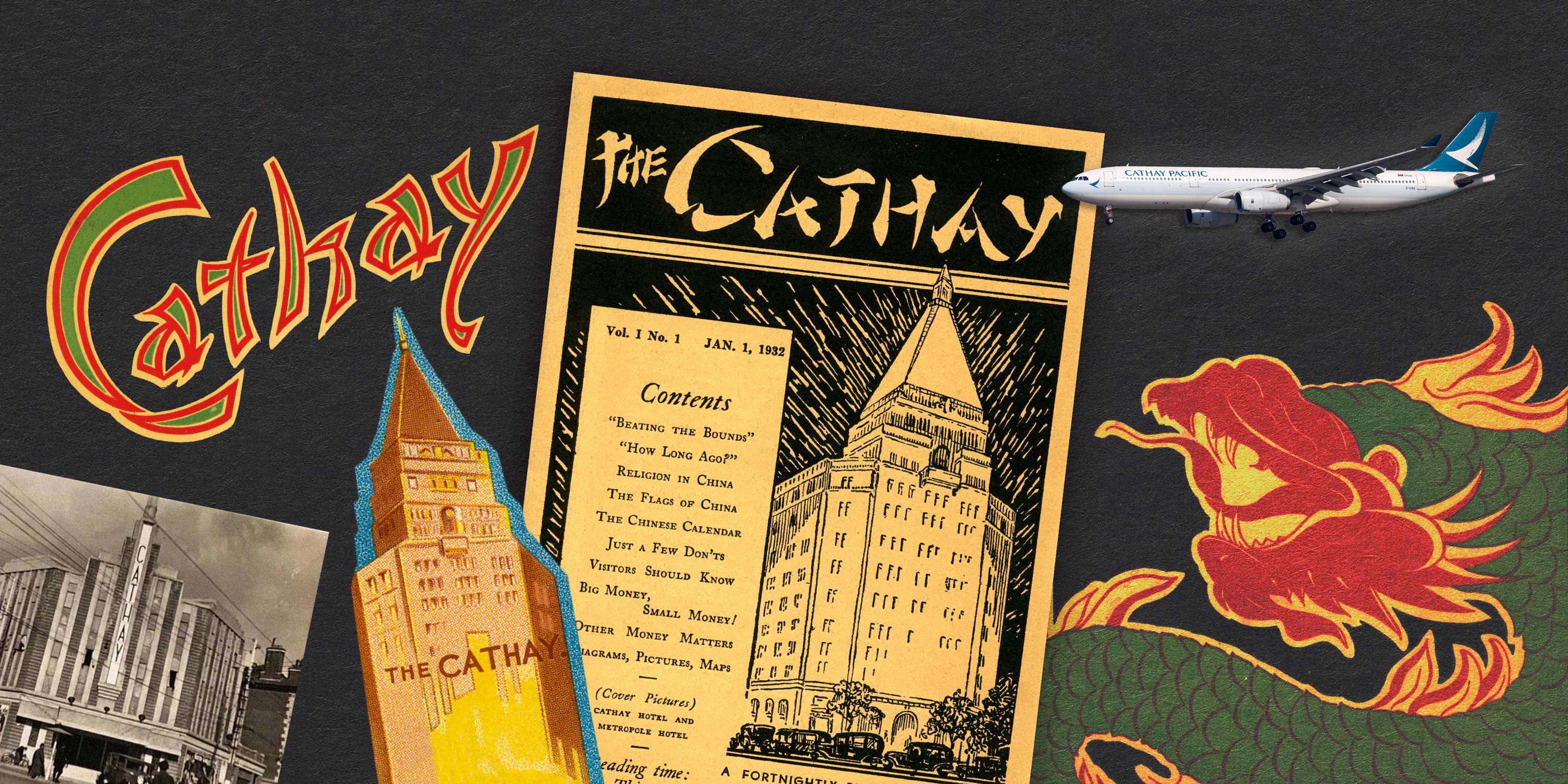
The name then found a romantic revival in the bustling commercial heart of the East. In the cosmopolitan Shanghai of the 1930s, “Cathay” was embraced as a symbol of ultimate luxury and modernity. The legendary Cathay Theatre and the grand Cathay Hotel (now the Fairmont Peace Hotel) adopted the ancient name to evoke timeless elegance and prestige. When the theater’s name was localized into the Chinese characters pronounced Guotai, evoking an auspicious idiom meaning “peace and prosperity,” it marked a brilliant fusion of Western phonetics and Eastern cultural values. Here, Cathay was no longer just a distant Western fantasy, but a glamorous reality woven into the very fabric of the city’s urban memory.
Decades later, this evocative name took flight, finding its most enduring manifestation in the clouds. By reusing the beloved “Guotai” moniker, Cathay Pacific’s founders seamlessly carried that century-old promise of peace and prosperity into the jet age.
The story of Cathay teaches us that names are far more than mere labels; they are the enduring vessels of our shared history. The long journey from “Cathay” to “China” charted a passage from fragmentation to wholeness, from distant myth to tangible reality. It serves as a poignant reminder that while maps and misunderstandings may carve the world into “us” and “them,” the human spirit — propelled by the footsteps of explorers and the verses of poets — can’t help but try to blur such divides. In the end, we are all, in some way, still searching for Cathay, hoping to discover that behind the ancient myth lies a shared humanity.
(Header image: Visuals from VCG, reedited by Sixth Tone)