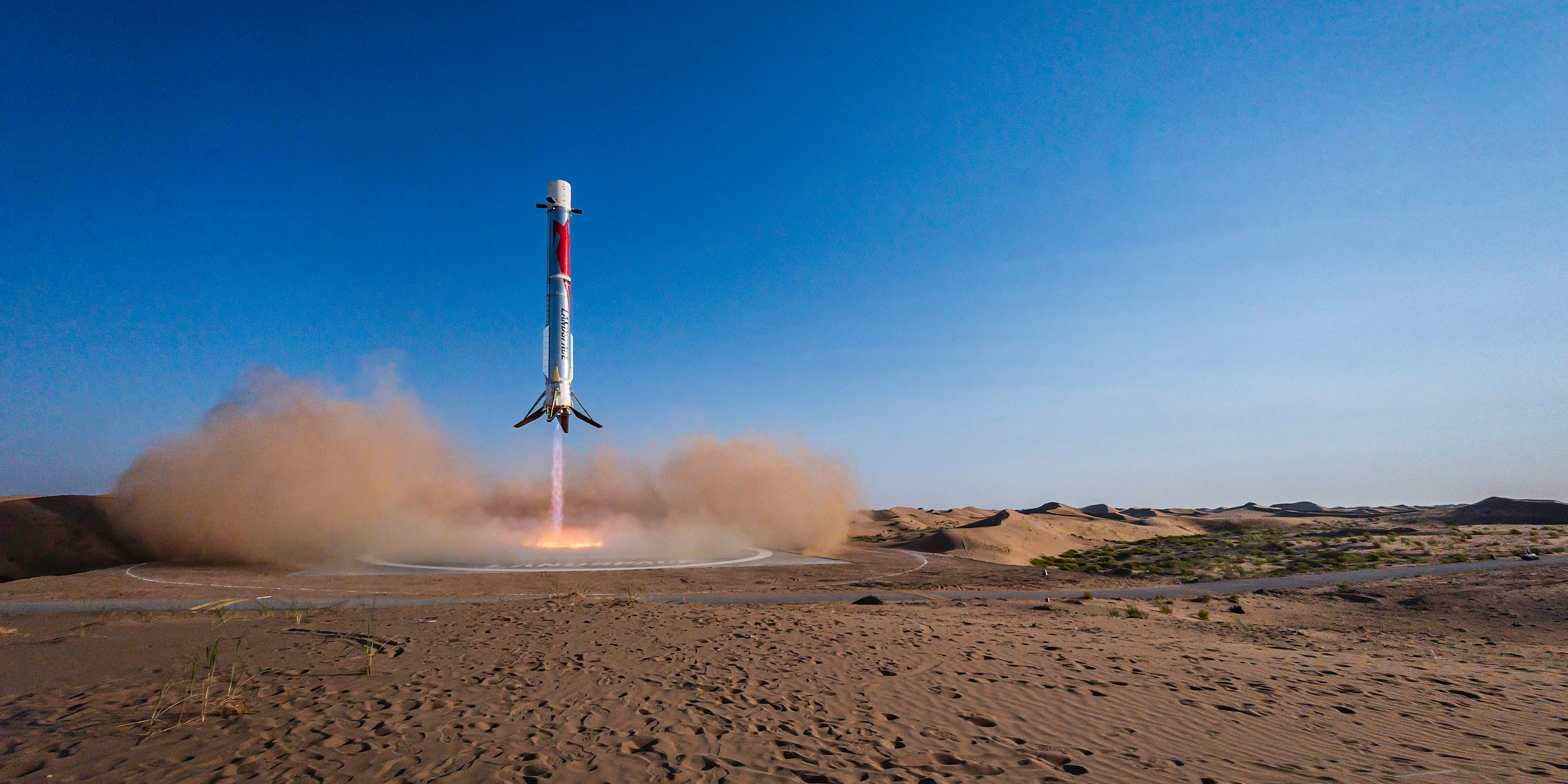
China’s First Booster Landing Marks Leap Toward Reusable Rockets
China has landed an orbital rocket’s booster, rather than discarding it, for the first time, paving the way for sustainable rocket launches and potentially cutting future launches’ costs by tens of millions of yuan.
The Aug. 19 milestone by Chinese aerospace startup LandSpace also makes China the second country after the U.S. to successfully recover rocket boosters on both solid ground and at sea — the latter feat accomplished last month.
U.S.-based aerospace companies SpaceX and Blue Origin were previously the only enterprises to have successfully landed rocket boosters on solid ground. SpaceX has also recovered boosters at sea — by landing them vertically on drone ships — compared with China’s net-capture method.
On Wednesday at 7:35 am, the 66.1-meter-tall Zhuque-3 lifted off from the Dongfeng Commercial Space Innovation Pilot Zone in the northern Inner Mongolia Autonomous Region, and delivered an internet satellite into its designated orbit.
The rocket’s stainless-steel booster, carrying nine liquid oxygen-methane engines, later landed 390 kilometers away in neighboring Gansu province.
A similar attempt by the same company on Dec. 3 last year failed following combustion. On the latest model, the team improved the landing propulsion system and added protective structures, domestic media reported.
China’s push to build extensive low Earth orbit (LEO) satellite networks — “megaconstellations” of coordinated satellites operating 2,000 kilometers or less above Earth — is driving growing demand for cheaper, more frequent rocket launches.
Such networks aim to provide services such as high-speed internet access in remote areas. The country currently has a few hundred satellites in orbit, and tens of thousands are ultimately planned.
A rocket’s booster, located at the bottom of the ship and used in the initial stage of launch, is commonly the most expensive component, accounting for 70% or more of a rocket’s hardware costs, LandSpace told domestic media. Traditionally, however, they are discarded after launch, leaving the upper part of the rocket to continue toward orbit.
Reuse of a common nine-engine booster could save at least 20 million to 50 million yuan ($2.9 million to $7.4 million), Zhang Liang, technical lead of a reusable rocket research team at Sun Yat-sen University’s School of Aeronautics and Astronautics, told domestic media.
However, Zhang added that China still faces a shortage of launch facilities. The cost advantage of reusable rockets will only become significant if there are enough launches for rockets to be reused multiple times a year.
According to LandSpace, the cost per launch could fall by about 45% after five uses. The Zhuque-3’s first stage is designed to be reused at least 20 times, with the company ultimately aiming to bring launch costs below 20,000 yuan per kilogram of payload.
LandSpace told domestic media that it plans to relaunch the recovered booster as soon as possible.
Over the past decade, supportive policies from the central government have led more private companies to enter China’s space sector, which state-owned enterprises previously dominated.
Last November, the China National Space Administration released a two-year action plan pledging to expand access to rocket testing facilities and strengthen international cooperation. The space sector is also listed as a strategic priority in China’s 15th Five-Year Plan, which began this year.
Editor: Marianne Gunnarsson.
(Header image: LandSpace’s Zhuque-3 rocket booster lands in Minqin, Gansu province, Aug. 19, 2026. VCG)