China Before the Infinite Camera Roll
Of the many consumer goods that entered China in the 1980s, one small item transformed how millions of families recorded their lives: 35mm color negative film.
In 1984, Fujifilm established its Beijing office, as Chinese photographers were beginning to embrace the company’s color film, known for its green packaging and the distinctive greenish cast of its prints. Kodak, Fujifilm’s main rival at the time, soon followed, expanding its presence and introducing a network of express color photo stores across China in the 1990s.
These developments, together with the arrival of point-and-shoot cameras that required little skill to achieve proper exposure and sharp focus, enabled ordinary Chinese people to record their lives in color. The film was developed to produce negatives, which were then printed as photographs for family albums.
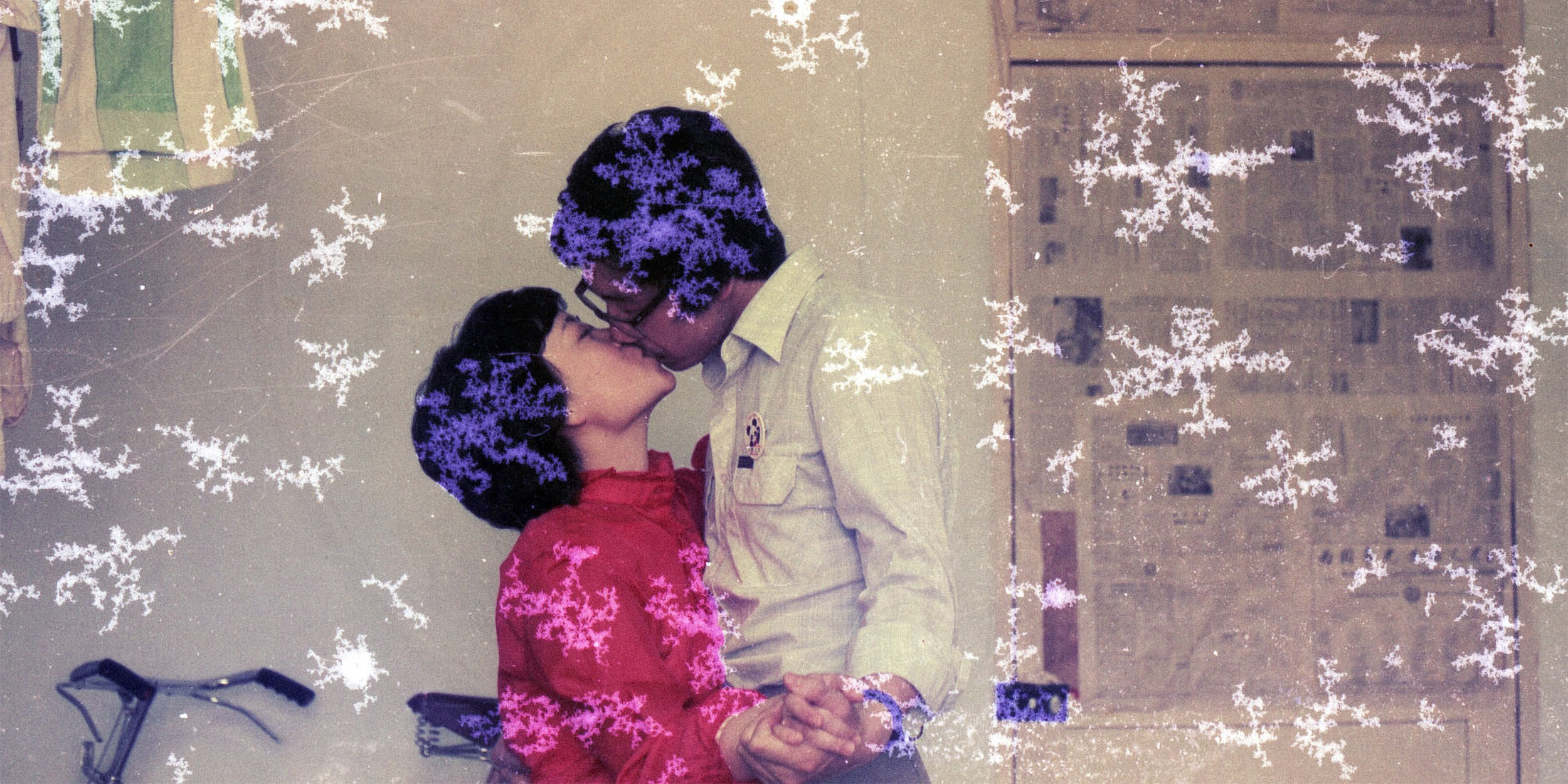
Not everyone kept the negatives. Many ended up at recycling plants, which is where French artist Thomas Sauvin’s work began. In 2009, Sauvin met Xiaoma, a Beijinger who recovered silver nitrate from X-rays, CDs, and negatives. The two struck a deal, and Sauvin received his first batch of negatives to digitize. Their partnership would eventually help create one of China’s largest private archives of photographic negatives: the Beijing Silvermine.
The project gives broader significance in banal, amateur images. As patterns emerge across dozens, sometimes hundreds, of photographs, personal moments become part of a collective record. One example is a series of portraits taken beside refrigerators, an appliance many Chinese households were acquiring for the first time in the 1990s. Together, such images document the transformation of everyday life as a rapidly changing China became wealthier and more urban.
Much has changed since then. Film gave way to digital cameras, and then to smartphones. People can now easily take thousands of photos a year, a number unthinkable to most families in the 1990s, when a roll of film contained just 36 exposures.
More recently, however, analog photography has enjoyed a revival on social media, where users are drawn to its vintage tones and textures. In 2025, Lucky Film, a Chinese manufacturer that once competed with Kodak and Fujifilm, announced the return of its color negative film amid growing demand from nostalgic millennials and curious Gen Z consumers. Yet a roll of film and lab processing now cost more than 100 yuan (US$14.80) for just 36 photos, leaving analog photography a niche hobby.
The intention behind analog photography has also changed, according to Sauvin. “Now, when people take analog photos, what’s in their mind is that they will scan the negative, and they will post it on Xiaohongshu or Instagram,” said Sauvin, who does not shoot film himself.
What has been lost? Humor, perhaps. Looking through the Beijing Silvermine images, it is hard not to be struck by the ease with which people posed and smiled, gazing into the camera with little of the self-consciousness or affectation common in photography today. Before social media, people seemed simply to be enjoying the moments they were living.
In June, Sixth Tone sat down with Sauvin to discuss what analog photography reveals about the lives of ordinary Chinese people in the 1990s and today, his own relationship with the archive, and the challenges posed by artificial intelligence. The interview has been edited for clarity and length.
Sixth Tone: What was your first impression of the earliest batches of recycled negatives, and how did you begin to interpret their meaning?
Sauvin: They were very banal. Quite boring, sometimes very repetitive. It took maybe two or three years before I started to understand what I could do with them. At some point, because of the quantity, you leave the universe of personal stories and enter the universe of collective memory.
A simple example is that, at the beginning of the project, I came across a photo of a woman posing next to a fridge. And I thought, “Oh, having your portrait taken with a fridge is an unusual thing to do.” Then I saw another one, then another one, and now I probably have a series of 25 pictures like this. In the early 1990s, households in Beijing began acquiring refrigerators. They would decorate them and take photos with them. And that’s something no one else would really record. A photojournalist would never make a series about this, nor would a historian or an artist. It’s too close to daily life. It’s too simple. Yet ordinary people, accidentally and unconsciously, capture the bigger picture in these negatives.
Sixth Tone: Is there a single frame or series that interests you most?
Sauvin: So many. I like the photos taken at Beijing World Park. It opened in 1993, and people went there to get a sense of travel, to experience the outside world and its monuments. In the archive, I have thousands of photos taken there in 1993, 1994, and 1995. It was the perfect playground for taking photos. You could have your picture taken with the Twin Towers, the Statue of Liberty, the Eiffel Tower, and so on.
Then, when I went through photos taken in the early 2000s, these Chinese tourists weren’t at the World Park anymore. They were in the actual countries. And when I look at these negatives, as a French person, I always wonder: Is it the real one or the World Park one?
Sixth Tone: Besides the Eiffel Tower series, were there any photos that connected the collection to your own life?
Sauvin: A lot. I was born and raised in Paris, so I’m attentive to photos taken there. I found photos taken on Rue Fabert in the 7th arrondissement, where I learned to walk when I was 1 year old. It’s my home. Seeing someone posing right where I learned to walk was a strange feeling.
I also remember going to the Louvre Museum as a kid and seeing tourists taking photos: flash, flash, flash! Two or three decades later, I started the Silvermine project and found those kinds of photos. Because they were photographing oil paintings with a flash, you always get this big white dot in the image. I made a series about them called “Dazzling Old Masters.”
But the entire archive also has a very strong connection with me. The first time I went to Beijing was in 1999, on a family exchange. In 2009, exactly 10 years later, I started this project, which allowed me to discover the Beijing that existed before I arrived. I wouldn’t have done that with any other city in the world.
Sixth Tone: Have you been able to contact the people in these images?
Sauvin: There’s a photo I found in 2010 that I absolutely love: a young girl posing on a red motorcycle on a street in Dashilar, Beijing. One day, she got in touch with me on Weibo and said, “That girl on the bike, it’s me.” She sent me the printed photo from her family album.
I immediately sent her the other 35 photos from the same roll, and she discovered many that she’d probably never seen because people didn’t always print every photo. Looking through them, she realized that the roll contained four consecutive birthdays, meaning the film had been in the family camera for more than four years. They had to wait that long to finish the roll, have it developed, and finally see the images.
That says a lot about how our relationship with photography has changed and how analog photography captures who we are as human beings in a very pure way. Because it costs money and takes time, you make sure to record the moments that matter. I really like the idea of these latent images sitting in a film canister for four years, then one day being put into chemicals and revealing all these moments. And I find it crazy that, after waiting four years, the negatives could be thrown away the very next day.
Sixth Tone: There is a fine line between the privacy of these images and the public nature of your collection and exhibitions. How do you navigate that tension?
Sauvin: Of course, I’m dealing with very private, intimate photos that were never meant to be used in a book or shown in an exhibition. People are vulnerable because they are themselves. That’s something I always try to keep in mind.
I always make sure not to make fun of people. That’s not easy, because a very important part of the Beijing Silvermine’s visual universe is its sense of humor. There’s something very light, funny, and fresh about it. So you need to preserve that sense of humor because it’s the soul of the project, while never crossing the line into making fun of people.
Another rule I’ve given myself almost since the beginning is that I generally avoid using two images of the same person. That way, I make sure never to delve too deeply into one person’s life. What brings the photos together are more anthropological themes. The photos come together and contribute to a theme. But I would not be comfortable showing many photos taken by the same person.
In 2015, a very good friend of mine in Beijing came to me with a big cardboard box containing all the negatives and photos of her late father. He took a lot of photos and organized everything very neatly, with handwritten information everywhere: Here are the 120 films; there are the 35mm films. It was absolutely beautiful.
She gave it to me and said, “I think you’re doing great things with negatives, so this is yours, and just do what you want with it.” I was never able to open the box a second time because it was not my place to deal with this material. It all comes from one person. I know who this person is, so I can do absolutely nothing with it.
Sixth Tone: How do your curatorial decisions reflect the way you view analog photographs within their historical context?
Sauvin: In this exhibition, curated by Holly Russell at Fotografiska Shanghai, we present one room with 1,300 prints. That’s the selection I’ve been working on for 16 years. The selection was organized around themes, topics, and angles that emerged organically from the archive.
But when we brought the archive to Shanghai, we decided not to present each series together. Everything is mixed, so it’s up to the viewer to look at the photos and, just like I did, start seeing connections between them. I also didn’t decide which photo would go where. They were hung quite randomly by the workers who installed the show, and some amazing connections happened simply because of that.
We also decided to present everything as 10-by-15-centimeter prints, which is probably the size of the prints that would have been made from these negatives for family albums. No photo is bigger than another, so we’re not claiming that one is more important. What makes them powerful is their coming together.
There’s something about found photography, about vernacular photography, that is completely crazy: Quantity is more important than quality. You need quantity to make the switch from personal memory to collective memory. That’s how you end up with a gigantic photo album. It’s not the album of a family. It’s the album of a city, a generation, a place, and a time.
Sixth Tone: We have seen a resurgence of analog photography recently, globally but especially in China. Lucky Film is producing color negative film again. What do you make of this renewed interest? Why do you think it appeals to young Chinese people?
Sauvin: I suppose it’s about our relationship with the medium. We’re always drawn to technologies from the past. We’ve seen this with music. We had vinyl records, then CDs, MiniDiscs, and MP3s, and now we are going back to vinyl. There is a worldwide trend of people going back to analog photography. I’m not sure I’m very interested in that. Now we’re at a stage where we’re mass-producing images, and I’d rather live in my time and do that than go back to an earlier, previous tool.
And there’s something very different. People 30 years ago were shooting analog, but there was no artistic intention or intention to share these photos online. There wasn’t this element of staging or representation.
Now, when people take analog photos, what’s in their mind is that they will scan the negative and post it on Xiaohongshu or Instagram. So the intention is not pure. In the end, what does it mean? It means it’s a filter, like a vintage filter of some kind. That’s why I’m not very interested in the trend. I love analog photography, but it died about 20 years ago.
Sixth Tone: Artificial intelligence is being used to restore and recreate faded or damaged negatives. Do you see it primarily as a boon or a bane?
Sauvin: I find it completely fascinating, and I’m sure that, combined with the right idea, it could be an amazing tool. I’m really open to it.
That being said, I need to be very careful because I have this Silvermine archive of 1 million photos, all made of flesh and blood, that come from ordinary people. They are physical objects, and for so many years, when I scanned a photo and shared it, people trusted that the photo existed. There was no question about that.
Then suddenly, about a year ago, we had this explosion of AI-generated images, and it changed people’s minds, mine as well. Now when you see a photo, the first question you ask yourself is: Is it real, or is it AI?
I really don’t want that confusion to happen with the Silvermine. I want to make it very clear: I deal only with analog photography, and I do not modify the photos in any way.