What Happens When Chinese Dreamcore Meets the Real World?
What if the zombie apocalypse was already here?
In the late 2010s, Chinese indie band Hardcore Raver in Tears imagined just such a world in “Take Her to Wanda Plaza,” a jagged, synth-heavy sendup of the country’s mindless consumer culture. Over pounding beats, singer Lu Yan sang of zombified shoppers and took aim at Wang Sicong, the scion of the Wanda real estate empire and one of the most infamous of China’s “second-generation rich.”
The joke landed because Wanda Plaza is more than a shopping mall; by the 2010s, it had become shorthand for a particular vision of urban life. In the 2000s, local governments across the country saw real estate and urbanization as key engines of economic growth as well as fiscal revenue. Teaming with developers like Wanda, they built vast new tracts of standardized residential districts across the country. These new neighborhoods needed new stores and restaurants, a niche that Wanda also filled by building over 500 Wanda Plaza malls in more than 200 cities nationwide.
At the time, this was all taken for granted as modernization in action. China was urbanizing at a staggering speed, and clean, convenient, and air-conditioned shopping malls like Wanda Plaza were welcomed by both the country’s rising middle class and brands hungry to tap an emerging market.
But for the generation that came of age during this transformation, the convenience and prosperity of the new urban landscape is increasingly tinged with a sense of sameness. Rapid urban expansion did not just change how Chinese cities looked, they argue; it also displaced what anthropologist Xiang Biao calls the “nearby”: the small-scale places and relationships immediately around us through which everyday life acquires meaning.
That longing has since found an outlet online. From obsessively documenting faded Y2K architecture to creating virtual cities and nostalgic video games, young Chinese are attempting to recreate an idealized virtual version of the turn-of-the-millennium city: chaotic but colorful, and full of corner shops, wet markets, arcades, street stalls, and other places to hang out.
The most obvious example of this trend is Chinese dreamcore, which blends aspects of the global dreamcore subculture with elements drawn from China’s own millennial moment. The walking simulator “There Exists Nobody,” for example, invites players to revisit China’s bustling millennium-era towns, where neighborhoods were filled with unpolished mom-and-pop shops rather than sleek shopping malls.
A more sophisticated case is artist Huang Heshan’s digital metropolis “Too Rich City,” which he dubbed a work of “socialist cyberpunk.” Drawing on Huang’s experiences growing up in the southern province of Guangdong, the virtual city mixes modern LED screens with nostalgic elephant slides and swan-shaped boats — both recurring motifs in Chinese dreamcore.
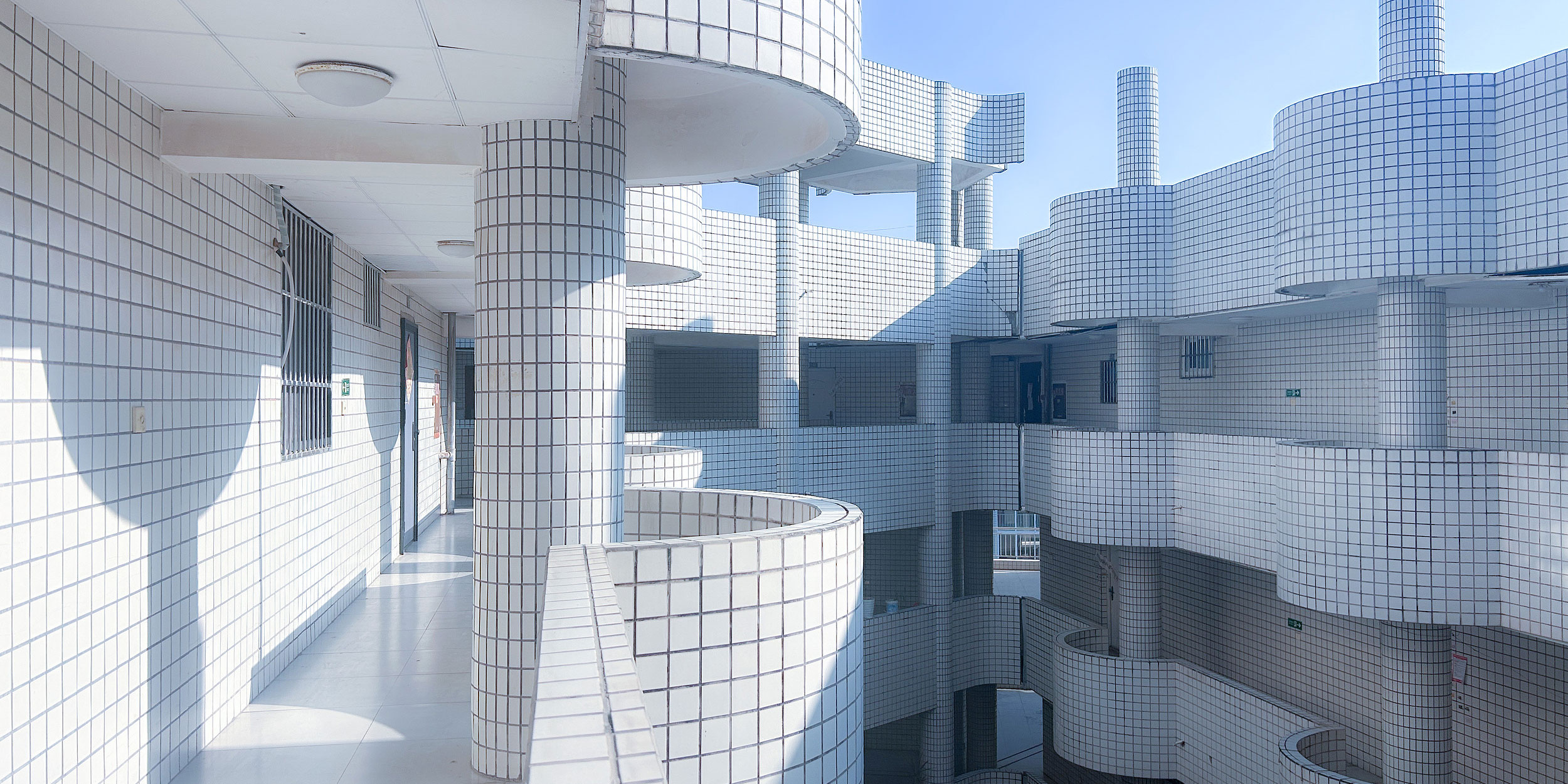
Similarly, Liu Yujia, a photographer better known by his social media handle, “Tiehe West Street,” has built a large following for his dreamcore-style documentation of China’s long-maligned Y2K architecture.
When asked why his work resonates with so many, Huang commented that China’s millennial buildings — many of which have been allowed to fall into disrepair — nevertheless remain vibrant in ways the newer, more uniform apartment blocks aren’t. They’re “a little chaotic, but also more human,” he explained.
Indeed, a key motive of Chinese dreamcore is a desire for more human-scale spaces. Cookie-cutter blocks of shopping malls, chain stores, and gated residential communities have smoothed the rough edges of many Chinese cities, yet their lack of texture — places with which people can establish organic connections — has also led to widespread disorientation and disillusionment.
It is in this context that the “nearby,” the academic term popularized by Xiang, has entered public discourse in recent years. Rather than accepting the numbing comfort offered by places like Wanda Plaza, China’s younger generation is searching for informal spaces and trying to rebuild tight-knit communities.
Standardized urban planning, alongside an increasingly digital economy, has also reshaped people’s sense of time. In 2000, an ordinary Chinese person might experience time through walking to a grocery store, a school, or a park. Nowadays, such embodied experience has been replaced by the “estimated time of arrival” displayed in food delivery and car-hailing apps. This abstraction has rendered interpersonal relationships likewise abstract and fragile, contributing to the desire to return to a slower, less hectic era.
It’s worth noting that Chinese dreamcore is not the only space where the younger generation is seeking shelter and trying to build a digital “nearby.” The anime and fandom subcultures, for example, offer a similar sense of belonging.
Much of this can be traced back to worldwide trends like the loss of “third places” where young people can hang out away from parents and teachers, forcing them into online spaces increasingly divorced from their physical surroundings and leading to what the scholar Keith Hayward calls a culture of “self-infantilization” — such as the global social media craze for kitsch toys like Labubu.
It’s not hard to see why dreamcore-tinged nostalgia would find such fertile ground in both the West and China, even if one romanticizes malls while the other rejects them. These online trends have limits, however. Loosely organized, they lack the capability to make an impact offline. Meanwhile, some of the very offline spaces dreamcore fans like to criticize have effectively incorporated the subculture, positioning themselves as a new kind of “nearby.” Shopping hubs such as Shanghai’s Bailian mall and Beijing’s Wangfujing street now host regular events for anime fans, while Changsha’s Wenheyou has redecorated its commercial complexes to look like vintage markets and evoke feelings of “old Changsha.”
Ultimately, Y2K nostalgia is not immune to the consumerism it seeks to reject. With mounting financial pressure for commercial real estate developers, the Wanda Plaza model may have passed its heyday. Yet the urban landscape it has imposed upon us seems likely to last. They may complain about monotonous “new districts” and their lack of organic street life, but young Chinese continue to find the convenience that modern cities offer irresistible. Chinese dreamcore provides a temporary relief — sooner or later, though, we’re snapped awake by the buzz of our phones.
(Header image: 500px/VCG)