China’s Post-Gaokao Teens Are Spending Big Before College
When Wang Yijun walked out of the gaokao examination room on June 8, she immediately started thinking about what she’d do that summer. After three years of putting aside her hobbies and personal interests to study for China’s national college entrance exam, the 18-year-old from the eastern city of Wuxi finally had a summer of her own.
But the summer’s freedom came with a price tag. After the exam, Wang’s parents bought her a laptop costing over 10,000 yuan ($1,400), both as a reward for her years of effort and a tool for her future studies. She also traveled to Beijing and its neighboring city Tianjin, dined out with friends, and enrolled in an audio mixing course.
“I’ve spent around 20,000 yuan in total since the exam,” she told Sixth Tone in August.
Wang’s experience reflects a broader shift taking place across China. This summer — from the end of the exam to early September — students fresh out of the gaokao are splurging on electronics, graduation trips, and new hobbies before they have to buckle down at university.
For many, the spending can reach upwards of 40,000 yuan. For comparison, China’s per capita disposable income last year was 43,377 yuan.
This year, approximately 12.9 million students sat for the gaokao. A report jointly released by XKB Data Research Center and iiMedia Research estimated that incoming first-year students would spend an average of 18,600 yuan this summer, more than double compared with 2020. Spending by family members, such as on accompanying students on trips and celebratory meals, also ranged from 30,000 to 40,000 yuan. Together, the sector — termed the “post-gaokao economy” — is expected to surpass 387 billion yuan this year.
Merchants are moving quickly to seize the opportunity. Electronics sellers have launched promotions that give students special discounts when they present their gaokao admission tickets, while 327 top-rated scenic attractions across the country have rolled out concessions targeting the group. Cosmetic surgery clinics introduced student packages priced below 1,000 yuan, along with interest-free installment plans for customers who show their exam credentials.
But although the trend has provided a much-welcomed boost to the domestic economy, it has also sparked a growing generational debate over where celebration ends and excessive consumption begins. Posts by other young Chinese showing off their purchases, and sometimes sharing tricks to get their parents to buy things for them after the gaokao, soon began to spread online. And parents, facing financial pressure from their 18-year-olds, have now taken their complaints online.
A new coming-of-age ritual
The debate has fueled a popular online meme: “After all, you only finished the gaokao — you didn’t suddenly become rich,” capturing parental concerns over the post-exam consumption fever.
A screenshot of a mother’s chat messages reacting to her daughter’s post-exam shopping list — with items totaling more than 30,000 yuan — has also made the rounds on social media. In it, she says to her child, “How about you be my mom?”
For Chinese students, the summer after the gaokao carries a special significance. Longer than other school-time summers, it is widely considered the last extended break before adulthood brings a new set of pressures — from grad school applications and civil service exams to career choices.
“That makes it feel like a milestone worth celebrating,” Wang said.
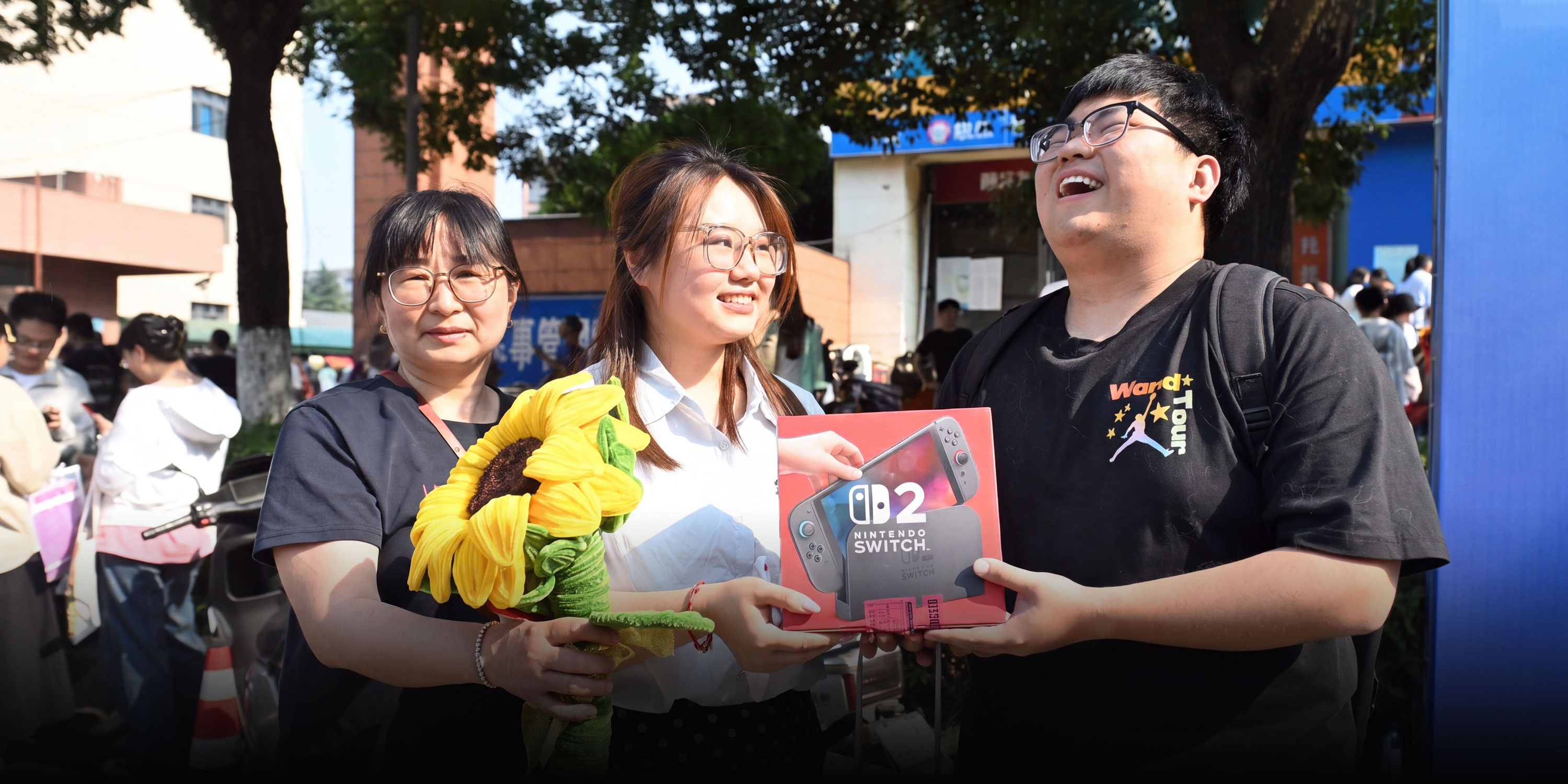
On the last day of the gaokao, images of parents waiting outside examination halls with gifts for their children routinely flood domestic short-video platforms.
In one widely circulated video this year, students walked out of an exam room to find their parents holding stacks of laptops, smartphones, tablets, smartwatches, and earphones, jokingly referred to as quanjiatong, or a “bucket meal,” a reference to KFC’s all-in-one spread. Many such gift packages feature high-end brands such as Apple, with a full set costing north of 30,000 yuan.
Wang said her social media feed is now filled with posts by peers sharing graduation trips, unboxing new devices, and making plans to transform themselves during the break.
Seeing others mark the transition with new phones, designer products, and overseas travel, she added, has left many her age who have taken the gaokao but haven’t received or purchased such gifts feeling as though they are falling behind.
Coming from a working-class family, Wang said she tries to balance enjoyment with practicality. For instance, she decided to continue using her old phone because it still worked well.
“Families inevitably differ widely in their financial circumstances, and that’s a reality we cannot avoid,” she said. “If there is something we want, working for it ourselves is a sign of maturity.”
Before the gaokao, Wang added, grades provide a clear standard of achievement. “But once you walk out of that exam room, you’re suddenly surrounded by a world where people are judged by their material possessions. You start to believe that spending, having the latest gadgets, and traveling can fill the ‘void’ that comes with a major shift in identity.”
But, she added, “We’re not just ‘consumers.’ We can create, contribute, and slowly grow as people, which defines us far more than what we own.”
Greater costs
Qiu Jiqing, a professor of women’s studies and family relations at Shanghai Jiao Tong University’s Lifelong Education College, told Sixth Tone that when she took the gaokao in 1996, her experience was vastly different.
“My parents didn’t buy me any special gifts,” she said. “They simply prepared the necessities I would need for college. When I left for university, I basically took only my bedding and daily essentials with me.”
Qiu said she believes that spending within a family’s means after their child takes the gaokao is justified, especially in an era where electronic devices have become an essential part of education. However, she cautioned that social media and marketing campaigns could overly boost spending and desire for material goods among young people who are still developing their understanding of how and when to save and spend money.
“Learning to distinguish between what we truly need and what we simply want is part of growing up,” she said.
Regardless of whether or not they partake in gaokao celebratory splurging, for many families, the end of the exam marks the beginning of a new stage of spending.
Zhang Chunxing, a mother from the eastern Shandong province whose son took the gaokao this June, has already started calculating the costs of her son’s higher education.
She said that her son’s living costs will amount to around 18,000 yuan a year and tuition will add another 6,000 yuan annually. Transportation, accommodation, and other daily expenses will require additional investment.
“After the gaokao, many children want new phones, trips or other rewards,” she said. “But parents also have to think about the next four years.”
For Zhang, preparing for university is not only about covering costs, but also about teaching her son — who will be leaving home for the first time — how to manage his own expenses.
Qiu, the professor from Jiao Tong University, said that because students spend all their time and energy studying before the gaokao, other skills such as financial literacy, self-management, and independent living are often lacking.
She added that the transition is a challenge for the entire family, as most families are used to a dynamic where parents decide and children follow. After the gaokao, both must learn a new way of relating to each other.
“Students need to learn independence and parents also need to adjust to start seeing their children as individuals who can make their own decisions,” she said.
Editor: Marianne Gunnarsson.
(Header image: A teenager (right) receives a Nintendo Switch 2 from his older sister outside an exam site after the gaokao in Hefei, Anhui province, June 9, 2026. Han Suyuan/CNS/VCG)